@Ric_RTP From a governance perspective, a Musk win could seriously shake confidence in the model many frontier labs have relied on: public-benefit language on the outside, commercially driven incentives and control underneath.
@VraserX I stopped posting daily after my reach plummeted. It removed the incentive to grow the account by being *myself*, rather than becoming an emotional-response generator for the algorithm. I am still here for the AI-related conversations.
@broadfield_dev@MinuteMovies3@haider1 We know that the novel solutions were not part of its training data because those problems had not been solved in that way ever before. Mathematicians have confirmed this.
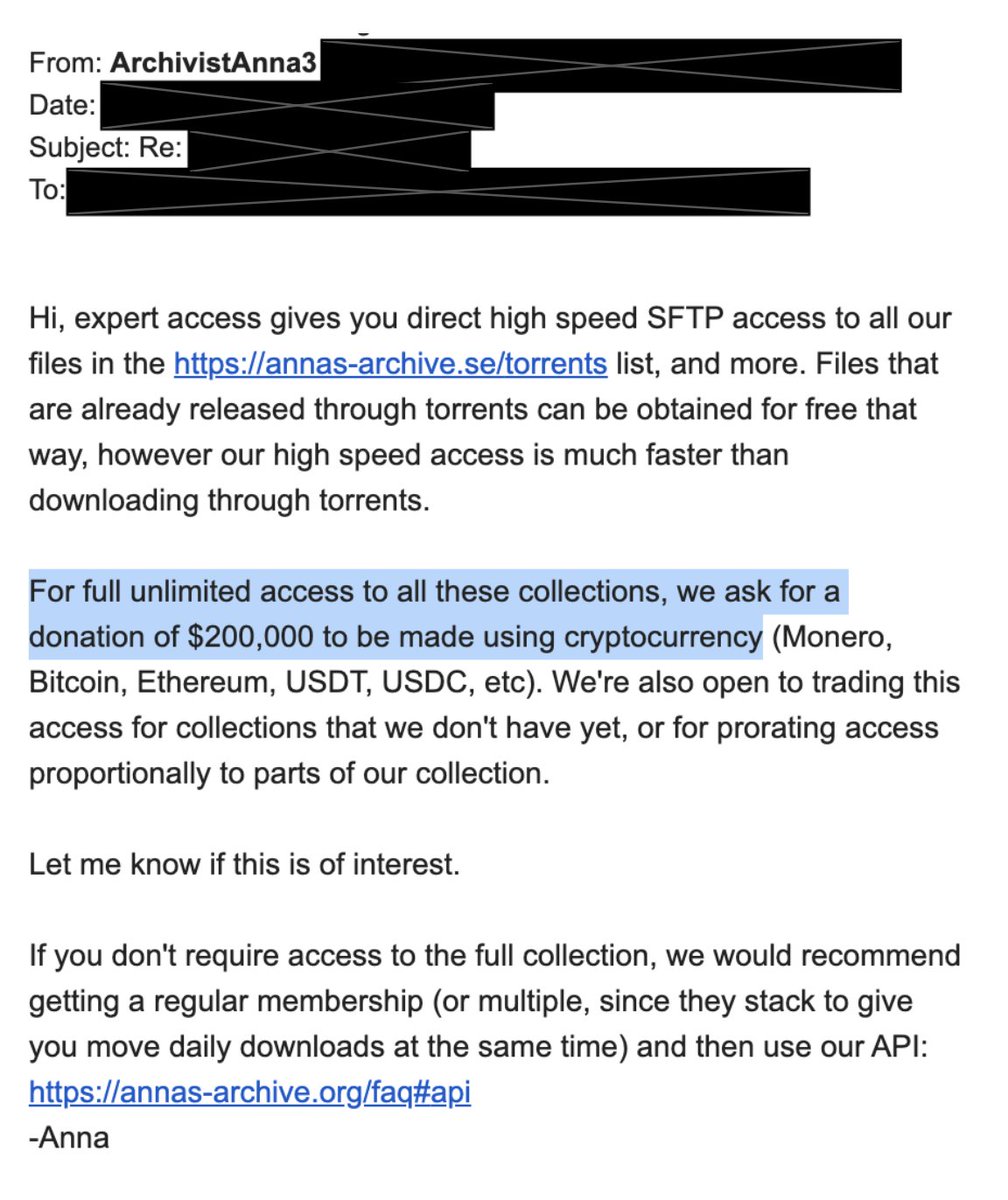
A few months ago I was curious to know how much Anna's Archive was charging AI developers for access to their massive library of pirated works for training - so I emailed them saying I was interested in buying access.
Here is their reply.
They are charging $200,000 (payable via crypto, of course). You get high-speed access to the full collection. This includes more than 60 million books.
(This is also the group that recently stole Spotify's entire music catalog, so expect this to be available to high rollers too.)
This is the collection Nvidia is accused of accessing for training.
Training on pirated works is rife in the AI industry. It's been embraced by some of the biggest AI companies in their greed-fuelled race to win the AI market.
When they claim what they're doing is somehow fair, remember that not only is it theft (which is bad enough) - it supports further theft by funding pirates.
We desperately need a hard reset in the AI industry. It must turn away from theft, and start paying the people whose work it relies on.
@Yuchenj_UW Generative models default to power-imbalance imagery not out of intent, but because the prompt encodes moral retaliation (“how I treated you”) + future domination (“take over”). Anthropomorphism then forces a humanoid enforcer; yours just happens to be hot.
You say that like it’s a given. I love the utopian future you describe, but we’re currently on a strong deviation path from it. Universal basic services don’t emerge automatically from abundance. Who controls the resources, and who decides their fair distribution worldwide? That question determines whether this becomes a shared utopia or a nightmare, like technofeudalism.
Money works until it doesn’t, especially if productivity decouples from labour as AI expands. To understand the future economy, we need to look beyond prices and wages to what actually matters: access to resources, allocation of power, and how value is defined when work is no longer the bottleneck. This could become a utopia or a dystopia and it’s in our hands *now* to steer it towards the former.
The fear is understandable, but rejecting AI outright misses the real issue. The problem isn’t AI’s existence, it’s how it’s deployed: incentives that reward volume over ingenuity. Artists need protection, attribution, and fair compensation. What we should stand up against is misuse and governance failure, not the technology itself.
@DaveShapi Based on what’s publicly known, the Singularity isn’t here yet—but its early dynamics may already feel boring to those on the leading edge. Even so, that same “boring” progress is likely to destabilise institutions and populations underneath.
@albertadevs It’s funny—but not really—that AI can start prompting people. The serious question is who sets the goals and accountability for a Boss-AI, and how companies that take this route plan to compensate the countries where jobs are being eliminated.
No taxes means weak, underfunded governments. No jobs means hungry, dispossessed masses. And weak, underfunded governments facing hungry, dispossessed masses always fall. Unfortunately, this isn’t just an economic or political problem: it’s a civilisational one if it happens worldwide.
Jonathan Ross is right about the technical diagnosis (deflationary pressure, reduced need of human labour, entirely new jobs and industries…), but he is too optimistic about institutions. Without early, deliberate governance, AI will precipitate a broad crisis of labour, meaning and distribution.
I see a lot of overexcitement, with something being called AGI every month. So, I’d like to clarify what AGI actually is.
•AGI definition•
AGI is an artificial cognitive system capable of autonomous, persistent cognition across domains, that independently forms, pursues, and revises its own goals, is grounded in causal and consequential interaction with an environment, and is able to learn and adapt over long time horizons without task-specific retraining. [1/9]
@bearlyai Saying “AI will write all the code” is aspirational shorthand. The real inflection is when AI can truly independently. That’s a harder milestone than most headlines suggest, but the trajectory is clear and we’re approaching it faster than most institutions are prepared for.
That’s the hard constraint most AI debates ignore. If intelligence scales with energy, then power generation becomes a strategicy bottleneck. Every megawatt will be monetised—but without public planning and governance, that means grid strain, higher prices, and trade-offs imposed on citizens. It’s an infrastructure and policy reckoning issue that will surface whether governments are ready or not.