Hearing aids, mouth guards, dental implants, and other custom-fit devices are often made using 3D printing. MIT engineers have developed a method that speeds up the process and dramatically reduces waste, making personalized manufacturing faster and cleaner. https://t.co/RdRPfYhr72
A Massachusetts Institute of Technology (MIT) graduate student, the 27-year-old has focused his research on resin 3D printing, which is commonly used in the medical and jewelry industries.
https://t.co/8JM4TfXhPI
@Scout_AB@MIT FDM printers like Bambu's can already use dissolvable supports, but resin 3D printing can't. Our new research brings dissolvable, recyclable support structures to resin 3D printing, which is faster, higher-resolution, and much more industrially relevant than FDM.
MIT engineers developed a technique for making intricate structures with supports that can be dissolved and reused instead of thrown away.
The team exposed the new resin simultaneously to patterns of UV light to form a sturdy structure, as well as patterns of visible light to form the structure’s supports. Instead of having to carefully break away the supports, they simply dipped the printed material into solution that dissolved the supports away, revealing the sturdy, UV-printed part.
Check out the full article here: https://t.co/FTzl0VNqCl
Image/video credits: @MIT
#3dprinting #additivemanufacturing #technology #engineering #innovation
MIT just invented a next-level 3D printing method that can build super complex designs, ike futuristic gadgets and wild architecture. It’s faster, smarter, and could totally change how we build things. https://t.co/E5t7pk22za
The co-authors who made this work possible include Carl Thrasher, Max Hughes, Kevin Zhou, Michael Durso, Saechow Yap, Professor Robert Macfarlane, and Professor A. John Hart, head of MIT’s Department of Mechanical Engineering.
Here are a few demo prints we made using this new process: functional gear assemblies, intricate lattices, volumetrically packed arrays of parts, and a denture base — no manual support removal needed!
Recycling in action: Print a dinosaur in an egg, dissolve the egg in monomer, then reuse the dissolved support solution to create more resin and print more dinosaurs — reducing waste and enabling sustainable resin use.
Using just one resin and two wavelengths of light, visible light forms a dissolvable thermoplastic while UV creates a sturdy thermoset. This enables automated resin printing, intricate designs, and fully closed-loop recycling.
@jack_watson_hfw One of my top memories working in Taiwan was handing a flash drive to a guy in a greasy polo, in a noisy open-air tooling shop where you could barely hear over the mills - and getting back a mold by the end of the week. All they needed was cheap steel, and they made it work!
This, times a million. Anyone who says AI and software alone will revive American manufacturing has never spent time in a factory. The US needs to rebuild its supply chain from scratch, starting with raw materials
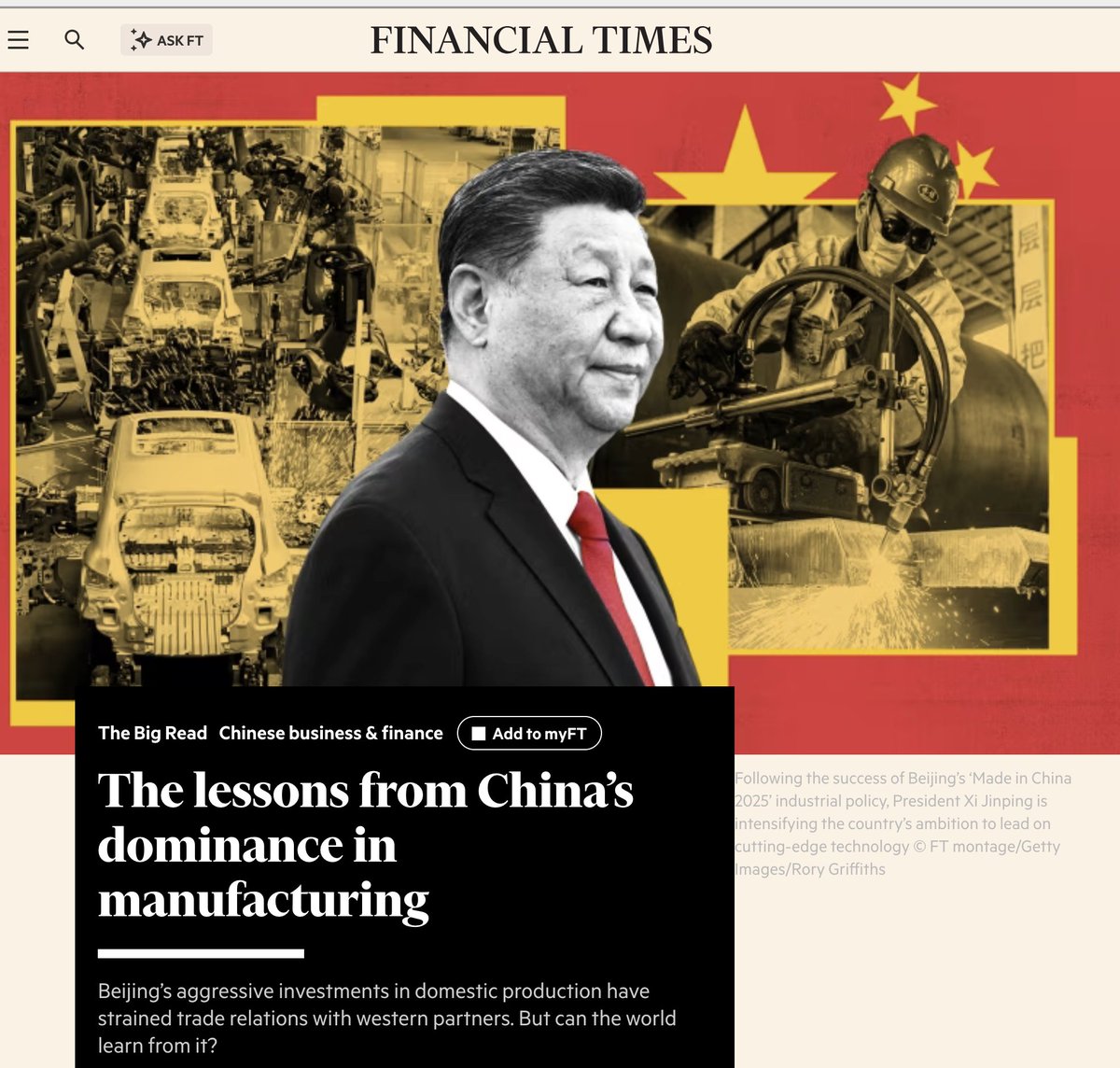
MSM continues to be clueless abt what makes China's mfg tick. While industrial robots, precision mfg, 3D printing & AI are important, the supply chain buildup - especially in basic & advanced materials that really solidified its position in mfg.
I will 1st talk abt Carbon Fiber & its importance in "new productive forces", electrification & AI application.
@mittcoats@StevenGlinert Strikingly accurate parallel. While western investment and training were key for China’s rise, that success was largely enabled by deliberate Chinese industrial policies from around 1980 on - joint ventures, tech-transfer rules, incentives, special economic zones, etc.
@RealChinaCharts Huge losing strategy! If the US focuses only on “advanced tech,” we’ll have zero resiliency. Being fully dependent on another country for any part of a critical supply chain puts our whole system at risk of disruption
@mittcoats@StevenGlinert China is already generating IP faster than the US in a ton of fields. They’ve moved past copying and are making huge innovative leaps. Most of the US is still totally unaware of this.
@chairmang This argument usually falls on deaf ears because folks in the US have no idea how far ahead China is - it’s hard to conceptualize unless you’ve toured factories in both countries. The American public urgently needs a reality check on our manufacturing capabilities