Sleep is essential for the development of the infant brain.
A new study led by researchers at @UNC_CBP, shows how sleep loss impacts brain development and may play a role in increasing one's risk of developing #Autism spectrum disorder.
https://t.co/PMgAl70Tot
Check out our new paper on the interplay between sleep and synapses during development! @Diering_Lab
Developing forebrain synapses are uniquely vulnerable to sleep loss | PNAS https://t.co/Epow9lkr6b
Thanks to Cohen lab and @Diering_Lab for a great joint lab retreat yesterday! We did a @nightsciencepod workshop on the creative process in science, followed by a picnic and paddle boarding at Jordan lake
At the University of North Carolina at Chapel Hill in the US, Dr Graham Diering and Dr Shenée Martin are looking at the #biomolecular and #neurological changes that happen when our #sleep is disrupted, and whether this could be a trigger for the development of #Alzheimer’s.
https://t.co/gurSgf5Uc8
Delighted to share an article showcasing our investigators and our research linking sleep and Alzheimer's disease on @FUTURUMCareers! (Beginning at page 56)
@DieringLab
Issue 24 of Futurum is out now!
What is expected of you? How encouraged are you by your community to pursue an ambitious career pathway? How are your aspirations affected by society’s expectations of you?
How will you confound expectations?
https://t.co/MikFlLfD2r
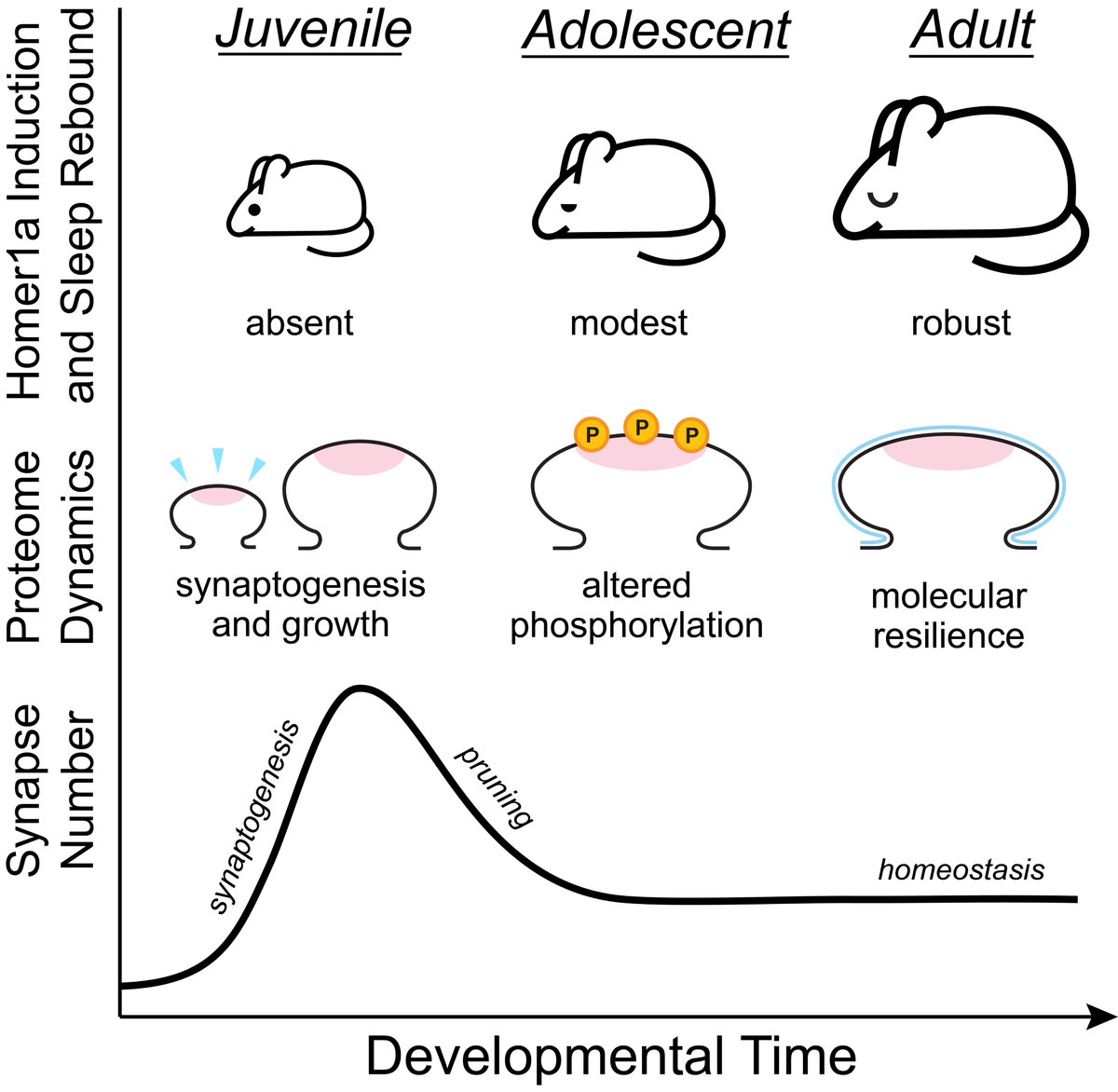
I am excited to share our newest preprint! Led by Sean Gay @SeanMGay, we take a dive into the synaptic function of sleep and consequence of sleep loss across development #Synapse-#BrainDevelopment: https://t.co/WgeGdow8Db 1/10
@SeanMGay @SFARIorg Our study suggests that sleep performs distinct functions at different stages of the lifespan. Sleep supports brain growth in early life, transitioning to homeostatic functions with maturation. 9/10
This week on social media, researchers discussed research on sensory issues in fragile X mice. That and more in this week's Community Newsletter.
https://t.co/X33eICmerZ
What do we find?
1. The onset of sleep disruption occurs early in AD and is a precursor for cognitive decline
2. Sleep disruption is independent of synaptic tau pathology
3. Synaptic and behavioral response to sleep disruption differs in males and females
Check out our preprint on @biorxivpreprint@ToddCohen27
Sheryl S Moy
@KathrynMHarper
Sleep disruption precedes forebrain synaptic Tau burden and contributes to cognitive decline in a sex-dependent manner in the P301S Tau transgenic mouse model https://t.co/IDZPWVRzDG
Check out our preprint on @biorxivpreprint@ToddCohen27
Sheryl S Moy
@KathrynMHarper
Sleep disruption precedes forebrain synaptic Tau burden and contributes to cognitive decline in a sex-dependent manner in the P301S Tau transgenic mouse model https://t.co/IDZPWVRzDG
I am thrilled to see Greg Miner and team’s work on the role of PLIN5-FATP4 membrane contact sites in #LipidDroplet to #Mitochondria fatty acid transport published today in @Dev_Cell: https://t.co/ULbYXa7APG 1/5