Digital Asset is hiring!
From Engineering + Product to Security, Sales, and Network GTM, we’re transforming the future of financial markets.
Open roles include:
🔒 AppSec Security Engineer
🛡️ IT Security Admin
🌐 Product Manager
📰 Marketing Coordinator
🧑💻 + More
Join us 👇
The use cases that succeed with institutions show ROI within 3 to 6 months of production, not ones that require transforming the business first.
That keeps integration cost low enough to prove results early. @YuvalRooz discusses with @_TalkingTokens.
Digital Asset has partnered with The Value Exchange on a report, The Case for Tokenized Equities, examining how the market is developing and what it will take to support broader adoption.
Tokenised equities already represent billions of dollars held by more than 300,000 investors, with institutional activity growing alongside a fast-growing retail market.
That scale is pushing infrastructure, regulation and operating models into sharper focus.
The report also covers market development across retail and institutional investors, operational opportunities in settlement, and the regulatory considerations shaping what comes next.
Read the full report: https://t.co/GvcycWaBlV
Korean regulation now permits financial institutions to bring domestic equities like SK Hynix and Samsung onchain, with a February launch.
@YuvalRooz discusses with @Official_Upbit why Korea’s retail base could be the catalyst for institutional adoption.
https://t.co/rZw5n4Xxq8
“The infrastructure, the technology is all in place. Now, its a matter of the industry scaling adoption and application of use cases that add incremental value beyond what the traditional finance infrastructure offers today,” - DA's Ed Corral.
Read more.
https://t.co/gJLtlIauw5
TODAY: Julie Lascar, Director of Policy at DA will be speaking on the Tokenized: What Happens When Assets Move Onchain?" panel at 3PM.
Learn more: https://t.co/mOuJ9wVPrQ
The future of blockchain is being shaped in Washington, DC.
Groundwork brings industry leaders, policymakers and the next generation of talent into one room to explore what comes next.
Co-hosted by @1inch Forward and the @BlockchainAssn during @dcfintechweek.
Seven panels and six roundtables. Speakers from @RobinhoodCrypto, @Uniswap, @circle, @digitalasset, @FireblocksHQ, @OpenZeppelin, @trmlabs, @Dune, @Alchemy and @CertiK. Faculty from Columbia, NYU, Rutgers and George Mason. Students moderate two of the main stage panels.
📅 16 October
📍 Washington, DC
A familiar, fintech-like experience backed by an AI agent that finds yield opportunities, automates tasks within parameters users control, and generates end-of-month reports.
@HelloNavra Co-Founder @MCagney previews what’s coming to the Navra app.
Derivnex has completed the first OTC swap on Canton Network, a total return swap between DRW and Marex referencing the iBoxx USD Liquid Investment Grade Index tokenized by Kaiko.
Read more: https://t.co/GSm5b3RiXL
Managing an OTC swap over its lifecycle requires multiple systems and ongoing reconciliation between counterparties.
Derivnex closed the first OTC swap on Canton, a total return swap between @DRWTrading and @MarexGlobal referencing an index @KaikoData tokenized on the network.
Digital Asset is proud to be a Gold Sponsor of DC Fintech Week 2026, hosted by @fintechthinksdc, taking place October 13–16 in Washington, D.C.
Since 2017, DC Fintech Week has convened leaders across government, industry, and technology to explore the future of finance. From digital assets and AI to payments, policy, and financial inclusion, the week spans the full fintech ecosystem.
It’s one of the few public forums where senior government leaders engage directly with the broader market to drive the conversations shaping the future of finance.
Stay up to date on registration, programming, and opportunities to get involved: https://t.co/Za5AzyKWYL
Distribution, liquidity, and secondary markets are still being built out for tokenized assets beyond initial issuance.
At RWA Leaders Summit on Oct 16, Aurélie Dhellemmes joins panelists from Solana, Fuse, and XDC to discuss it.
Request to join.
https://t.co/GOjsvds5z1
The world isn't homogenous like the internet, so replicating transaction data everywhere creates no economic value.
Architecture has to solve for privacy as controlled visibility.
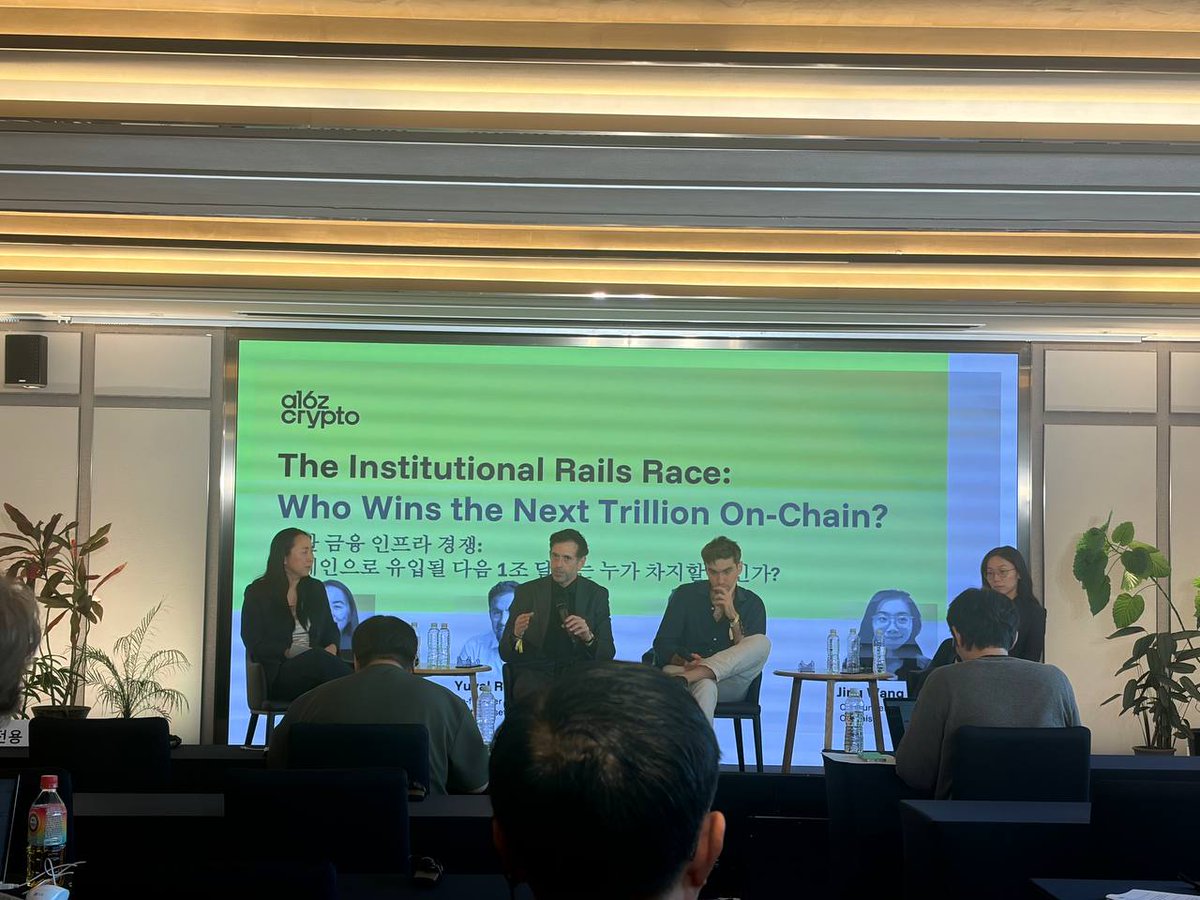
"Privacy is a must have to move capital markets on chain" - @YuvalRooz, a16z Crypto Korea Summit.
Congratulations to @HelloNavra and @MCagney on their Series A, led by @RibbitCapital.
We’re proud to support their vision of making the onchain economy more accessible to traditional finance by bringing institutional-grade financial products and access onchain.
We're excited to announce Navra's successful Series A, led by @RibbitCapital
Thank you to our investors Jump , DCM, DST Global Partners, Faction, Baseline Ventures, DA, Distributed Global, Blockchange, RPM Ventures, Morgan Creek Digital, Figure and others who believe in what we're building. 🧵
@YuvalRooz co-founded @digitalasset in 2014 on one premise: value should move as freely as information does on the internet. He went on to play a pivotal role in forming the @CantonNetwork.
In January 2027, he joins us on stage at #cfcstmoritz.
At the @ISDA Digital Assets Forum on October 6, Oberon Knapp, Digital Asset's Global Head of Equities, joins the panel "Rewiring Financial Markets,".
The discussion will cover how banks, asset managers, and market infrastructures are putting tokenization, digital money, and DLT to use today.
Learn more: https://t.co/s6Et8qh8J0
@ISDAConferences
Digital Asset is hiring a Director of Sales, RWA in New York, working with institutions to bring tokenized funds, repo, treasury, and settlement workflows onto @CantonNetwork.
The role blends enterprise sales and ecosystem engagement.
Learn more: https://t.co/A1MJLPmnMH
🚨 Markets, policy, infrastructure, and global capital are converging at KBW2026.
Meet the speakers and partners bringing those conversations together in Seoul this fall:
Joseph Lubin - Founder | @MetaMask
Bo Hines - CEO | Tether @USAT
Jeff Yan - CEO | @HyperliquidX
Tom Lee - Chairman | @BitMNR
Yuval Rooz - Co-Founder & CEO | @CantonNetwork
Kyoungsuk Oh - CEO | @Official_Upbit (Dunamu)
Caroline Pham - CEO | @Moonpay Institutional
Balaji Srinivasan - Founder & Author | @NS
Arthur Hayes - CIO | @MaelstromFund
Harry Jung - Former White House
✨ KBW2026 Conference Partners:
@Official_Upbit • @0G_labs • BRV Capital Management • @Stable • @useTria • @GOATNetwork
📍 September 30–October 1 | Walkerhill Hotels & Resorts, Seoul