I don’t believe finding the right person means finding someone perfect. For me, a lasting relationship means accepting that we will misunderstand each other, disappoint each other, and sometimes make mistakes.
Love is not about avoiding every difficult moment. It is about learning how to face them without losing respect for each other or ourselves.
So for me, the real question is:
“Is this the person I want beside me when life becomes difficult?”
Because in the end, what matters most is not perfection, but whether two people can remain on the same side while life keeps changing around them.
Train your mind to focus on wisdom and compassion. Attachment brings about suffering. Let’s go of your desires and attachments. Release from your craving and clinging.
Dharma.
Not everyone who keeps their distance is afraid of connection.
For some, social environments are simply overwhelming because they absorb far more than what is openly expressed. They notice the tension behind friendly gestures, the competition hidden inside compliments, and the discomfort covered by laughter.
What others dismiss as ordinary interaction can feel strangely demanding to them. Maintaining polite enthusiasm, participating in empty conversations, and acting interested when no genuine connection exists can leave them emotionally drained.
So they become selective.
They protect their attention instead of offering it everywhere. They would rather spend an evening alone than feel isolated in a crowded room. They prefer silence to conversations built on appearances and one sincere relationship to dozens of superficial ones.
This does not mean they are incapable of closeness. In fact, the opposite may be true.
When trust is present, they connect with unusual depth. They listen carefully, speak honestly, and have little interest in social games. Their relationships may be fewer, but they are rarely accidental.
From the outside, this can look like withdrawal.
From the inside, it is often a refusal to repeatedly invest emotional energy in interactions that feel hollow.
They are not rejecting humanity.
They are waiting for something real.
I have worked with several young people between the ages of 17 and 25 and observed their mental development in relation to their joy and inventiveness.
I noticed that with the formation of the ego and the process of growing up, this childlike innocence and spontaneous joy are gradually replaced, as if the mind were being reprogrammed. The consolidating personality continually builds up its inner structures and defines the world more and more rigidly and narrowly, until this world begins to lose its wonders.
This is the transition from the “beginner’s mind” (Shoshin) to the expert mind, the “disenchantment of the world” (Max Weber), or simply the price we pay for a stable identity and the ability to act.
You’ve already poured so much time, money, or energy into something and even though, it’s clear, it’s no longer working, you just can’t stop.
That’s the Sunk Cost Fallacy.
Our brain hates losses and hates admitting we were wrong even more. So we quietly calculate: “I’ve already invested so much,I can’t quit now.”
But those resources are gone. They’re never coming back. Rationally, only the future costs and benefits matter.
A few everyday examples:
You stay in a relationship that makes you unhappy because you’ve already been together for so many years.
A company keeps pouring millions into a project that’s clearly failing because “so much is already invested.”
You finish a degree or training even though you know you’ll never work in that field.
The uncomfortable truth: Continuing only because of the past is almost always more expensive than quitting at the right time.
Sometimes the bravest and smartest move is simply to let go, even when it hurts.
#psychology
Everyone experienced this.
In a relationship, you get ignored. No replies, no eye contact, like you don’t even exist anymore.
At work, people barely talk to each other anymore. Just cold politeness, and you notice the attention that used to be there is simply gone.
That’s passive-aggressive anger. It comes quietly, avoids any direct confrontation, and still leaves you feeling confused and small.
It often starts in childhood: When anger or disagreement was punished or met with the withdrawal of love, kids learn to express their aggression “under the radar.”
Later it turns into a pattern: Deliberately playing dumb, saying “Sure, of course, let’s do that”… and then doing nothing. Or spreading rumors, working intentionally inefficiently, just letting things slide.
Most of the time there’s no real malice behind it, just pure fear of open conflict.
What actually helps? Don’t chase. Don’t over explain.
Simply stay calm and make it clear: These little games won’t work with me.
The clearer you are, the less room there is for manipulation.
@realalexlains You mean Morocco is cooperating with Israel and America to create a weaker Spain and, consequently, possibly a weaker Europe? Not that I understand much about politics, but some things are never a coincidence.
I'm not talking about the knowledge one accumulates. That accumulated everyday knowledge (the fixed description of the world) becomes a prison wall, just as you described in your first post. The knowledge I'm talking about is the opposite: it destroys this wall so that reality can surprise us again—so radically that sometimes we no longer know whether we are still, or merely, "human."
I'm talking about the knowledge, the ability to consciously experience the world anew so that we are no longer trapped by ego and social categorization. Absolute freedom is not a place, but the state in which categorization itself ceases to define you.
@Karlish_11 What do you think of this: Knowledge is the ability to willfully change one's own reality in order to achieve absolute freedom from ego and social conditioning.
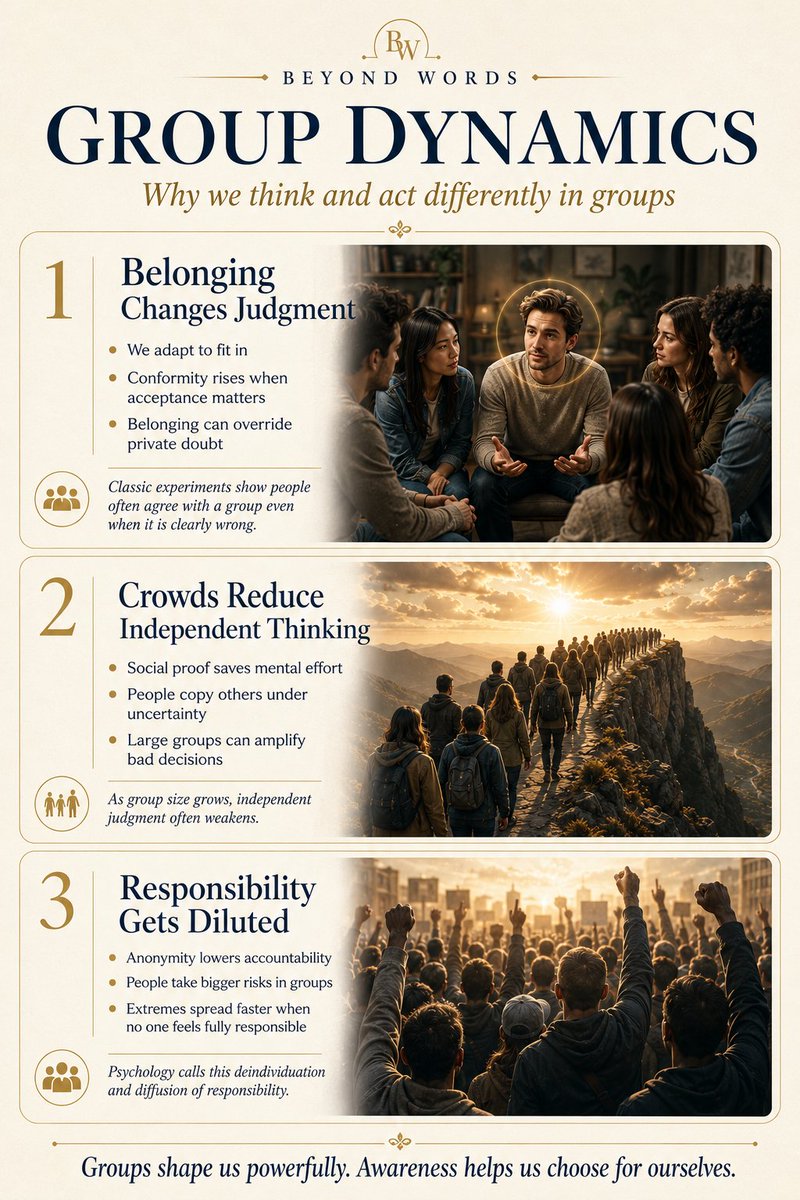
I used to think I was pretty independent.
Then I started paying attention to how I behave when other people are in the room.
In meetings I soften my opinions.
In big groups I sometimes go quiet even when I have something to say.
It’s subtle and almost invisible, but it’s real.
The more I’ve watched myself and others, the more I’ve realized:
we don’t just join groups, groups quietly rewrite us.
They change how certain we feel, how bold we are, and how responsible we feel for what happens next.
In a group it becomes easier to assume someone else will take care of it and the sense of personal responsibility just thins out.
I notice how the more extroverted voices naturally take up most of the space, while quieter ones, including my own slowly move into the background.
What if your body replaced itself entirely? When does the 'you' disappear? This is the terrifying precipice of human evolution. #FutureTech#Humanity#Existential
Self-esteem is that quiet inner verdict you carry about your own worth. It's not just “Can I do this?” but “Am I enough as a person?”
Around 30% of adults live with chronically low self-esteem. It often shows up as the voice that dismisses every compliment, turns small mistakes into proof of failure, and keeps whispering “You could be better" , "That's nothing special" , "you didn't really deserve it”, even after real successes.
Think of someone who finally gets the promotion they’ve worked years for… and still feels like a fraud who’ll be exposed any day. Or the person who always apologises for simple things. That’s low self-esteem in everyday life.
These patterns are frequently shaped in childhood through critical or conditional raising , lack of warmth, or experiences that taught us our value depended on performance or approval. The good news is they are not permanent.
The deeper shift begins when you realise a simple truth: you are already complete. Your inherent worth is not measured by what you achieve, produce, or how others see you. It exists independently of everything you do.
You’re not broken. These early patterns were learned and they can be gently unlearned by remembering, again and again, that you were whole from the start.
#SelfEsteem #MentalHealth