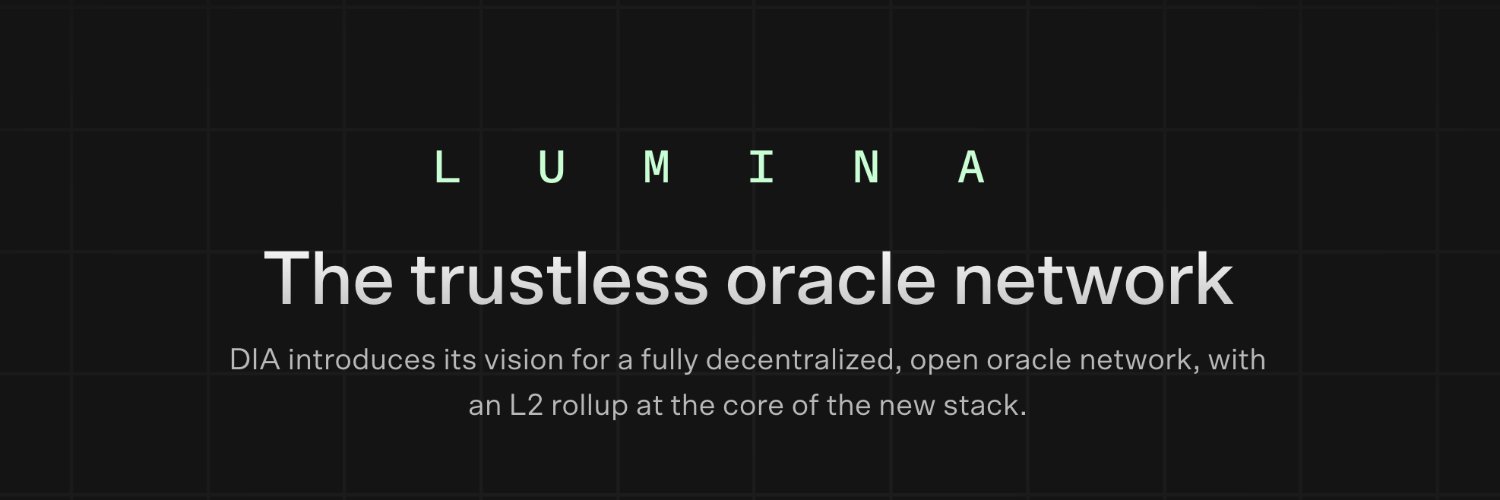
Curious to learn more about DIA and what's to come with Lumina?
I really enjoyed this discussion with @DefiantNews where we dove deep into the Lumina architecture and the road ahead for DIA.
We have a great chat with @dillonhanson12 at ETHDenver about @DIAdata_org's new rollup-powered oracle architecture—built for trustless, verifiable data feeds across DeFi, RWAs, and beyond.
#MediaPartnership
The liquidity requirement for robust oracle price feeds can be a significant bottleneck when considering the "tokenize everything" thesis.
This is why DIA has launched Fundamental Feeds, which calculate an asset’s NAV and fundamental value rather than strictly market trades.
Tokenized RWAs just crossed $30B. That measures how much value has been put on-chain. It says nothing about how much of it anyone can actually trade.
TVL and liquidity get read as the same signal. They aren't. One says an asset has been represented as a token. The other says there's a buyer, a price, and a way out when you want it. Much of today's tokenized value scores high on the first and near zero on the second.
Most tokenized treasuries mint through the issuer and redeem through the issuer, with little trading in between. If the only buyer is the issuer at redemption, that's not a secondary market. It's a redemption line.
And it won't be uniform across asset classes. Treasuries, equities, commodities and FX already have deep off-chain markets, so they arrive on-chain with a price and people who know how to make one. Private credit, real estate and one-offs don't. Tokenizing them doesn't create demand that never existed.
@dillonhanson12 from @DIAdata_org makes this point during the Protocol Roundtable: expecting every tokenized asset to reach deep on-chain liquidity is a real bottleneck. Issuance has matured much faster than the market structure that makes an asset tradable.
A tokenized asset with no compliant venue to trade still has value. But it's a redemption mechanism, not a market.
What do you see as the biggest obstacle to building real secondary markets for RWAs?
Traditional equities are geo-restrictive, gated by brokerage access, and trade only 5 days a week.
ST0x is brings these assets onchain, enabling 24/7 access, with each token backed 1:1 by the underlying equity share.
Excited to support @st0x_io on its tokenization journey!
.@st0x_io runs 24/7 trading for tokenized equities and ETFs on @base, each backed 1:1 by shares held at a regulated broker.
DIA oracles set the reference price its order book quotes around, with pre and post-market sessions kept separate from regular hours.
Stocks are onchain.
The use of offchain collateral to back onchain strategies is growing across the industry. Yet builders and even their users still have to trust opaque API's and issuer-reported NAVs.
DIA ZK Changes that.
Don't trust, prove.
Today, we are excited to launch DIA ZK, the verifiable data assurance layer for DeFi, RWAs, and cross-chain applications.
Yield-bearing stablecoins, tokenized treasuries, and vaults built on offchain strategies now hold tens of billions in onchain value. The highest yields among them are earned offchain: basis trades on centralized exchanges, tokenized treasuries, private credit, CeFi lending. While the token lives onchain, the strategy that pays it does not.
That creates a problem for issuers. Holders, risk curators sizing allocations, and lending markets deciding whether to list a token cannot see the custody balances, exchange positions, or loan books behind the yield. They ask for proof, and an issuer-controlled dashboard or a monthly attestation is becoming less convincing as the basis for trust.
In June this year, a yield-bearing stablecoin lost its peg after the third-party service that verified its reserves ended its relationship. A lending market built around the token was left with roughly $18 million of affected collateral, and a separate vault with no direct exposure to the stablecoin was hit too because both relied on the same verifier.
DIA ZK addresses this. It proves that a reported value came from the stated source and was not altered on its way onchain. It proves the statement rather than the value: a condition such as reserves exceeding supply, without revealing the underlying figures. The proofs are posted and verified on DIA's oracle chain, rather than relying on a feed that a single verification provider can switch off.
Reserve disclosure requirements under MiCA already apply in the EU, and the US GENIUS Act will introduce federal reserve and disclosure requirements for qualifying stablecoin issuers. Continuously proving backing onchain, without forcing an issuer to reveal its underlying books, is the next capability the oracle layer has to provide.
If your protocol depends on stablecoin reserves, tokenized fund NAVs, or vault collateral held offchain, this is where to start.
I had a great time chatting with @MartindRijke on Maple Finance and learning some tips on how they scaled even during crypto's most challenging periods.
Thank you Martin!
@MartindRijke joined @maplefinance two weeks before the 2022 CeFi collapses.
Then he helped scale it from $9M to $3.6B in AUM, closing one institutional deal at a time while competitors shut down.
In this new episode of Beyond Yield, we explore how on-chain lending actually works, and why stablecoin yield lags adoption by 6 to 12 months.
Curious to learn more about DIA and what's to come with Lumina?
I really enjoyed this discussion with @DefiantNews where we dove deep into the Lumina architecture and the road ahead for DIA.
We have a great chat with @dillonhanson12 at ETHDenver about @DIAdata_org's new rollup-powered oracle architecture—built for trustless, verifiable data feeds across DeFi, RWAs, and beyond.
#MediaPartnership
1/n
Hacks have been plaguing DeFi's growth as of late...
so we got together with a group of friends to create https://t.co/FY6k4wxt96: a FREE real-time hack detection platform!
i'd like share how it works + how you can use it today, FREE!
@litecoin launched in 2011 as a payments network, and it's been running for 14 years without native smart contracts.
@LitecoinVM changes that, as the first EVM rollup is live on testnet.
DIA is now the oracle layer, starting with feeds for BTC, LTC, ETH, and more.
Proof of Liquidity has been one of the highlights of the EthCC week.
Great conversations connecting allocators and teams building DeFi infrastructure.
Shoutout to our co-hosts @yield_network, @inkonchain, @stsdigital_io, @FundersVC.
Most tokenized RWAs don’t trade. They sit in wallets at a discount to NAV with no exit.
We’re bringing together issuers, DeFi builders, oracle teams & market makers to debate: who builds the secondary market for illiquid on-chain debt?
Good conversations happen at EthCC when you stop looking for announcements and start looking for the right people 🤝
We connected with @DIAdata_org to explore how oracle infrastructure determines the lending markets you can safely run. Specifically, what verifiable collateral pricing needs to look like before a lending market goes live!
Research in progress, and we love to be on the frontline! 🚀
P.S. Protofire already works with DIA on enabling verifiable oracle infrastructure on non-EVM chains, this is a natural next chapter! ⛓️
@particula_io So excited to see this come to life! Particula is truly the unlock needed to bring institutional-focused assets onchain with actual transparency and ratings 🔥
One of my favorite things about working at DIA is the integral role that oracles play in enabling new use cases onchain.
Evolution is key in an industry which grows 24/7.
Proud of this journey as we continue building the modern data layer for onchain finance!
DeFi is no longer an experiment. It’s financial infrastructure.
Over the past decade, we’ve evolved from exploration to production. From experimental primitives to bringing billions in capital onchain.
So did DIA. Today, we unveil our new brand that reflects that evolution.
DeFi is no longer an experiment. It’s financial infrastructure.
Over the past decade, we’ve evolved from exploration to production. From experimental primitives to bringing billions in capital onchain.
So did DIA. Today, we unveil our new brand that reflects that evolution.