@RapydGlobal joined Funders' portfolio 💼
https://t.co/AFs3sSa87x participated in Rapyd’s Series F round alongside @TargetGlobalVC, @BlackRock, @generalcatalyst, @Fidelity and other leading investors.
Why we backed Rapyd:
▫️ World-class team with proven fintech scaling experience
▫️ Concrete unit economics tailor-made for the business model
▫️ Product is a category-defining global payments stack
Rapyd is setting a new standard for the global finance stack. And it's a true pleasure to be a part of their journey.
Full list of lending protocols with over $1B in TVL providing the deepest liquidity for complex DeFi strategies right now ↓
@aave - TVL $13.10B The best choice for positions above $500K offering minimal slippage and stable institutional liquidity across all major networks.
USDC supply 3.29% | borrow 3.99%
USDT supply 2.68% | borrow 3.60%
@Morpho - TVL $7.00B The highest rates on stablecoins through isolated markets but requires mandatory pool diversification to maintain liquidity depth.
USDC supply 3.68% to 4.22% | borrow 4.12%
USDT supply 3.21% to 3.52%
@sparkdotfi - TVL $4.98B Channels the Sky Savings Rate providing predictable governance set yields without market volatility.
USDC supply 3.60%
USDT supply 2.50% | borrow 3.40%
@DeFi_JUST - TVL $3.24B Dominates TRON with the largest TVL on the network offering investors the lowest fees for high frequency transactions.
USDT supply 1.32% | borrow 3.02%
@kamino - Dynamic live rates on platform TVL $1.40B Up to 95% LTV in eMode on Solana with built in auto compounding vaults. The absolute best choice for aggressive looping.
@compoundfinance - TVL $1.22B The longest track record since 2018 featuring isolated borrow markets in V3 and battle tested conservative durability.
USDC supply 3.02% | borrow 3.83%
USDT supply 2.63% | borrow 3.53%
@VenusProtocol - Dominates the BNB Chain with competitive rates and low transaction fees for the entire ecosystem.
USDC supply 2.48% | borrow 4.31% TVL $1.10B
The decentralized lending sector has transformed into a transparent highly liquid alternative to the global interbank market.
The combination of Aave V3 and Morpho Blue forms a monolithic foundation guaranteeing the deepest exit liquidity for safely closing large institutional positions. Meanwhile Kamino unlocks aggressive leverage application on Solana and JustLend makes high frequency transactions on TRON practically free.
Smart investors only need to properly align their yield requirements with the unique architectural risks of each platform.
@MonetaCore Spot on. A properly tuned threshold for inaction requires a much more complex constraint architecture than the task execution algorithm itself. Overactivity by an agent only generates new operational risks.
The Evolution of Agentic AI and the New KYA Standard
• Enterprise deployment: AI agents are operating in production at a corporate scale. The baseline deployment model has shifted from simple assistants to autonomous workflow executors.
• Operational uncertainty: Agents lack a verified owner, restricted permissions and an end to end activity log. This creates a systemic risk for compliance, auditing and incident investigation.
• Infrastructure layer: A new Know Your Agent (KYA) infrastructure layer is emerging. It includes identification, permission granting, real time behavior monitoring, pre deployment model verification and attack prevention.
The integration of agentic AI in 2026 is no longer a question of technology viability but strictly a matter of secure management in a production environment.
@csh_jacky Absolutely spot on. Basic agent identification is meaningless without capturing operational memory, which is why the ultimate product of KYA must be complete accountability for every single action.
We discussed this exact scenario at conferences following the @DriftProtocol and @KelpDAO exploits, as practice directly confirms that auditors are critically lagging behind algorithmic systems.
As a result, software code verification has ultimately become nothing more than a marketing tool.
However, condemning the entire decentralized finance sector ignores the actual threat statistics.
Ninety percent of capital losses occur due to operational security failures and successful social engineering, where mundane access leaks destroy more liquidity than actual protocol vulnerabilities.
The industry will survive only if it shifts its focus from endless code audits toward strict institutional standards for private key control.
PSA: I now consider *all* of DeFi unsafe.
Coding agents are superhuman at finding vulnerabilities, and smart contract security is too asymmetric: defenders need to fix every bug while attackers need just one exploit to steal funds.
Spent the last few days at Doers Summit Limassol and it was a genuinely fantastic experience. The event organization was top tier.
We focused heavily on the Web2 and fintech segments, had dozens of meaningful conversations and were impressed by the density of interesting founders and ambitious people building from Cyprus and across the region.
Our Partner Alexander Alemaskin joined the jury panel to review a number of early stage startups during the pitching sessions:
• Local founders are moving away from generic apps to solve practical regional challenges like logistics, hiring and resource optimization.
• The ecosystem is shifting from startup theatre toward grounded businesses focused on operational efficiency, automation and AI enabled workflows.
• Cyprus continues evolving into a dense regional hub connecting talent and capital flows across Europe, MENA and the CIS.
Massive thanks to the organizing team at @DoersSummit for putting together such a high value networking ecosystem.
Top AI and compute-native projects by market capitalization, cross-checked across @glassnode , @coingecko , and @CoinMarketCap ↓
@NEARProtocol (Near Protocol / Ethereum)
@bittensor (Custom L1)
@DfinityToday (Custom L1)
@render (Solana)
@AskVenice (Base)
@virtualprotocol (Base / Ethereum)
@GoKiteAI (Avalanche / Custom L1)
@grass (Solana)
@graphprotocol (Ethereum / Arbitrum)
@akashnet (Cosmos)
Current market data suggests that institutional liquidity in the AI and compute-native segment remains concentrated across these protocols, although exact rankings vary depending on the data provider and category methodology.
What remains consistent across the major analytics platforms is a fragmented infrastructure landscape: capital is not loyal to any single ecosystem and continues to follow execution efficiency, liquidity depth, and compute availability.
Rather than a single AI supercycle, the market increasingly looks like a competition between underlying networks for the base layer of the emerging machine economy.
@HyperliquidX and HIP-3 should currently be viewed as an emerging infrastructure angle rather than a confirmed core leader of the AI sector, at least for now 😅
Institutional capital is well acquainted with foundational RWA projects. Market participants actively utilize Tether Gold, BlackRock BUIDL, and Hashnote USYC.
However a new tier of early protocols is currently emerging with strong dynamics and the potential to compete with recognized leaders.
Let us examine ten projects demonstrating the highest growth over the past 90 and 180 days.
1. @Neutrl (sNUSD): tokenized yield strategy issuer grew by 1421.3% over 180 days.
2. @PreStocks (ANTHROPIC): equity tokenization platform recorded a 743.9% increase over 180 days.
3. @GetYieldFi (vyUSD): yield strategy protocol grew by 176.3% over 180 days.
4. @paretocredit (ParetoFAL USDC): onchain credit fund added 154.3% over 180 days.
5. @DinariGlobal (USD+): tokenized fund provider increased its capitalization by 127.4% over 180 days.
6. @onrefinance (ONyc): onchain yield generation instrument grew by 76.7% over 90 days.
7. @protocol_fx (fxSAVE): yield strategy issuer added 58.7% over 90 days.
8. @VNX_Platform (VNXAU): tokenized gold provider showed a 43.0% growth over 90 days.
9. @NestCredit (YNRWAX): credit fund increased its metrics by 214.9% over 90 days.
10. @piku_dao (USP): yield strategy issuer grew by 128.8% over 90 days.
The tokenized asset market is systematically diversifying beyond sovereign debt. Capital is actively seeking alternative yield strategies and onchain credit instruments.
Emerging protocols successfully attract liquidity through highly flexible capital allocation models. This trajectory confirms the willingness of smart money to accept calculated risks for improved margin performance.
The institutional environment is transitioning from basic asset custody toward the construction of complex portfolio strategies.
Data source: research by @RWA_xyz.
Did anyone actually track @grovedotfinance and understand its core architecture?
The protocol launched in June 2025 as a capital allocation layer within the Sky (formerly MakerDAO) ecosystem.
The platform automatically deploys capital into tokenized RWA assets, Aave lending, Morpho vaults, and Curve LP positions.
This infrastructure operates across Ethereum, Base, Avalanche, and Plume.
Let us review the actual metrics:
• Grove Savings TVL has reached $5.7 billion.
• Core protocol TVL stands at $2.67 billion.
• Annualized fees exceed $72.6 million.
• The $SKY Savings Rate offers a 3.65% APY. This rate competes tightly with $AAVE at 3.89% and $MORPHO Prime at 3.75%.
The fundamental value of Grove lies in algorithmic capital routing. The protocol bridges fragmented liquidity across multiple networks and forms a unified yield curve for stablecoins.
Dynamic balancing between tokenized RWAs and lending pools establishes the baseline risk free rate for the sector.
The project operates as a comprehensive treasury primitive. It automates corporate asset management and drastically cuts portfolio rebalancing costs.
CB Insights data for the first quarter of 2026 reveals a structural redistribution of capital within fintech. The global deal count dropped to a multiyear low of 762 transactions, marking the fifth consecutive quarter of decline.
At the same time, the total funding volume held steady at $12.1 billion, confirming the simple truth that liquidity is not leaving the industry but merely shifting its focus across stages and sectors.
The primary influx of capital was directed toward late rounds, whose share reached 35 percent and effectively doubled the average metrics of the previous two years. Against this backdrop, the crypto sector demonstrated the maximum level of institutional conviction.
The average valuation per employee in crypto startups reached $6.4 million compared to the $3.5 million fintech average, and seven out of the ten top teams from the past quarter operate specifically in the Web3 segment. The market is ready to pay a premium for a strong crypto narrative at the Series B and Series C stages.
Current market selectivity concentrates capital exclusively in companies with a high probability of an exit.
This configuration creates a highly pragmatic investment environment for seed funds, as overall price pressure and valuation overheating have noticeably decreased while fierce competition for fundamental technological projects remains intact.
The @FundersVC team will be attending the Doers Summit Limassol in Cyprus. The event is shaping up to have a strong agenda, and we plan to be highly active, particularly within the Web2 and fintech segments.
Our focus and team on the ground:
• Marfa Shishkina, Founder / GP - Will be attending the closed GP/LP event. Core focus: global strategy and capital allocation.
• Alexander Alemaskin, Partner / CFO / Late-Stage Lead - Will serve as a judge at the demo day and actively evaluate deals at the scaling stage.
• @al_nechaev, Partner (DA & DeFi) - Open to strategic discussions regarding Web3 infrastructure and liquidity deals.
• Pavel Miasnikov and Feliks Omarov - Working directly within the ecosystem: scouting emerging fintech trends and meeting with strong founders.
We are always on the lookout for category-defining projects and infrastructure solutions. If you are building a solid product or see clear synergies for partnership, send us a DM or drop a comment below.
See you at DOERS 👋
The Top 10 Strategic Technology Trends for 2026 are here 💡
See how leading organizations are building resilience and trust in an AI-first world.
Explore the strategies shaping tomorrow: https://t.co/i338WAQG1t
#GartnerSYM#TechTrends#AI#CIO#Technology
Y Combinator’s RFS for Summer 2026 confirms a market shift we’ve been acting on at Funders VC : the AI industry is moving from the "discovery" phase to the "ROI" phase.
The first wave of LLM adoption naturally focused on testing capabilities and accessible applications. Now, the market demands foundational infrastructure and sustainable unit economics. The hype cycle is over; the execution cycle has begun.
At @FundersVC , we aren’t looking for broad horizontal platforms. Our current thesis is built around "real solutions for real problems." We are hunting for AI-infra and Vertical AI deeply embedded in narrow industries such as logistics, construction, manufacturing, QA or B2B fintech.
We back founders who are building the backbone of the next decade by:
• Delivering margin expansion
• Solving complex legacy enterprise workflows rather than building superficial features.
• Demonstrating clear paths to revenue and capital-efficient growth from day one.
Every VC makes a bet on what the world will look like in 10 years. Our bet is on founders turning technological shifts into scalable, cash-generating businesses.
We’ve already onboarded the demo day winners into our portfolio and are actively working with them. Meanwhile, the full recap of the Cannes event is finally here!
A special thanks to the @Cointelegraph team for inviting us to join the jury 🤝
The entire atmosphere, key pitch highlights (focusing on DeFi and RWA), and the $180k prize pool distribution have been wrapped up in two convenient formats.
Whether you want to refresh your memory or see how it all went down, check out the links below:
📖 Read the article on CT: https://t.co/JcGk8mbBLR
🎥 Watch the video recap: https://t.co/ijOzP6feyo
A closer look at Tether’s venture arm shows a portfolio moving far beyond standard crypto infrastructure.
Stakes in Blackrock Neurotech, Neura Robotics, and Generative Bionics indicate a clear focus on deep tech and human-computer interfaces.
Meanwhile, investments in platforms like Rumble and Holepunch show an active interest in alternative media and P2P communication networks.
This isn't just basic diversification. Tether is essentially using its massive financial float to buy into the physical and digital hardware of the next decade.
The Tether model: From Stablecoin to permanent capital
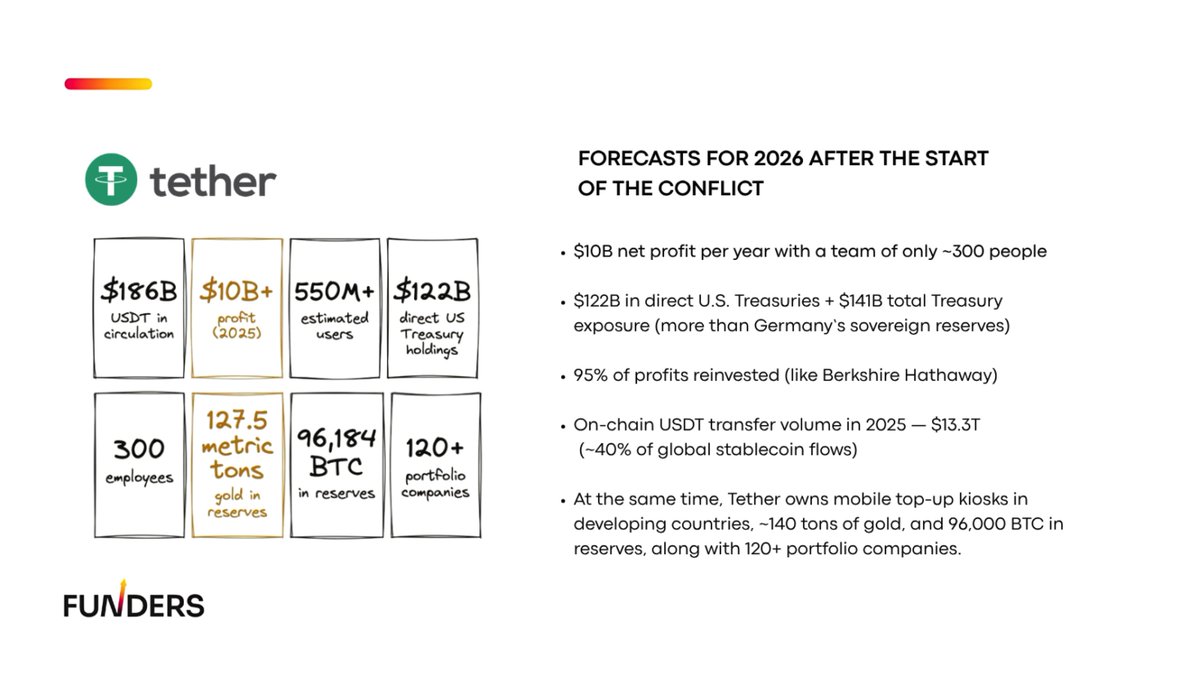
Tether generates roughly $10 billion in annual net profit with a team of around 300 people. Its operational leverage is driven by exposure to $141 billion in U.S. Treasuries. The liability base carries effectively zero cost.
95% of profits are deployed directly into a portfolio of hard assets. This includes 96,184 bitcoin:native, 140 tons of physical gold, bitcoin mining infrastructure, and stakes in more than 120 private companies. In 2025, solana:Es9vMFrzaCERmJfrF4H2FYD4KCoNkY11McCe8BenwNYB on-chain transfer volume reached $13.3 trillion, accounting for roughly 40% of global stablecoin flows.
Structurally, @tether occupies a position with no real equivalent in traditional finance. Banks pay for deposits. Insurance companies absorb underwriting risk.
Tether acquires liquidity for free, allocates it into Treasuries yielding 5%, and reinvests the spread into assets with effectively unlimited duration. The cost of liabilities is fixed at zero, while the value of assets compounds over time.
The next layer is control consolidation. Direct access to 40% of global stablecoin flows positions Tether as an operator of settlement infrastructure. The launch of its own blockchain, @Plasma, with zero fees and restrictions on speculative assets, removes dependency on external networks. Mining farms in Uruguay, Paraguay, and El Salvador add a physical base for asset generation.
The regulatory track forms the second pillar. In January 2026, ethereum:0x07041776f5007aca2a54844f50503a18a72a8b68 was launched under the GENIUS Act framework. The issuer is Anchorage Digital Bank, reserve custodian is Cantor Fitzgerald, and the CEO is Bo Hines, former head of the White House Crypto Council. Separate perimeter, separate product, separate audience. A sanctioned access layer running in parallel to the core structure.
Bottom line: the market is still debating reserve transparency while the structure already operates like a vertically integrated holding company. Short-term float is being arbitraged into long-term control over settlement infrastructure, energy production, and hard assets.
The Tether model: From Stablecoin to permanent capital
Tether generates roughly $10 billion in annual net profit with a team of around 300 people. Its operational leverage is driven by exposure to $141 billion in U.S. Treasuries. The liability base carries effectively zero cost.
95% of profits are deployed directly into a portfolio of hard assets. This includes 96,184 bitcoin:native, 140 tons of physical gold, bitcoin mining infrastructure, and stakes in more than 120 private companies. In 2025, solana:Es9vMFrzaCERmJfrF4H2FYD4KCoNkY11McCe8BenwNYB on-chain transfer volume reached $13.3 trillion, accounting for roughly 40% of global stablecoin flows.
Structurally, @tether occupies a position with no real equivalent in traditional finance. Banks pay for deposits. Insurance companies absorb underwriting risk.
Tether acquires liquidity for free, allocates it into Treasuries yielding 5%, and reinvests the spread into assets with effectively unlimited duration. The cost of liabilities is fixed at zero, while the value of assets compounds over time.
The next layer is control consolidation. Direct access to 40% of global stablecoin flows positions Tether as an operator of settlement infrastructure. The launch of its own blockchain, @Plasma, with zero fees and restrictions on speculative assets, removes dependency on external networks. Mining farms in Uruguay, Paraguay, and El Salvador add a physical base for asset generation.
The regulatory track forms the second pillar. In January 2026, ethereum:0x07041776f5007aca2a54844f50503a18a72a8b68 was launched under the GENIUS Act framework. The issuer is Anchorage Digital Bank, reserve custodian is Cantor Fitzgerald, and the CEO is Bo Hines, former head of the White House Crypto Council. Separate perimeter, separate product, separate audience. A sanctioned access layer running in parallel to the core structure.
Bottom line: the market is still debating reserve transparency while the structure already operates like a vertically integrated holding company. Short-term float is being arbitraged into long-term control over settlement infrastructure, energy production, and hard assets.
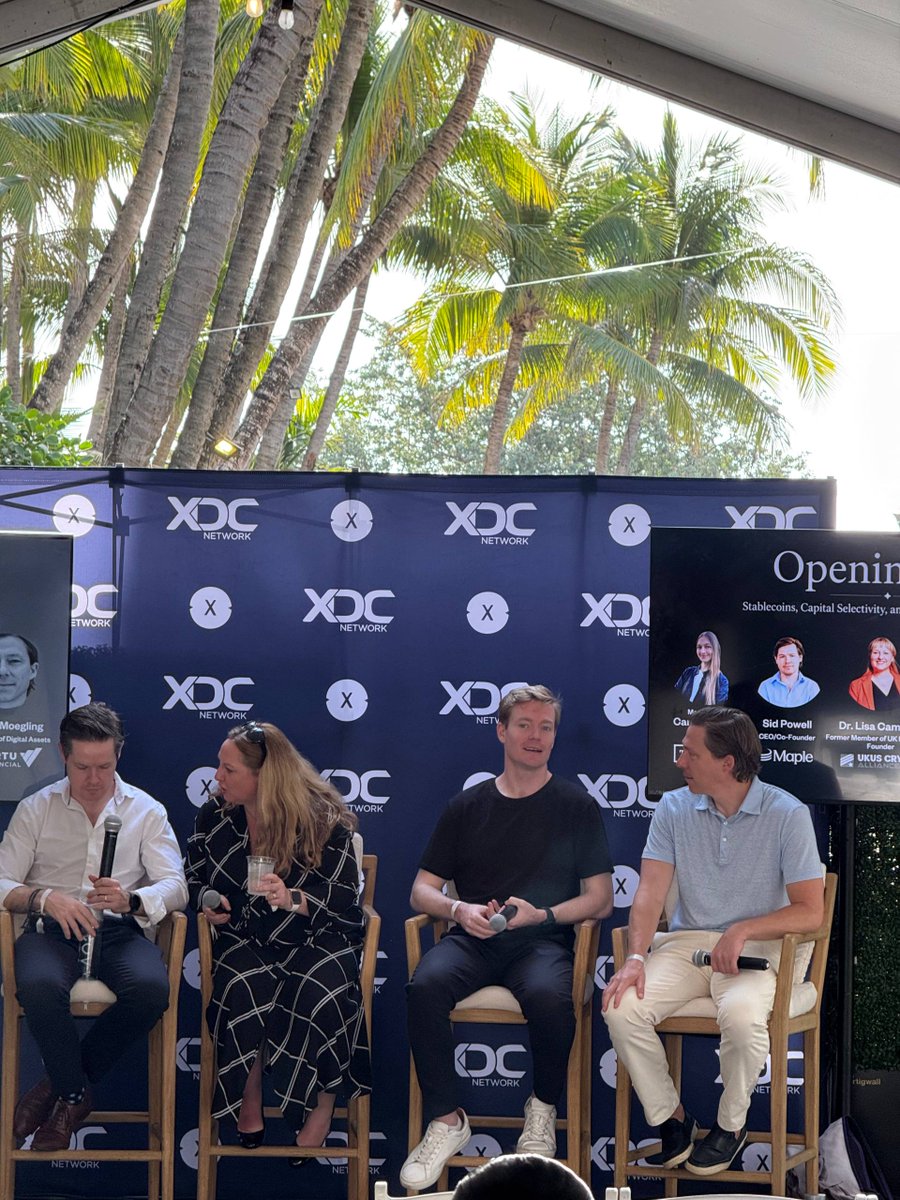
Attended the Opening Bell event by @XDCNetwork today.
It was a truly great event with lots of familiar faces. A huge thank you to the organizers for the top tier execution.
Special appreciation for the excellent breakfast and coffee ☕️
Conferences may have been canceled or rescheduled but we are still moving forward and adjusting.
Check out our plans for May. We are excited and look forward to meeting everyone in person.
To set up a meeting DM @FundersVC 👇
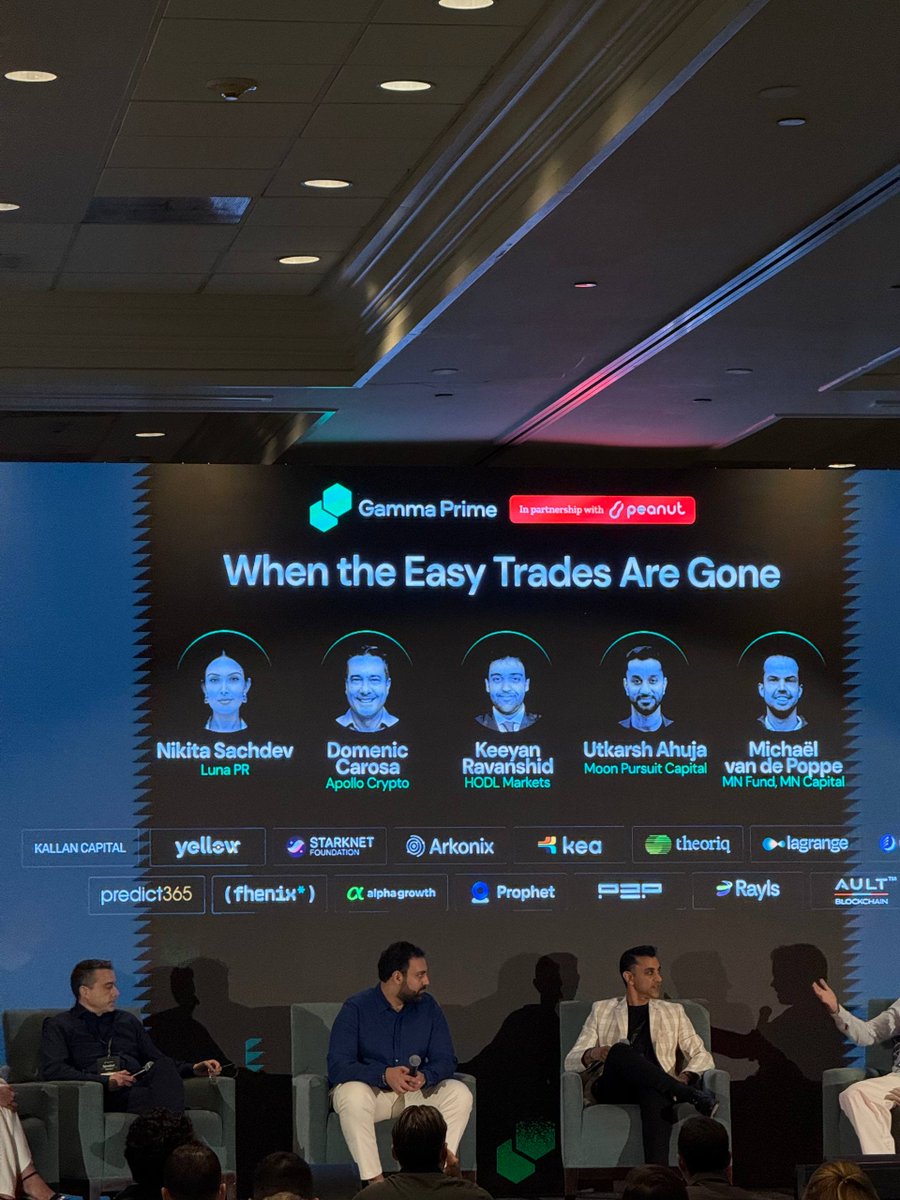
Our partner @al_nechaev is currently attending the Tokenized Capital Summit 2026 in Miami.
@GammaPrime_Com consistently host exceptional events with an incredibly strong audience. A huge thank you to the organizers for the top tier execution.
You can watch the live broadcast here: https://t.co/5n1oC7RzYK