Mercury: Metal of the Gods or Forgotten Technology?
⚡️⚡️
Mercury is the only metal that is liquid at room temperature. Today, it is classified as toxic, banned in medicine, removed from thermometers, and cannot be transported without special permission. But…
Mercury used to be everywhere:
- In medicine: Sulema, Calomel, amalgams, mercury ointments;
- In construction: amalgams were used in mirrors and domes (including St. Isaac's Cathedral in St. Petersburg)
- In mechanics: as the basis for rotating platforms and compensators that replaced bearings.
- In optics: mercury mirrors enabled extremely precise reflection for observing stars and laser calculations.
❗️ And now the question: Where was it obtained in such quantities?
- Natural sources are extremely rare. The main mineral is cinnabar (HgS), which is mined deep and dangerously.🤔
- Mercury was used in enormous quantities for the amalgamation of gold. Up to 100 tons were needed for the dome of St. Isaac's Cathedral alone.
- The production and transport of such masses in the 18th and 19th centuries without a heavy chemical industry is highly questionable.🤔
Today it is banned.
Not because it is "dangerous," but because it conducts heat, energy, and potentially information in a different way than other substances. And understanding this could take us beyond the physics of the 19th century.😉⚡️⚡️
Perched precariously upon a jagged precipice of burnished rock, the Mehrangarh Fort rises like a titan’s crown over the "Blue City" of Jodhpur. Built from the very sandstone it stands upon, the fortress walls seem to grow organically out of the earth, a seamless fusion of nature and human ambition. Every weathered brick and intricately carved jharokha (balcony) whispers tales of Rajput valor, where the echoes of clashing swords and royal courtships still linger in the dry desert wind.
The architecture is a breathtaking contradiction: massive, impenetrable bastions designed for brutal warfare support delicate, lace-like stone screens where queens once gazed upon the world unseen. You can almost feel the presence of the craftsmen who spent lifetimes chiseling beauty into these stones. To stand before its towering gates is to feel small against the weight of centuries. It is more than a monument; it is a living testament to a defiant spirit that transformed a desolate hilltop into a masterpiece of eternal majesty.
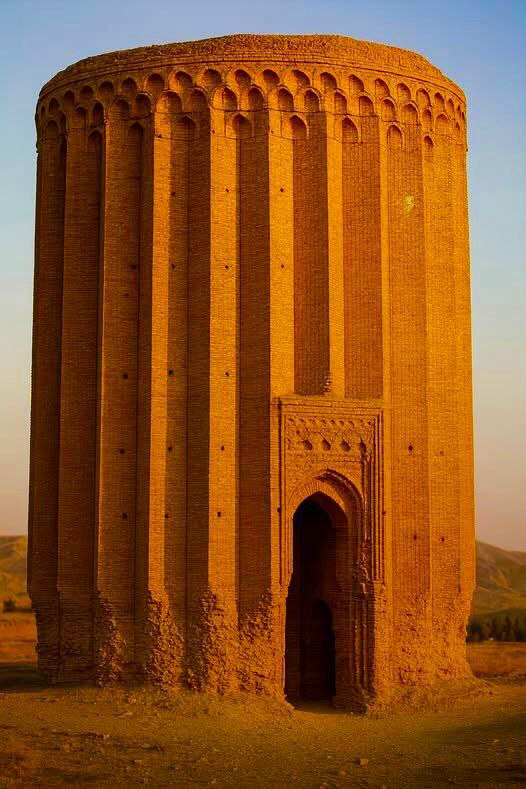
Travel back in time to Ray, Iran, where a 1,000-year-old wonder still stands proudly: the Tower of Togrol. Since 1063 AD, this brick sentinel has risen 20 meters above the desert plain, combining ingenious engineering with a captivating legend.
Some historians believe it houses the tomb of Togrol Beg, the powerful founder of the Seljuk dynasty. Others claim it served as a beacon for Silk Road caravans, its silhouette cutting through the fog and guiding travelers under the moonlit sky.
The true wonder, however, lies in its form: a smooth inner cylinder 11 meters in diameter, surrounded by a 24-sided outer ring 16 meters in diameter. This daring geometry not only reinforces the tower's stability during earthquakes but also transforms the monument into a gigantic sundial—the shadow of each spire marks the hour of the day.
Almost a thousand years later, the Tower of Togrol still marks the time after sunrise – a testament to the old masters who combined astronomy, spirituality and architectural courage under one roof of brick and sarud.