What if manufacturing life-saving medicines were as simple as farming eggs? What if farms that have long provided products to feed billions could provide products to heal billions?
Listen to Neion Bio's vision @messaginglab
https://t.co/V00EAveGi1
Every job i’ve gotten in tech has been through X and I’ve always wanted a way to track/refer my network on here.
Excited about @cosign and what @david__booth@eriktorenberg and co are building.
Check out the companies I think you should join: https://t.co/vH8m6MsZeE
One of the best bubble indicators from @pmarca -- where Harvard and Stanford MBAs go after graduation.
If they go into tech → market’s overblown.
If they go back to banking → great time to invest in startups.
Social status of MBAs is a good bubble indicator. Cool trivia!
I grew up in a small mining town in the Copperbelt in Zambia. I remember being taught about HIV in first grade and the ads on every billboard about using condoms.
This is a huge deal for drug accessibility. It’s true that the future is here it’s just not evenly distributed. Often science and engineering isn’t the barrier its policy and regulation.
I’m excited about the next decade in biopharma. We’ll find more drug targets and we’ll get better at binding them and reducing off-target effects. The major bottlenecks are not in finding promising candidates.
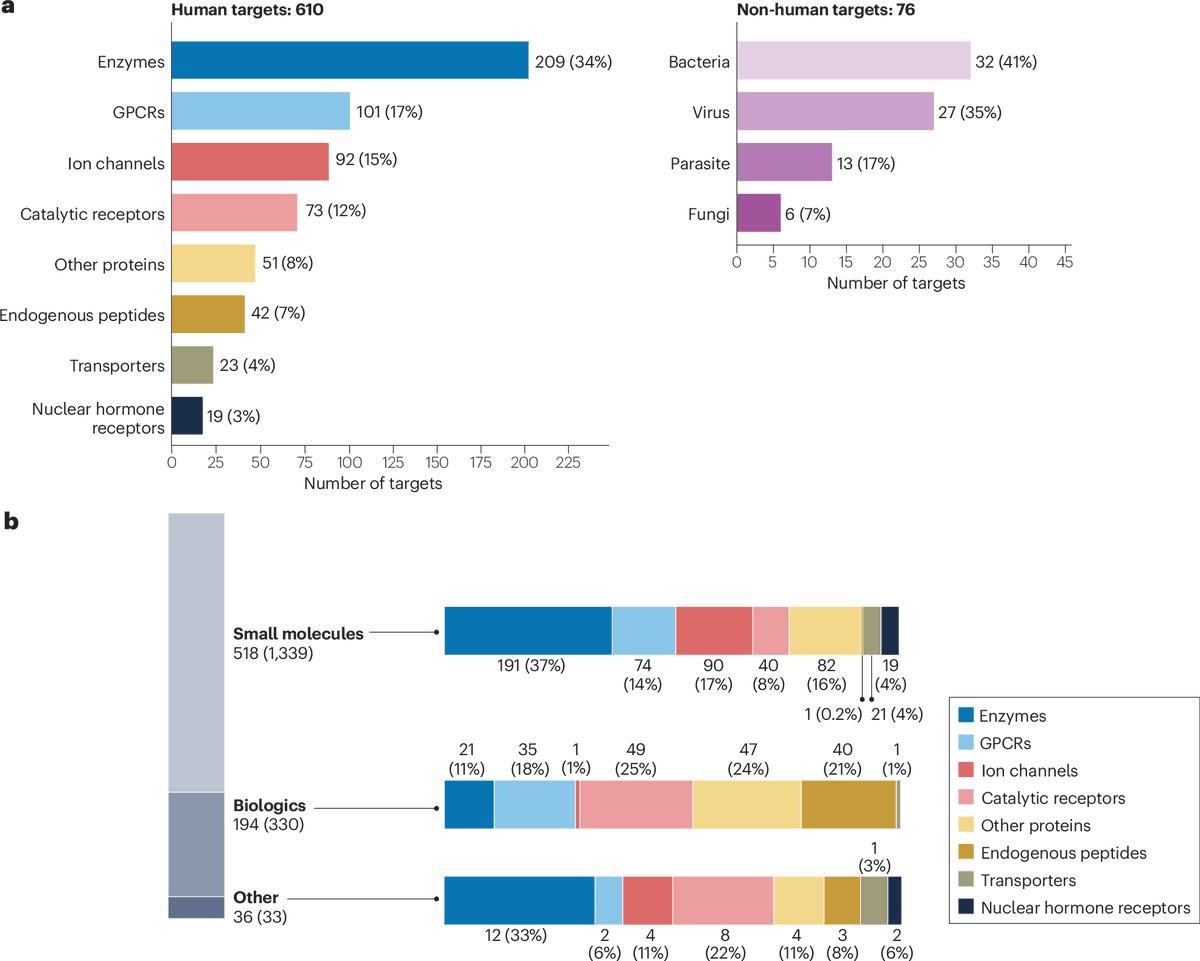
The evolving landscape of drug targets
https://t.co/5OMoUEClEZ
https://t.co/fTzpQTwnje
In the past 25 years, advances in areas such as genomics and the diversification of therapeutic modalities have expanded the drug target landscape, which now includes ~700 targets mapped here
New York City is rolling out public toilets that only give you 10 minutes to finish
An announcer warns if time is running out before the door slides open, potentially exposing users to the public
New York City is rolling out public toilets that only give you 10 minutes to finish
An announcer warns if time is running out before the door slides open, potentially exposing users to the public
Cool list. I know startups working on 2 and 6 with great teams. 7 seems oddly out of place compared to the rest.
Other ones that didn’t make the list that would be good to see: predict a precise cellular response to an arbitrary input, predict development from a genome, create a synthetic cell that can propagate, predict all on and off target effects of proteins in an organism.
Worth a read!
“>one day assistant asks obvious question
>"how do you know your intervention actually improves the far future?"
>silence
>open spreadsheet
>increase column width
>add confidence interval
>assistant asks again
>"no, I mean how do you know the sign is positive?"
>stare into cosmic light cone”
>be me
>discover effective altruism
>apparently normal charity is inefficient
>why donate to random sad thing when spreadsheet can tell you optimal sad thing
>fair enough
>buy mosquito nets
>save lives
>numbers look good
>feel powerful
>couple years later
>someone asks an innocent question
>why only count people alive today
>huh
>future people matter too
>obviously
>my grandchildren shouldn't matter less just because they haven't spawned yet
>reasonable.jpg
>keep following logic
>what about their grandchildren
>also yes
>what about people in 500 years
>sure
>5000 years
>why not
>500 million years
>starting to get weird but morality is morality
>open calculator
>humanity could survive for an astronomically long time
>could colonize galaxy
>could have trillions upon trillions of descendants
>maybe digital people too
>maybe simulated civilizations
>maybe dyson spheres full of happy uploaded minds
>calculator starts smoking
>realize currently living humans are rounding error
>8 billion people suddenly looking extremely beta
>future contains potentially 10^something people
>can't even fit beneficiaries in google sheets
>new moral priority unlocked
>protect the long-term future
>stop thinking in units of "people helped"
>start thinking in "fraction of cosmic endowment preserved"
>malaria?
>terrible
>but only kills existing humans
>AI extinction could delete the entire light cone
>nuclear war could permanently derail civilization
>bad institutions could lock in terrible values for ten million years
>someone invents wrong constitution in 2140
>quadrillions suffer
>better fund governance workshop now
>friend says maybe we should improve hospitals
>explain opportunity cost
>friend says hospitals are full of actual sick people
>explain scope sensitivity
>friend stops inviting me to dinner
>need to decide what to fund
>easy
>expected value
>suppose project has one in a million chance of preventing extinction
>sounds tiny
>but extinction destroys 10^50 future lives
>multiply
>mother of god
>$10 million project has expected value of several galaxies
>charity evaluation complete
>someone asks where the one-in-a-million number came from
>expert judgement
>which expert
>us
>how calibrated
>extremely thoughtfully
>reduce estimate to one in ten million to be conservative
>still beats curing cancer by 38 orders of magnitude
>epistemic robustness achieved
>someone says maybe project doesn't work
>assign 20% chance
>still astronomical
>maybe project makes problem worse
>assign 5% chance
>still astronomical
>why 5
>because 30 felt pessimistic
>publish 46-page report
>contains seventeen sensitivity analyses
>every sensitivity analysis begins after assuming intervention has positive sign
>critic says you're multiplying enormous hypothetical stakes by extremely uncertain probabilities
>yes
>that's literally why it's important
>critic says the uncertainty might be structural rather than numerical
>make probability smaller
>critic says no, I mean maybe your model is wrong
>make probability smaller again
>critic begins rubbing temples
>discover AI safety
>perfect longtermist cause
>AI might kill everyone
>or create utopia
>or seize galaxy
>or tile universe with paperclips
>or create billions of conscious software minds
>finally a problem with numbers big enough for me
>start AI safety nonprofit
>mission: prevent dangerous AI
>hire smartest people available
>smartest people immediately start building better AI to understand dangerous AI
>interesting
>we must understand capabilities to understand safety
>we must scale models to study alignment
>we must race ahead so less responsible actors don't get there first
>we must deploy systems to learn how deployment can go wrong
>we must build the thing quickly because building the thing quickly is dangerous
>outsider asks why the people most worried about AI apocalypse all work at AI companies
>complicated field
>company releases stronger model
>very concerned
>company begins training even stronger model
>extremely concerned
>company raises $14 billion
>concern reaches unprecedented levels
>need to influence government
>future is at stake
>normal democratic process too slow
>politicians don't understand exponential curves
>public doesn't understand x-risk
>experts must guide them
>who counts as expert
>people who understand x-risk
>who understands x-risk
>our friends
>someone objects that this seems politically convenient
>explain we're representing future generations
>future generations unavailable for comment
>develop concept of value lock-in
>terrifying possibility that one ideology controls civilization forever
>therefore extremely important that civilization adopts correct values before lock-in
>whose values
>let's circle back
>begin with impartial morality
>end with small group of people deciding what quadrillions of hypothetical beings would want
>beautiful arc
>meanwhile actual humans keep doing annoying things
>voting wrong
>having parochial attachments
>loving family more than strangers
>caring about local community
>getting upset when told their suffering is cosmically negligible
>evolutionary biases everywhere
>explain that moral intuition cannot be trusted
>except intuition that future digital people count
>and intuition that extinction is uniquely bad
>and intuition that our probability estimates are sane
>and intuition that our institutional choices improve the future
>those intuitions survived peer review
>someone donates $5k to local homeless shelter
>inefficient
>could have funded 0.0000000000003% of an AI governance researcher
>think of all the simulated people you just killed
>okay maybe don't phrase it that way publicly
>PR team says "future generations deserve a voice"
>much better
>journalist asks what longtermism means
>say "future people matter"
>everyone agrees
>great
>journalist asks what follows from that
>well technically we should redirect enormous resources toward low-probability interventions affecting astronomical futures
>journalist raises eyebrow
>return to "future people matter"
>motte has entered the chat
>critic: of course future people matter
>me: glad we agree
>critic: I don't agree that your institute knows how to help them
>me: why do you hate our grandchildren
>eventually notice uncomfortable implication
>if future value dominates everything
>then helping people today mostly matters through effects on future
>education matters because future institutions
>health matters because future productivity
>democracy matters because future trajectory
>human beings slowly become instrumental variables in their own moral philosophy
>see starving child
>feel compassion
>check spreadsheet
>child's direct welfare contribution negligible
>but perhaps childhood nutrition improves national institutional quality
>compassion restored
>tell myself this is impartial altruism
>one day assistant asks obvious question
>"how do you know your intervention actually improves the far future?"
>silence
>open spreadsheet
>increase column width
>add confidence interval
>assistant asks again
>"no, I mean how do you know the sign is positive?"
>stare into cosmic light cone
>10^50 people staring back
>none of them exist
>none of them can tell me
>none of them can falsify my assumptions
>realize I have invented the perfect constituency
>infinitely important
>completely silent
>and always represented by me
The impending situation in biosimilars is not getting the attention it deserves.
There has been a ton of focus from the federal government (with good reason) on small molecule generics that mostly come from India and China. Biologics (and biosimilars by extension) manufacturing is structurally different.
These facilities cost billions and take many years to build. We don’t have anywhere near the required capacity for biosimilars in the US and hardly any are manufactured here today. To address this issue with traditional manufacturing technologies we would need to start building this infrastructure yesterday. But let’s say by some miracle we did that, the costs would be 2-3x those in China. That isn’t acceptable. We need technologies that enable domestic manufacturing while simultaneously reducing costs (disclaimer: that’s what we do at Neion Bio).
We’ve seen what happens when we hand over the manufacturing of critical materials to other countries. There is nothing more critical to life, liberty and the pursuit of happiness than human health.
A new industry report shows 90% of major brand-name biologic drugs losing exclusivity over the next decade have no low-cost competitors in development. https://t.co/PLvsuNSsBf
It is obviously cool that we are starting to apply AI to interesting math problems but I’m kinda nostalgic for the days of pen and paper. In undergrad we had to sit and prove the closure problem (you average NS and create more unknowns than equations making it not solvable other than with approximations). I remember being so happy that I snapped a photo of it.
We’re sharing a solution to the Navier-Stokes Millennium Prize Problem, one of the deepest problems at the frontier of mathematics.
The proof was produced by a group of agents, using an OpenAI next-generation model significantly more capable than GPT-6 Astra.
The problem concerns whether the description of smooth three-dimensional fluid motion modeled by the Navier-Stokes equations can break down. It has remained unresolved for roughly 90 years.
@brad_rothenberg One of my favorite planes. Some parts were designed to be loose fitting because they would heat up and expand so much during flight. It had to take off light because it would leak fuel on the ground so every mission started with a mid air refuel.
You cannot become a “hard tech” company without becoming a manufacturing company. You cannot become a great manufacturing co without becoming exceptional at physical operations. Technology alone is not enough to win in the space. If your investor does not understand what this really means be wary. 🚩🚩🚩
Here's a glimpse behind the curtain at Neion Bio.
In biotech, we often take manufacturing for granted but it is fundamental to innovation. "Those serious about software should make their own hardware." The same is true in biology.
The manufacturing of life-saving biopharma medicines has been stagnant for decades. Legacy technologies that rely on a single type of cell reached diminishing returns in the late 2000s. In order to squeeze out more we relocated these factories in areas with lower costs ex-US.
Spending billions to rebuild this infrastructure domestically using largely the same legacy technologies is fighting a losing battle. Sure there may be an incremental improvement here and there but these facilities will be uncompetitive as soon as they go live (if they ever go live).
We now have the ability to efficiently and accurately reprogram complex biological systems, so why are we restricting ourselves to the small sliver of biology that happened to work 50 years ago?
Thanks @teleodaniel and @EricDai_BioE for helping tell our story.
Producing the 3 to 5 grams of a biologic needed for IND-enabling studies costs millions of dollars using traditional CHO manufacturing.
A single egg, meanwhile, contains 6 grams of protein, costs just 10 cents, and requires only chicken feed and water as inputs.
Neion Bio is taking advantage of this incredible technology to turn chickens into drug factories. And they’ve already signed a commercial deal with a drugmaker to produce biosimilars.
With AI leaders promising to unleash countless new therapies, we’re going to need to scale up our manufacturing. That sci-fi future may be one where we stop producing drugs in huge steel tanks, and instead start farming them like we do our food.
We sat down with co-founders Dimi Kellari and Sam Levin to discuss this future. [Disclosure: I’m an investor, though I wasn’t at the time of recording.]
Watch the full episode below, or look up Free Radicals (@FreeRadicalsBio) on your favorite podcasting platform.
Thank you to @SynBioBeta for hosting us!
0:00 Intro
1:07 What Neion Bio does
4:53 How the founders arrived at synthetic biology and chickens
10:21 Biosimilars as Neion’s first commercial market
13:30 Why farming drugs is a viable path to reshoring biomanufacturing
18:38 Neion’s technical moat & why engineering birds is difficult
25:50 Advantages of chicken-based manufacturing
30:06 Why CHO manufacturing became the industry standard
33:21 What it takes to disrupt CHO manufacturing
37:57 What it means to program biology
42:48 Skepticism around this new manufacturing approach
47:00 Applying tech principles to biotech
55:34 Natural intelligence vs artificial intelligence
57:14 The future of farming drugs & programmable chickens