Pep Guardiola makes it clear: mistakes are part of improvement.
You can dribble ten times and lose the ball ten times — and still improve from it.
But if you don’t try? There’s nothing to improve.
Not trying is the real mistake.
Fear stops growth.
Action creates learning.
Progress comes from courage, not perfection.
That’s how teams get better — step by step, stage by stage.
Really nice football-specific conditioning drill from Juventus training.
Run 36.5m to bounce-pass (6secs)
Run 58m to finish cutback (10secs)
Run 67m box to box recovery (12secs)
Approximately 161m of HSR metres in one rep.
#Chelsea build up example vs #Flamengo in the #ClubWorldCup
- Exploit the 2v1 against the CDM
- Pin to free the 10
- Blindside movement to exploit the space
Made with @LiveTagPro
• Player with ball starts with pass to one side of square
• Receiving player touch and pass across square to opposite player
• Receiving player takes forward touch and shoots
• Players follow pass to rotate positions
Today's session is a pass and shot pattern... ⚽️👨💻
Full Session Post
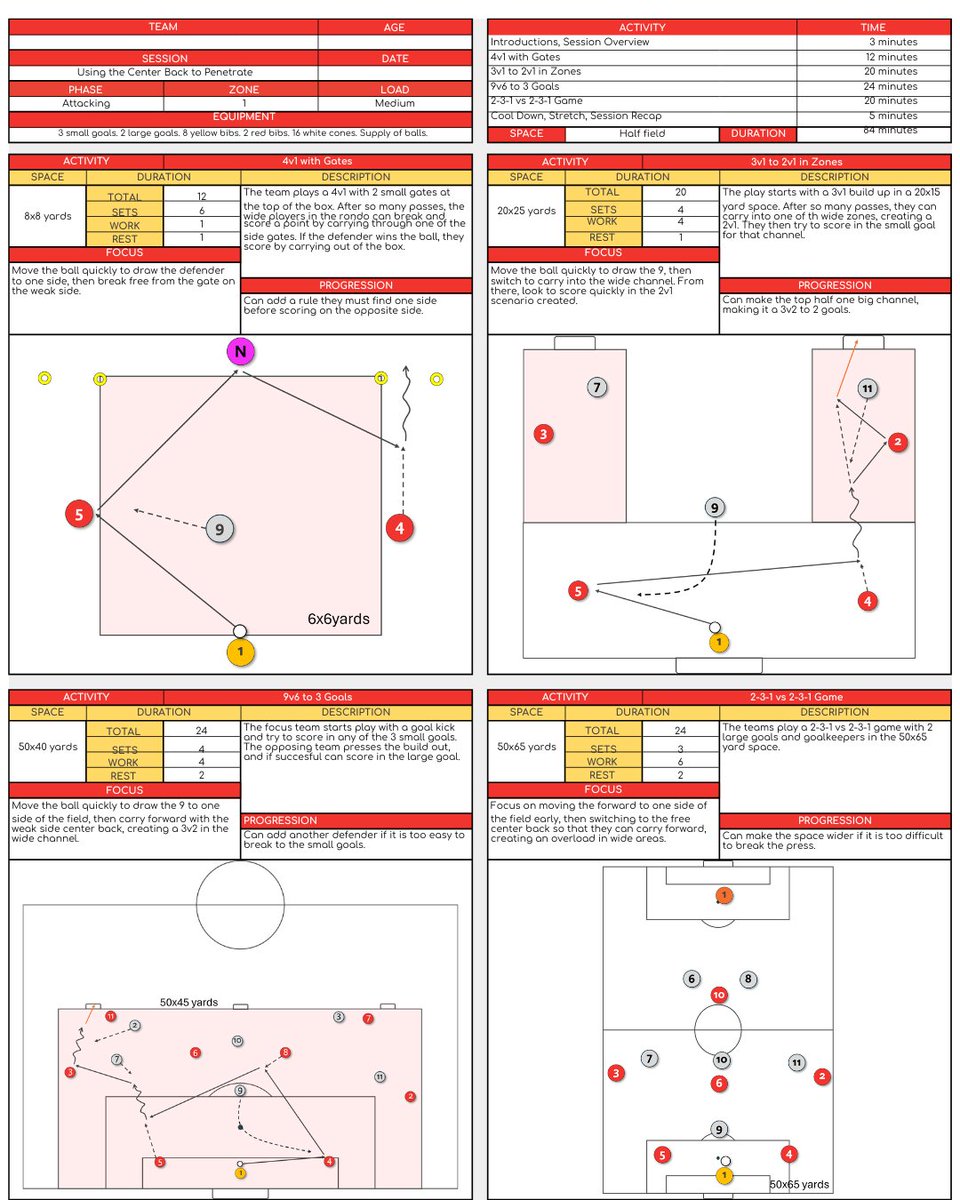
Here’s the full session layout 📋 on “Carrying with CB’s to Penetrate.”
A full progression that starts with simple cues and ends in a position-specific 2-3-1 game.
Each activity is broken down below 🧵⬇️
#CoachesWeeklyBreakdown
(https://t.co/2TSdmO4iTm)
He dared. He dreamed. He did. 🤍🇦🇺
He did what the likes of Antonio Conte, Jose Mourinho and Mauricio Pochettino couldn’t. He made fans’ dreams come true. It shouldn’t be ending like this.
Thank you.
The great Frank Lampard talking with the great Rodri about scanning. Mr Lampard calls it picturing, borrowing from his father’s term for it.
“Pictures, pictures, pictures” Frank Lampard Snr used to shout from the sidelines as he watched his son progress at the West Ham Academy.
Why?
Because all team invasion sports are the same. At the heart of these games lie the skills of anticipation and decision-making. Players who scan their performance environment give themselves the opportunity to:
1. See opportunities to exploit them
2. See dangers to deal with them
3. See patterns to understand the game around them
So, of course, it’s critical to instruct a player to scan. And, of course, creating activities in sessions that encourage scanning is crucial.
But here’s the thing. Perhaps the most powerful way to promote scanning behaviour is to help players understand why ‘picture taking’ is important. So often, establishing the meaning underpinning behaviour can change behaviour.
Useful can be to encourage players to understand that your team invasion sport is about actions and interactions. They constantly have to interact with their playing environment - teammates, opposition, space, ball, and target. Help them understand they are detectives of what’s happening around them. A Sherlock Holmes of the interacting elements emerging and dissolving, shifting and shaping around them.
By moulding their interest in their performance environment, you help your players mentally in two ways. It places their focus of attention outwards - they get out of their head into the game - an external focus of attention. Importantly, it also increases their activation levels (alertness and readiness) due to a rise in their fascination with what’s going on around them (a dopaminergic link here, perhaps).
Scanning, scanning, scanning
Pictures, pictures, pictures
…these are important instructions…but even more powerful could be to help players understand why they need to get their head up and start exploring the game around them.