🎉 Milestone! First Indian NCE from discovery to US FDA approval, fully in-house (no shelving/out-licensing). Salute to Dr. Habil Khorakiwala & @WockhardtLtd on #Zaynich! Proud turning point for Indian pharma innovation. 🇮🇳
https://t.co/T8PgSfgXpg
FDA has approved Zaynich for adults with complicated urinary tract infections (cUTIs) caused by designated susceptible microorganisms. https://t.co/VnIsXvAZhd
🧠 AI won’t take your job.
It’s coming for your mind.
@Sanjay__Bakshi dropped a sharp reminder: highlighted from the latest Baillie Gifford piece.
Used with intention, AI turns one person into a team.
Here’s what actually matters:
→ AI multiplies what one person can deliver
→ The real skill is asking better questions
→ Quality of your prompt = quality of the output
→ Curious minds get an unfair advantage
Stop using AI like a search bar.
Start using it like a thinking partner.
Give it context. Set constraints. Stay in the driver’s seat.
That’s when the real leverage shows up.
The winners won’t be the ones who use AI the most.
They’ll be the ones who still think while using it.
Passive use quietly dulls your edge.
Intentional use compounds it.
Your new role:
Architect of ideas, not just executor of tasks.
AI handles the heavy lifting.
You decide the direction, add judgment, and bring the human edge it can’t replicate.
Master intentional AI use and you don’t just work faster — you think bigger.
In 1942, the Japanese rounded up all Chinese men in Singapore.
They were filtering out the healthy young ones to execute.
Lee Kuan Yew was 18. A guard pointed at him and said: "Go to that lorry."
He knew what that meant. The lorry went to the beaches. The beaches meant machine guns.
He asked: "Can I collect my other things?"
They said yes.
He walked away, found his family's gardener, and hid in his quarters for two days.
When they changed the screening inspectors, he tried again. This time, he got through.
The ones sent to that lorry were taken to the beaches and shot. Somewhere between 50,000 and 100,000 didn't survive.
60 years later, he sat down at Harvard to explain how he built Singapore from a tiny island into one of the wealthiest nations on Earth:
On what the war did to him:
"We lived in happy, placid colonial Singapore in the 1920s and 30s. The British Empire would have lasted another thousand years, so we thought."
Then the Japanese came. In less than one and a half months, the British collapsed.
"Three and a half years of hell. Butchery. Brutality. Many didn't survive. I was fortunate. I did."
"But it changed us."
"What right did they have to do this to us? Why did the British let us down so badly?"
When the war ended, Lee went to Cambridge to study law. But he was watching with different eyes.
"Can they govern me better than I can govern myself? Because they scooted when the Japanese came in. And why shouldn't I be running the place?"
On learning languages to lead:
Lee was the best speaker in English. But only 20% of Singapore spoke English.
The masses spoke Hokkien, Mandarin, and Malay.
"So every day at lunchtime, instead of having lunch, I would sit down with a Hokkien teacher and laboriously and painfully learn to convert my Mandarin into Hokkien."
"Had I not mastered that, the battle would be lost by default."
His first speech in Hokkien, the kids laughed at him.
"I said, please don't laugh. Help me. I'm trying to get you to understanding."
By 6 months, he could get his ideas across. By 2 years, he was fluent.
"Believe it or not, at the end of two years I could speak better than most of them."
"That came respect."
It showed two things: how determined he was, and how sincere. Here was a man doing all these other things and still learning their language just to talk to them.
On fighting the Communists:
The Communists had been organizing since 1923. The year Lee was born.
"Here we were in the 1950s trying to beat them. And they are professionals at organization."
They had elimination squads. Guerrillas in the jungle. Killer squads in the towns.
Lee stood up and said no.
"They denied that they were Communists. 'We're just left-wing socialists.' So I did a series of 12 broadcasts to set the scene. And I made it in three languages."
English. Malay. Mandarin. 20 minutes each.
"When I finished each broadcast, the director of the station couldn't see me. Went into the room and found me lying on the floor trying to recover my breath."
"But it was a fight for survival. Life or death."
On where trust comes from:
"It's difficult to establish trust in times of calm. You just say, 'Well, it's an argument, therefore I'm a better guy than you.'"
"But when the chips are down and you can get eliminated in a very unpleasant way and you show that you're prepared for it and you'll fight for them, it makes a difference."
"Without that trust, we could not have built Singapore."
On IQ vs EQ:
Harvard asked him: would you prefer high IQ or high EQ in a leader?
"IQ, you can get beautiful paper done. Complex formulas worked out. Elegant solutions."
"But when you've got to get a team to work and put that formula into practice, you're dealing with human beings."
"If you're not good at EQ, you can't sense that A doesn't get on with B, and you put them in the same team. It's no good."
He rated his own EQ as 7 or 8 out of 10. His IQ as "maybe 120."
But he had colleagues who could sense a person instantly.
"He shook hands with the man and said, 'I recoiled when I felt his palm. Evil man.' And he was. How does he know? I don't know."
"So I learned whenever I had to do interviews to choose people, I would get people who are very good at seeing through a candidate."
On corruption:
Singapore in the 1950s was full of deals, bribes, and organized crime.
"When we took over, we decided that this was the critical factor. If we did not make it so that every dollar put in at the top reaches the ground as one dollar, we're not going to succeed."
"We came in and made a symbolic act. We dressed in white shirts, white trousers, and said we will be what we represent."
He put the anti-corruption bureau under his personal portfolio.
"I gave the director the authority to investigate everybody and everything. All ministers. Including myself."
One of his own colleagues took half a million in bribes. When the investigation started, he asked to see Lee.
"I said, if I see you then I'll be a witness in court. So best not see me. Better see your lawyer."
The man committed suicide. Left a note saying: "As an oriental gentleman who believes in honor, I have to pay the supreme price."
"It's a heavy price. But it reminds every minister that there are no exceptions."
On consistency:
Lee had three journalists analyze 40 years of his speeches.
He asked them: what was the dominant theme?
All three said the same thing: consistency.
"What I said at the beginning, throughout all that period, the theme stayed loud and clear."
"That made it simple. Because you know where you stand with me. And you know what I want to do."
On delivering results:
"We deliver the homes, the schools, the jobs, the hospitals."
"Today, 98% of our people own their own homes. The smallest would be about $100,000 US. The biggest about $300,000."
"Once you own that amount of assets, you are not in favor of risking it with a crazy government. Your assets will go down in value."
"But that was planned."
Why? Because Singapore is small. Everyone does national service. If you're going to fight, you better be fighting for something you own.
"So we give everybody a stake."
On changing culture slowly:
Lee wanted Singapore to speak English. But he couldn't force it.
"Had I passed a law and said you will all learn English, we would have had mayhem. Riots."
Instead, he let parents watch who got the best jobs. The jobs were already there, from the multinationals and banks. They all used English.
"They watched and saw who got the best jobs. And they switched."
It took 16 years.
"I did not want to have said 16 years. Because in those 16 years I lost 20,000 Chinese graduates who had poor jobs. I wanted to make it shorter. I couldn't. I would have run into flack."
On whether leadership can be taught:
Lee quoted Isaac Singer, the Nobel Prize winner for Yiddish literature.
Someone asked Singer: "Can you make a writer write great literature?"
He paused. Then said: "If he has the writer in him, I will make him a good writer in a shorter time."
Lee's version:
"Can you make a leader of anybody? I don't think so."
"He must have some of the ingredients. He must have that high energy level. He must have the ability to project himself, his ideas. He must have the desire, almost instinctively, to say 'let's do something better.' Of wanting to do something for his fellow men and not just for himself and his family."
"You can't teach those things. He's either got it or he hasn't got it."
"But if he's got that, then you can save him a lot of trouble."
On sustaining yourself:
Harvard asked how he managed despair over decades of leadership.
"If your message is one of despair, then you should not be a leader. You must give people hope."
"But there are moments when you feel very down. Either because you're physically down, or emotionally down, or because the world has turned adverse against you."
"When you are in that condition, the first thing you do is get a good night's sleep. Then get a swim or chase a ball. Get the cobwebs out of your mind."
"If you're not fit, you're going to make mistakes. Physically fit. You must stay physically and mentally fit."
In his later years, he learned to meditate.
"At the end of 20 minutes to half an hour, my pulse rate can go down from 100 to about 60. You can feel yourself subside. You still your mind. You empty your mind."
"Then when you are rested, you resume quietly. You still got the same problems. Maybe you sleep on it. Come back. Look at it for a few days. Then decide."
This 2 hour Harvard interview will teach you more about leadership than every business book you've read combined.
Bookmark & give it 2 hours this weekend, no matter what.
What excites you most about this AI-biology convergence?
• Faster cures for cancer and Alzheimer’s?
• Dramatically cheaper drugs?
• Or the chance to reprogram biology itself?
Drop your thoughts (and any names you think fit the “quiet infrastructure” profile) below 👇
If you’re into frontier tech, biotech, or long-term compounding, follow for more deep dives like this.
RT if this thread shifted how you see the next wave of medical innovation. Let’s discuss!
#AlphaFold #AI #Biotech #DrugDiscovery #Medicine #NobelPrize
The AI Revolution: From Cracking Biology’s Toughest Puzzle to Rewriting Medicine
In 2024, the Nobel Prize in Chemistry went to Demis Hassabis and John Jumper for AlphaFold—the AI that finally solved the 50-year-old “protein folding” problem.
A challenge so vast it was known as Levinthal’s Paradox: one protein could fold into more shapes than there are atoms in the universe.
Yet AlphaFold predicts its exact 3D structure from a simple sequence… in minutes.
Mind officially blown? 🤯
Watch closely for players mastering the fusion of:
• Precision scientific instrumentation
• Real-time AI analytics at the hardware level
• End-to-end clinical execution platforms
The winners will control the bridge between biological truth and computational power—turning AlphaFold-style insights into therapies at unprecedented speed.
The 10–15 year drug timeline is dying. A new era of accelerated, smarter medicine is arriving faster than most expect.
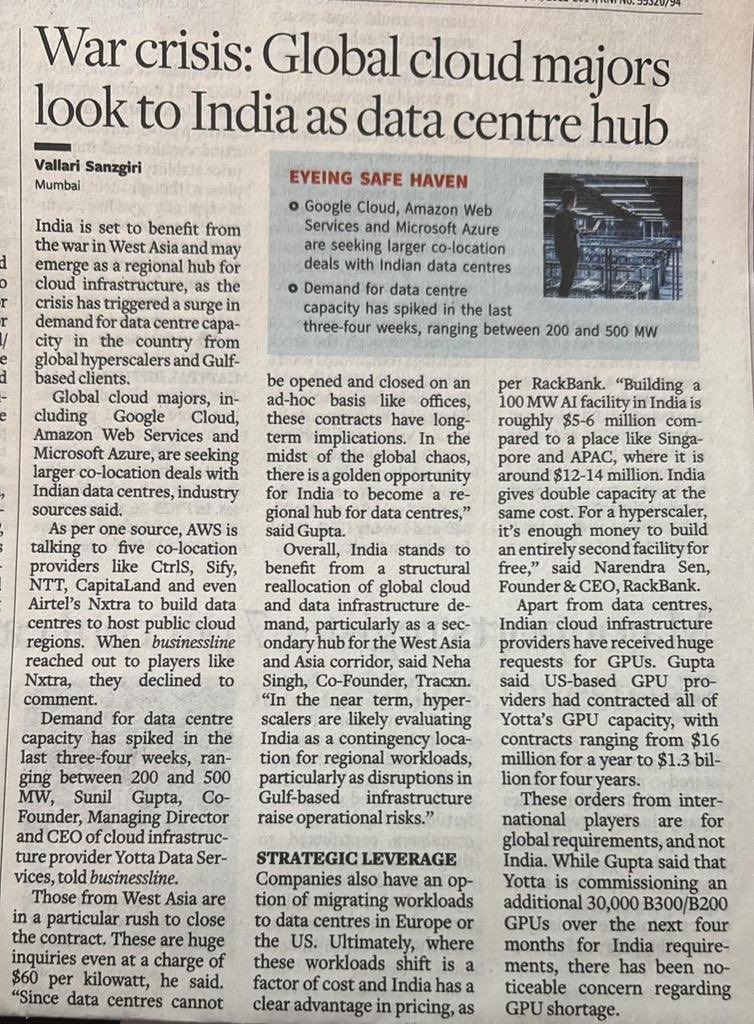
🔥 West Asia war = India’s Data Centre jackpot!
Global cloud giants @googlecloud@AWSCloudIndia@Azure are chasing HUGE co-location deals with Indian players.
Demand just exploded 200–500 MW in 3–4 weeks. India gives double the capacity at half Singapore’s cost.
Here’s the complete 7-Layer Data Centre Ecosystem Map (60+ companies) powering this boom 👇
Game-changing multi-year opportunity! 🇮🇳☁️
Bullish on India’s AI infra story? Drop your thoughts 👇
#DataCenters #AI #DigitalIndia #CloudBoom #MakeInIndia
🚨 US-Israel-Iran War – Day 37 Update (Apr 6, 2026)
Conflict still fully active.
No ceasefire. No regime collapse.
Strait of Hormuz remains CLOSED.
My Monte Carlo model (50,000 sims) just recalibrated.
Median end date: May 28
Full breakdown + new probabilities 👇
What’s YOUR prediction for when this ends? Drop it below 👇
Strait of Hormuz = Deciding Factor ⚠️
• Closed by IRGC since March 2
• US aerial campaign running (A-10s, Apaches, bunker busters)
• Israel assassinated IRGC naval commander Alireza Tangsiri on March 26
• Iran still in control and charging fees on China/India tankers
Trump’s new ultimatum: “Tuesday will be Power Plant Day and Bridge Day” if it doesn’t reopen.
Everyone’s screaming about headlines.
The MARKET is debating something far bigger:
Are we finally leaving the era of passive-led mega-cap dominance…
…and entering the age of energy security, defense spending, industrial capex, and real-asset scarcity?
The Strait of Hormuz may decide it all.
• US reinforces control → Mega-caps stay king
• US quits the war→ Hard pivot to gold, commodities, India, LatAm & rest of world
Watch these 3: 🛢️ Oil
🪙 Gold
📈 Long-end US yields
My takeaway:
Don’t overpay for perfection.
Own the scarce stuff.
Own the bottlenecks.
Prepare for broader market leadership.
Thoughts? @RaoulGMI@LynAldenContact@zerohedge@JavierBlas
Where are you positioning? 👇
A tech consultant with zero medical training used AI tools, cheap sequencing, and mRNA manufacturing infrastructure to build a custom cancer vaccine for his dog.
Result: the tumor reportedly shrank by 75%.
That is not just a wild story.
It is a signal.
The biggest shift in medicine may not be AI alone.
It may be the rise of the orchestrator:
someone who can combine models, biology, data, and execution faster than old systems can react.
The tools are getting faster.
The science is getting cheaper.
Manufacturing is no longer the bottleneck.
Regulation and institutions are.
We are moving from medicine as a centralized monopoly of expertise
to medicine as a stack that can be assembled.
That changes everything.
#AI #Healthcare #Biotech #Medicine #mRNA #PrecisionMedicine #Innovation
Timeless Wisdom from Benjamin Graham: Mental shield against FOMO
1/ In today’s meme-stock frenzy and algo-trading chaos, investing feels like gambling. But Benjamin Graham’s 1949 classic, “The Intelligent Investor,” flips the script: Treat stocks like businesses, not bets. It’s the blueprint Warren Buffett swears by. Let’s dive into its enduring lessons. #ValueInvesting #IntelligentInvestor
2/ Core Thesis: Investing succeeds when it’s “businesslike.” A stock isn’t a ticker—it’s ownership in a real company. Success? Value the business accurately and master your emotions. Graham survived the 1929 crash to teach us: Don’t predict markets; outsmart your own greed and fear.
3/ Investment vs. Speculation: Graham’s line in the sand. Investment = Thorough analysis + Safety of principal + Adequate return. Anything else? Speculation—chasing trends, charts, or hype. Pro tip: If you wouldn’t hold a stock for 5 years with markets closed, don’t hold it for 5 minutes.
4/ Meet Mr. Market: Graham’s genius parable. He’s your manic-depressive partner quoting wild prices daily. High on euphoria? Sell to him. Low on despair? Buy from him. Key: His moods don’t define your business’s value. Use him as a servant, not a boss. Brilliant psychology hack!
5/ Margin of Safety: The book’s holy grail. Buy assets way below intrinsic value—like engineering a bridge stronger than needed. If a stock’s worth $100, snag it at $70. Protects against errors, downturns, or surprises. Hunt “net-net” bargains: Companies cheaper than their cash + assets minus debt.
6/ Defensive vs. Enterprising Investors: Not everyone’s a stock picker. Defensive? Low-effort: Bonds, blue-chips, or index funds for average returns without wipeouts. Enterprising? Dig for undervalued gems, like A&P in the 1930s—sold below cash value due to temporary panic. Know your lane!
7/ Psychology Wins: Your biggest enemy? Yourself. Brilliance fails without discipline. Graham’s rules: Know your business, supervise managers, ensure profit potential via math, and act boldly on sound judgment. Ditch complex models—stick to simple, businesslike decisions.
8/ Final Wisdom: Success is character > IQ. Build wealth by buying value at discounts, ignoring crowd noise. Mirror test: Am I analyzing value or reacting to Mr. Market? Master yourself, and the market becomes your tool for security. Graham’s legacy? Timeless in our volatile era.
9/ Go grab the book—it’s a mental shield against FOMO. What’s your top takeaway from Graham? Drop it below. #Investing #FinanceTips #WarrenBuffett