My article "Can #Deliberation Bring #AI to the Masses?" came out in this beautiful volume by Ruth Chang and @amiasrinivasan, paired with an essay by Philip Pettit: https://t.co/THg2L0RFPd The same version is available for free here as well: https://t.co/dcysHgFfSg
Is democracy too demanding? We chat with @DissentientOne about his book, approaching democratic reform from the perspective many people do not have the time to devote to politics https://t.co/P0d3KESnS5
🏛️ Episode 42 | Rules of the Game 📜
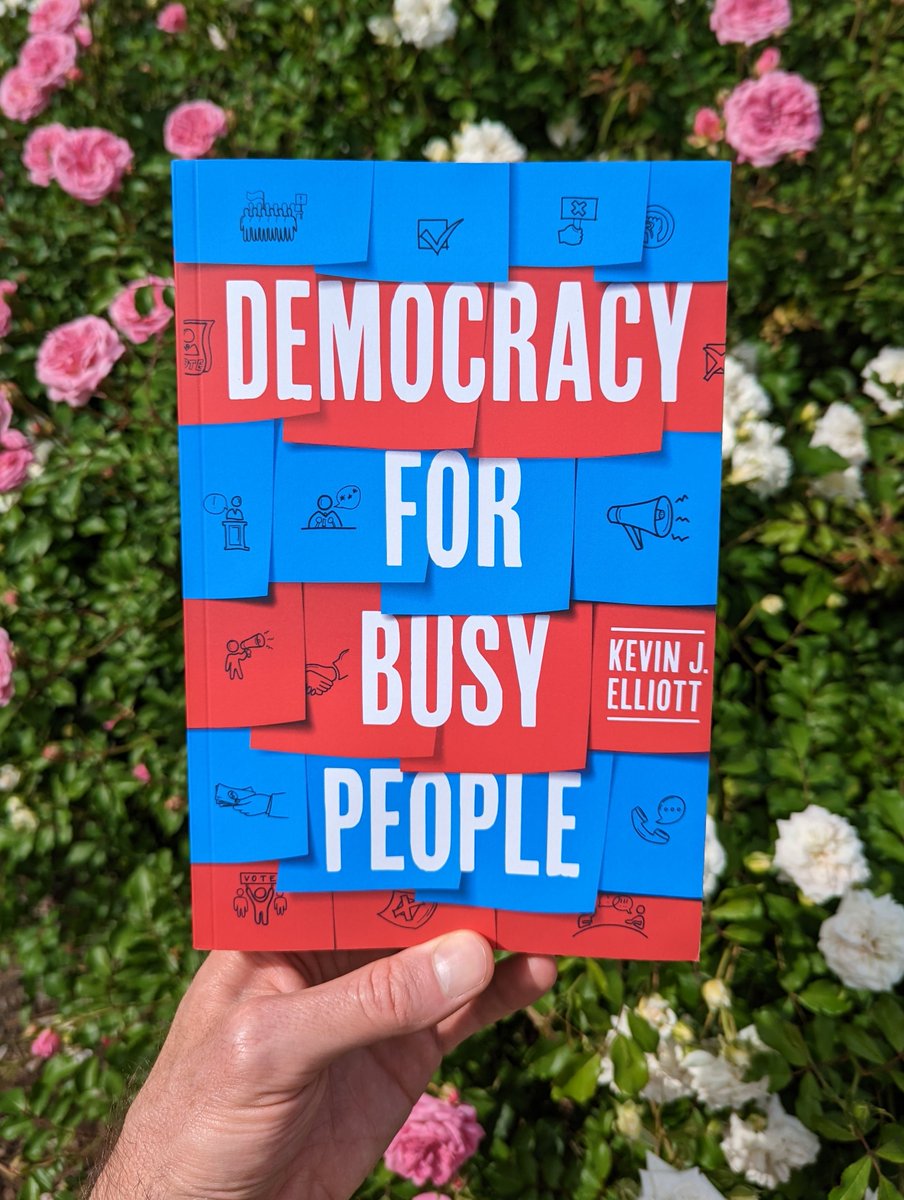
With Kevin Elliott @DissentientOne, I discuss his book "Democracy for Busy People".
How can we make democracy work for busy people, while enhancing its democratic nature?
Spotify: https://t.co/6DbuorAvwe
Apple: https://t.co/6nv8vflxef
"'How is it that we hear the loudest yelps for liberty among the drivers of negroes?' This question, asked by English writer Samuel Johnson in 1775, still touches a nerve today." https://t.co/MJut4ziAQn
Prof. Kevin Elliott from Murray State University has recently written a book titled ‘Democracy for Busy People’, that focuses on building institutions that empower people who have little time for politics. See here 📚 https://t.co/hXbc0c4c0T
I argue there are at least two fundamentally different ways citizens experience their relationship to political parties: based on identity & closeness. These understandings are embedded in existing survey measures of partisanship & I argue they matter for how we study & value it.
Partisanship is partly a performance, and we learn how we ought to enact it in part by looking around the social environment. When journalists influenced by political science tell us there are just identity partisans who stand with daggers drawn, that limits our pol imaginations.
I conclude that if we want what's best about partisanship on any of these accounts, we should be attentive to the plurality of partisanships. We should also revise how we study partisanship to better reflect how citizens live it every day, and avoid polarized conflict.
For White & Ypi, the situation is even more stark because their account is ~incompatible with identity partisanship but works well with closeness partisanship. They value partisanship for how it sustains collective projects, but identity isn't about that while closeness may be.