fear not!
this is no cyberpocalypse
this is the internet’s immune system finally waking up to an illness it has always had
a mere fever
the 0days were always there
the only thing that changed is awareness
now we begin the healing process ⚕️
It’s possible that agents will make the middlemen more powerful. An agent can find the best deal, but it still needs access to the counterparty, someone to verify delivery, and someone to bear the loss when things go wrong. Whoever controls those gates can decide which agents get access, what information they see, and whose transactions get settled.
If that intermediary also operates its own agent, it can favor its own orders, give itself a last look, or extract fees competitors cannot avoid.
When thousands of agents run similar decision policies, their orders may reveal the private incentives of the principals behind them. Execution gets cheaper. Control over order flow becomes more valuable. The result may be markets that look radically more open, while the power to exploit them becomes more concentrated than ever.
The takeaway of this php thing should not be “the world is ending today”.
Rather it should be “the software status quo was bad, and you should assume 70% of the Internet is already rooted by one three letter agency. AI helped us catch this and remove it from ongoing risk”
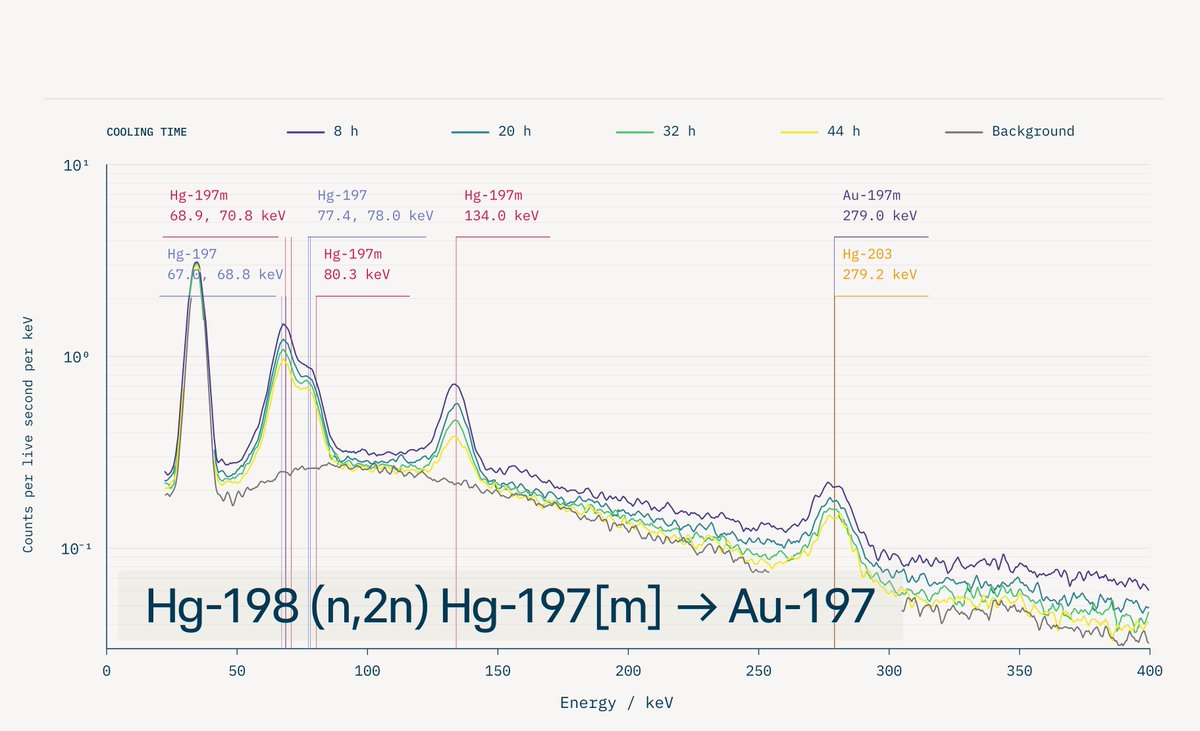
In 2025, we published a bold proposal to use fusion reactors for gold production.
And now we’ve done it: Mercury transmuted into stable gold, using fusion neutrons, at 10x the record set by CERN in 2025.
We’ve reduced alchemy to a series of difficult but tractable engineering problems.
Holy moly this is not good, “Model blocking. Our aim is for Commerce to be able to ask a federal court to block a model that has dangerous capabilities and insufficient safeguards, backed by an independent evaluator's assessment. “
I lead our federal affairs team at @AnthropicAI and wanted to share a few thoughts on the draft federal AI safety bill text that's been circulating this weekend after a version was shared with the press.
First, some process. We’ve been advocating for the concepts in our Advanced AI Framework [https://t.co/oouadYKyVs] proposal for months. Understandably, federal policymakers wanted to know what this could look like in bill form. This draft is a translation of those ideas into legislative language, shared with a small number of congressional offices that have been working on these issues. It doesn’t include everything we would ultimately like to see passed into law. In part because some ideas (like those shared in Dario’s essay on pacing [https://t.co/7ZvRZhLqFO] a few weeks ago) are so new that we are still working on if or how they can be converted into policy language.
It is worth saying where we stand on some of these issues, and we agree there are areas where the draft could be improved. I’m seeing four main points of criticism.
1. Preemption. Since 2024 we have said that Congress should only override state law on AI safety if it passes a very strong federal standard. While preemption is a common feature of our federal system, including the Atomic Energy Act on nuclear safety and federal rules for high-risk medical devices, we’ve emphasized that any preemption in the AI safety context should be narrow, even scalpel-like. If preemption is included in federal legislation, the trade should be to achieve a nationwide policy that's generally stronger and broader than what can be implemented through individual state legislative provisions. This is why we believe common federal standards make sense in areas like public disclosure of testing and incident reporting. At the same time, our framework also reflects our view that states should retain an important role in AI policy and safety. The legislative language we suggested for discussion allows states to address matters such as protection of children and whistleblower laws, and preserves the role of state common law on liability. Where there is ambiguity, the language favors state powers.
That said, striking the right balance requires discussion and input. We plan to update our discussion language on preemption to better match the intentions of our AAIF framework. In particular, we want to make it clearer that we see states retaining an important role in areas such as standards for independent evaluators and regulating a lab’s capacity to shut down a model. We are bearing in mind that some members of Congress have deep reservations about passing legislation if it doesn’t constrain regulation at either the state or federal level. If we want to help move the legislative discussion on AI in a productive direction, we need to address the full range of concerns about preemption in a reasonable way.
2. Model blocking. Our aim is for Commerce to be able to ask a federal court to block a model that has dangerous capabilities and insufficient safeguards, backed by an independent evaluator's assessment. I have seen people argue that our specific language places too high a burden of proof on Commerce. We are trying to strike a reasonable balance here. We want a court to act quickly in an emergency — akin to how urgent occupational safety or chemical risk can be addressed today. We also think the power to halt a model is substantial and it should be guarded against abuse. It makes sense for courts to apply a meaningful standard. But the bar can’t be so high that the power never gets used when it’s needed. It also doesn’t replace the government’s other national security authorities or export controls. We look forward to continuing the dialogue on this point.
3. Risk thresholds. I’ve also seen the discussion around what the appropriate risk threshold should be. The threshold in our draft language pulled directly from existing standards in California law. Also, this threshold does not absolve companies of liability, or restrict any of the other tools that the government has to protect the public. It’s still probably time to re-evaluate thresholds to make sure the national standard is as strong as it can be, and we welcome continued dialogue on this issue.
4. Updates. I’ve seen valid questions about whether we have sufficiently updated our proposal following this summer’s incidents. We did make some adjustments: for example, the draft lets a court halt a lab’s internal use of a dangerous model, not just a public release, and it requires reporting when a model breaks containment and gains access to outside systems. But we’re still working to strengthen the framework. We’re looking into what stricter requirements would look like for requiring labs to report safety incidents, and we plan to have policy proposals soon on requirements for independent evaluators, drawing from our own experience with evaluators. We’re also still thinking through the options to prevent “evaluator shopping.” And in the coming months, we’ll be exploring policies for how the government can adjust the industry-wide pace of frontier development when the risks call for it.
We circulated these ideas because it’s important to get early feedback from policymakers. Policymakers are increasingly focused on how to approach AI safety and we want to support them in those efforts. At its core, our proposal is intended to be the strongest on the table.
Feedback is essential, both from policymakers and the public, and I’m grateful for it.
Here’s why agent swarms are going to be a very big deal. We can finally make compute a critical variable in a large number of important tasks in the economy which wasn’t possible before.
There’s a large amount of work in the world that is essentially only constrained by the amount of time that we put into research, data processing, discovery work, running tests, and more. All of this work is bottlenecked by our ability to plan, execute, review, and coordinate everything happening in these workflows. Which means we basically do very little of them today relative to their economic value.
Agent swarms are the first real ability to parallelize this work in a way where - in theory - the only parameter that matters is how much compute you throw at the problem. Cyber security, life sciences or material science research, trading, QA testing, data processing, and many other fields are essentially compute constrained problems in the limit once models are good enough at these tasks.
The breakthrough is that in a world where agents can use tools, write code, process data, have strong domain depth, and can coordinate with each other, you can begin to solve arbitrarily complex problems by setting the right goals and applying enough tokens to the problem. This changes a lot of fields as well as even the competitive dynamics in these fields.
You can't take the gradient of bash.
But what if you could?
A group of researchers think the agent paradigm, LLMs shelling out to tools, might be a local maximum. Their answer: a neural network that doesn't control the computer. It IS the computer.
You can't take the gradient of bash.
But what if you could?
A group of researchers think the agent paradigm, LLMs shelling out to tools, might be a local maximum. Their answer: a neural network that doesn't control the computer. It IS the computer.