@Bob_Wachter to your (well-made) points about waymo (in reference to AI in healthcare) , who would regulate such a situation in medicine? Surely won't be state DOHs and hope its not FDA. Just like LLMs are unregulated today, advanced AI will likely remain unregulated- do you agree? Concerning for safety. Here waymo did something before anyone or anything was harmed. How will we do that in medicine, absent a national agency?
https://t.co/pOyAMg47h9
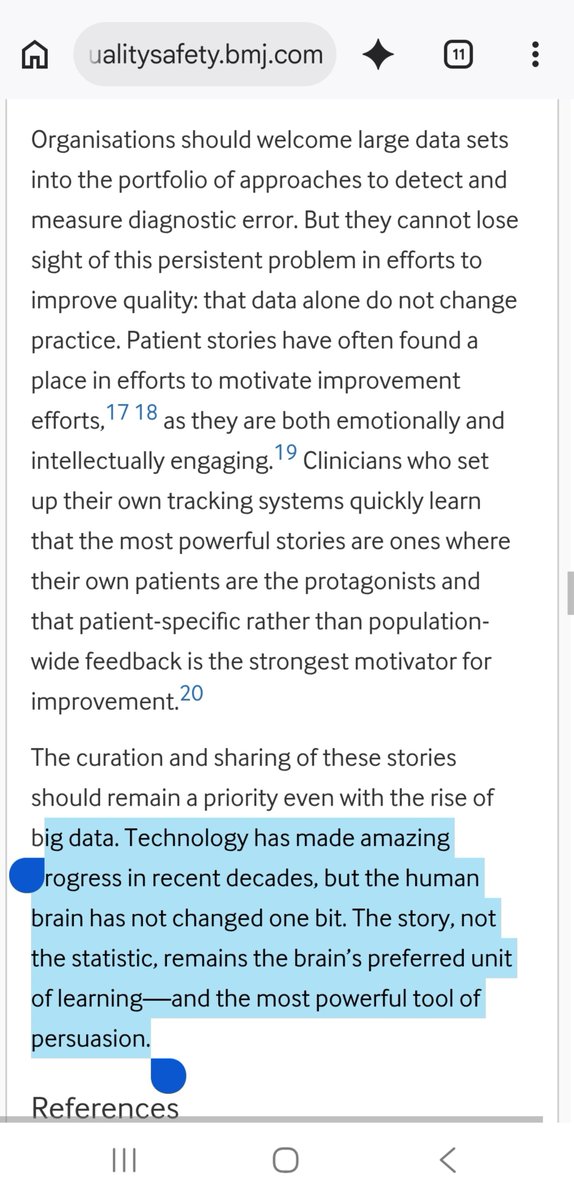
@BedsideMedNU Regret missing to attend this meeting. Cannot overstate the importance of the conclusion of one of @Gurpreet2015 's classic editorial with @kgshojania in @BMJ_Qual_Saf data of diagnostic error, big, large and small . Golden words!
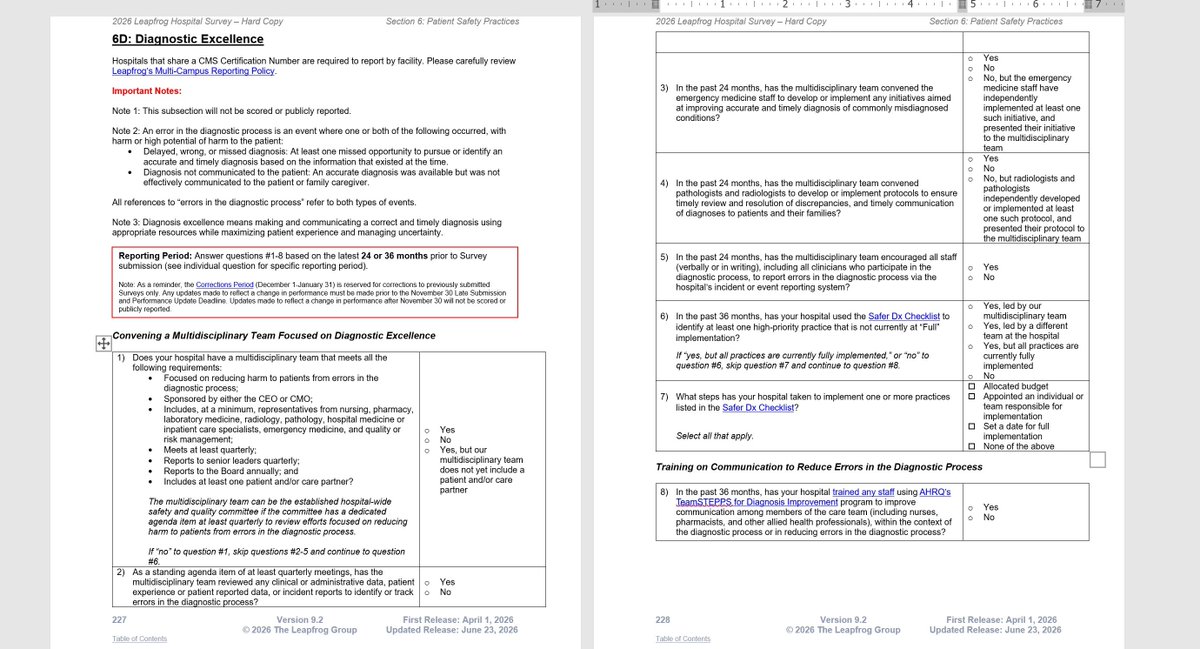
At #DEX26 significant announcement by @LeapfrogGroup - the optional section on diagnostic safety in their hospital survey will be now required and more importantly publicly reported from July 2027. This year 2500+ hospitals responded to the updated questions.
This is an important nudge to health systems to focus on an issue that has been chronically ignored, buried in peer review committees (if at all recognized). True, that some health systems may stretch their answers, use it to check boxes, but it still remains one of the first structural/process options for hospitals to measure and address missed, delayed and mis-diagnosis. Not a magic pill, nor is it a perfect solution - and like CMS' PSSM (as it stands now) may not be audited or validated easily even if self-attested and publicly reported (leaving scope for reliability issues). Yet these are important first steps for health systems/ hospitals to step into a zone they have and would still avoid for a number of reasons. As far as I know it is the best excuse for diligent/interested clinicians or CQOs and CMOs to use this as a system-lever to kickstart work to improve #patientsafety with re to diagnostic errors (i.e. assign ppl, $ and resources and offer political willpower internally within orgs).
This work has been going on for 5 years now - glad to have been part of Leapfrog's 12 member national advisory board that offered recommendations for best practices that influenced these Qs.
Surveys can always do better but need to start somewhere- and in a field where there was literally nothing, this is very good. These are the latest Qs (version 3.0) - far more relaxed/simplified to give a viable/easy start to several hospitals (and potentially link to potential CMS and Joint Commission efforts)
(for all best practices and case studies, see full report on recognizing diagnostic excellence- 2022, 2024)
@pfps_us@LeapfrogGroup
Looking forward to #DEX26. Particularly interested for opening "fireside chat" with @Bob_Wachter. If I was interviewing him, my first question would be
"why dont diagnostic errors get any respect and what can be done about it?" :) he wrote an imp paper in @Health_Affairs in 2010 with the exact same title. I think the concern holds true even today - we made progress in 2 decades-- upwards of $150 million were funneled by AHRQ (federal govt) and the Moore Fdn in the last 2 decades on finding out ways to reduce dx errors...but then the $ ended + also moved the conversation/lens to diagnostic excellence ( vs safety and errors) probably too soon. He was part of a national roundtable of experts i organized at this same meeting in 2013 in Chicago- everyone had high hopes from the great IOM report that came out 2 yrs later in 2015. Strong report but weak adoption except philanthropic org Moore remarkably funneling upwards of $100M and then closing out support. Infact back then the conference was called "diagnostic errors in medicine"- now its called DEX- "excellence" replacing "errors in medicine". My personal view is dx excellence is inherent to medicine- medicine (actual practice of medicine not the health care ecosystem) was always about dx excellence so we sort of lost focus/momentum from the sub-topic of timely/accurate dx to specifically reduce delays and misses. Dx excellence is, philosophically, to me akin to "pursuit of happiness" in the declaration of independence. Dx errors in 20 yrs met the same fate of pt safety in 40yrs. We are at a better place than 4 decades ago, but are we really, as in did we keep pace, have we become more transparent? Unless we know how to acknowledge and address our misses, it will always be a pursuit of excellence. Will be exciting nevertheless to hear him- he's written a very well researched and approachable book on AI and has been on a book tour (many on youtube). Chapters 3 and 4 relevant for today. Following his session, CMS, leapfrog and the joint commission take stage. Q for them is how to leverage what we know from $150million worth of 100s of papers so we can operationalize dx safety on the ground in hospitals? Leapfrog has a good survey but optional, CMS has PSSM measures but unaudited. I've tried to operationalize dx safety for abt a decade, and I can tell you, it actually does come down to the intersection of culture and what the law dictates. This can be heavily influenced by regulation (which influences the c suites to assign dollars, FTEs and resources). Like any other industry, market forces and regulations dictate health care. Market forces never focus much on safety as its too complex; ROIs dont get defined well. Leaving it to the intrinsic motivation of the good doctors and nurses creates variation. Regulations to address lack of transparency hold key to moving this conversation to a learning health system in the interest of patients, docs and the companies that manage health care. #patientsafety #medicalerrors #misdiagnosis #AI #diagnosticerrors
#patientharm
A digital quality measure for advanced-stage cancer diagnoses was associated with higher rates of missed diagnostic opportunities. https://t.co/8dPNwDjch8 @AndrewZimolzak, @Divvykant
@DrewAltman Wish we could frame this around prices. Much of this wouldn't even matter. "It's the prices, stupid", a wonderful smart man told us once. We are pathetically blinded to how we price care. I suspect half of health policy exists because of high prices. Cost control is a misnomer.
Here's a random example of what "emergency presentation" of #cancer looks like. And why it would make sense to look back, learn, and correct course for the next patient. Don't get caught up in calling it an "error", but definitely a miss, to learn from
https://t.co/09FjzIRL5N
Working with collaborators we looked at #patients who were diagnosed with a #Cancer diagnosis emergently - i.e. either in the #ED or the inpatient wards. Typically you do not expect to receive a cancer diagnosis in the ED or as an inpatient. IF that happens, it is likely the dx
A digital quality measure for advanced-stage cancer diagnoses was associated with higher rates of missed diagnostic opportunities.
https://t.co/rx3zIRt4K6
@HardeepSinghMD@AndrewZimolzak@Divvykant
There is a weird type of distress when your worry moves beyond the emptiness in your chest and sort of twists your intestines or abdomen. I felt it when sandyhook happened. This AM its abt those kids in TX. Unbearable to imagine what's happening to those families right now.
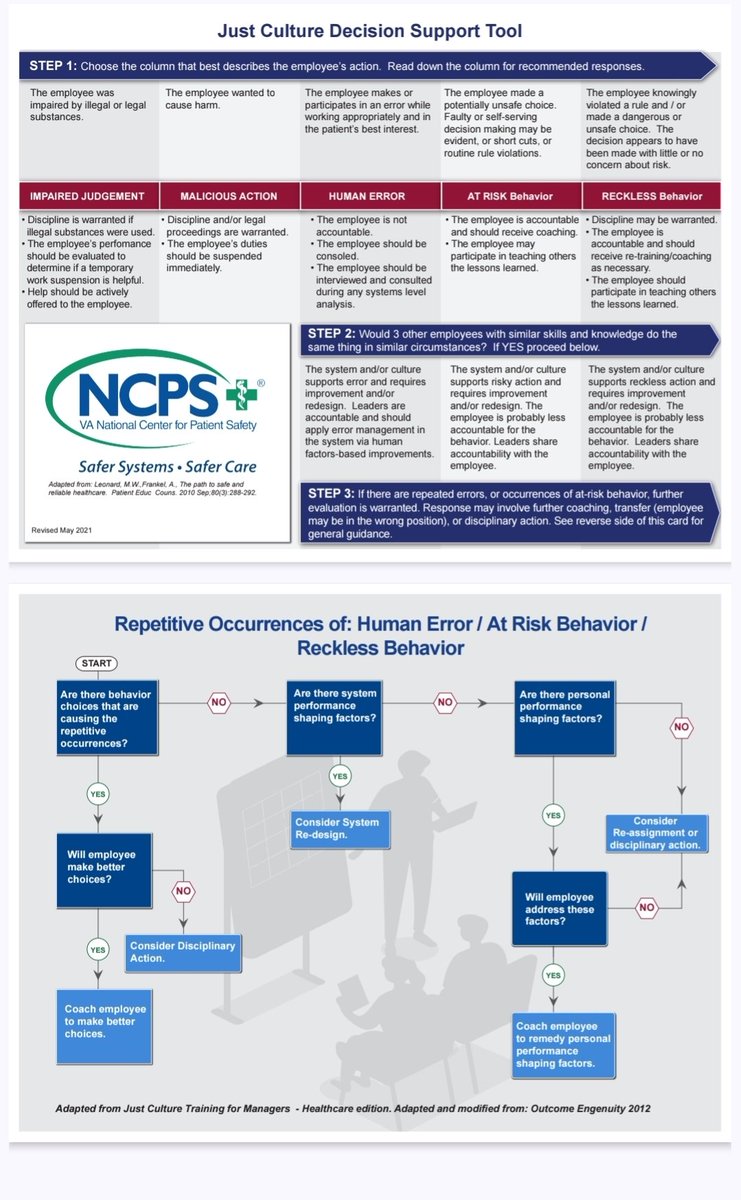
@MHatlie talks about sitting in meetings where #healthcare professionals do not really get what #Justculture is anymore.
Calls "diagnostic safety" a game changer in #PatientSafety where the harm and incidence is severely under/un-reported- so much to do! #CMSQualCon25
#CMSQualCon25
Re-upping - at the federal session, @CDCgov Dr Arjun Srinivasan just brought up diagnostic excellence/ diagnostic safety toolkits- here is a thread on the core elements he referenced + more resources.
@AHRQNews Dr. Umscheid CQuIPS dir, highlights CMS Quality conf attendees abt Dx excellence pilot- IDEAS grant recruiting hospitals. A toolkit they have is called MeasureDx. I live & breathe that toolkit at my org. DAILY. For 8 years now! It's doable. #AHRQ https://t.co/jcGeeIyKml
"This is an administration that's serious about #patientsafety - open to early conversations about disincentivizing i.e. adjusting payment in case of safety/harm events" Dr Michelle Schreiber DD/CMO of CMS. "Stop paying for preventable harm".
Well, need to know about them first?
@bsutariya - actually cautions quality & safety professionals- this- AI- is not bringing incremental change, you need to re-imagine how quality, safety will now be executed in health systems. Gives an eg of how stoke alerts resulted in dx in 2 mins instead of 20min using RapidAI.
Concept of "zero harm" has probably gotten in the way of truly tackling #patientsafety. It's imp to first acknowledge the burden of harm currently. With 1 in 10-15 in outpatient and 1 in 4 in inpatient setting experiencing adverse events, is too high @DBatesSafety#cmsqualcon
@KedarMate@DBatesSafety@TGandhi_Safety make the point that in the world of Q&S, typically resource-limited, AI can help automate lot of the manual, regulatory abstraction so safety professionals can focus on true quality improvement, that matters.