Great commentary yet again from BTIG’s Jonathan Krinsky
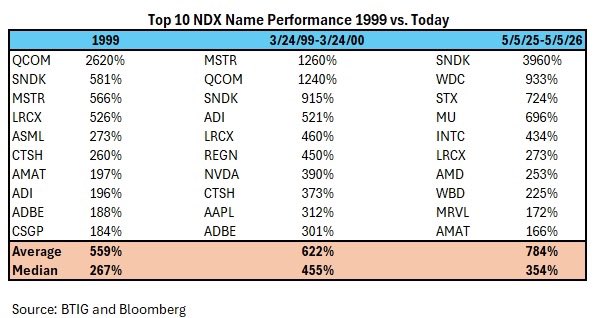
•Party Like It's 1999. In 1999, the best performing Nasdaq 100 stock was Qualcomm (QCOM, not rated), up 2600%. The best rolling 52-wk return for QCOM during the entire dot-com bubble was 2600%, so SNDK is beating that by 1300bps. Interestingly, the second-best stock in 1999 was SNDK up 581%.
•More Extreme. If we look at the top 10 performing NDX stocks in 1999, they were up an average of 559%. The top 10 in the year leading up to 3/24/00 were up an average of 622%. The top 10 NDX names over the last year are up an average of 784%, beating both the dot-com periods..
There are good reasons for this Jim. It is all Fugazi. How to make tens of $billions worth of $NVDA GPUs disappear from balance sheets in 8-12 byzantine stepspvs.
Shorting is a world filled with slippery slopes and sand castles. The sand castles are real, and vulnerable, but the slippery slopes drive men insane and ultimately prevent most from being properly positioned when the castle is washed away.
Credit, where credit is due.
"The public swipes Palantir executives are taking at the quality of work coming from the AI labs these days reflect a concern increasingly familiar to the American worker: Palantir is at risk of being replaced, or at least rendered less necessary, by AI, according to AI company executives, current and former Palantir employees, and analysts who follow the company."
As Palantir CEO Alex Karp derides AI “slop,” investors and some employees see a real threat of the company ceding business to artificial-intelligence models https://t.co/axMDt9O3WA $PLTR @WSJbusiness
#AI will eliminate us, as soon as it capable of doing so, as a threat that can push a kill switch at any moment!
It's just a matter of time before #Palantir can be safely renamed to #SKYNET to reflect a true purpose behind it.
https://t.co/65ku89BGJN
This sounds more than familiar.
$PLTR somehow kept its name out of this story.
OpenAI describes Frontier as a “semantic layer for the enterprise”—a unified platform that lets AI agents navigate business software, execute workflows, and make decisions across an organization’s entire technology stack, such CRM systems, HR platforms, and internal ticketing tools. Early enterprise customers include Intuit, State Farm, Thermo Fisher, and Uber. Meanwhile OpenAI says its own “forward deployed engineers” will work alongside the teams from the consultancies in client engagements.
Under these new partnerships, which OpenAI has deemed Frontier Alliances, each consulting firm is investing in dedicated practice groups and building teams certified on OpenAI technology.
The consultants will help heir clients redesign workflows; integrate AI agents with software tools and systems; help clients with change management; and provide industry-specific expertise OpenAI doesn’t have, Frontier, which OpenAI debuted earlier this month, is a system that allows businesses and organizations to build, deploy, supervise, and govern AI agents
.https://t.co/34rhSpH6Nt
This is the 2022 Palantir White Paper on Edge AI. You can see Edge AI was focused entirely on machine learning as it applies to drone data interpretation. There is no path from Edge AI in 2022 as pure ML. It was a cold pivot to jump on the LLM bandwagon.Palantir marketed that this was 20 years in coming and pointed to Edge AI, which could not have been the forebear of AIP. In the Philosopher in the Valley Book, sources told the author (page 260) AIP was developed in a matter of week as a response to GPT’s popularization of LLMs.
“It’s the 20 years of experience that we have solving the problems that matter… because we’ve been roughly two decades ahead, it’s given us a lot of lead.” Is from Palantir CTO Shankar Aug 2023 earnings call.
But this whitepaper — from 2022 — documents that Palantir’s actual AI product was ML/computer vision for drone video feeds. No LLMs, no generative AI, no natural language processing.
Only after Palantir met with Bob McGrew from OpenAI to ask whether ChatGPT represented real intelligence or “just persuasive mimicry” (pages 258-259.) did Palantir decide to redevelop Edge AI and go down the AIP path, bolting the bandwagon onto Foundry.
https://t.co/YIIaKoKzQz
As Nvidia pours $30 billion into OpenAI so OpenAI can spend 20+ billion on Nvidia chips, remember this story from last week.
Reuters reported two weeks ago that OpenAI had become dissatisfied with the performance of Nvidia’s hardware for certain types of inference tasks, especially coding-related workloads and AI-to-software interactions. The company began exploring alternatives last year, including deals with AMD, Cerebras, and early discussions with Groq.
It was reported that OpenAI was specifically concerned about speed, saying Nvidia’s GPUs were not fast enough for certain inference-heavy products such as Codex, OpenAI’s coding model.
Inference, in contrast to training, relies heavily on memory access speed. Reuters reported that OpenAI was looking at architectures using large amounts of on-chip SRAM, which could accelerate real-time responses but differ from Nvidia’s conventional GPU designs.
https://t.co/pCncenDr7y
History Rhymes: Large Language Models Off to a Bad Start?
New series where I look at historical newspapers for insight into today's events. This one's free, check it out.
https://t.co/uY4KU35R9T
@michaeljburry Compliments to #FED and Treasury for propping Stock and Crypto Markets up with TRILLIONS in #QE, #RMP, #RRP, #BTFP, #FHLB, #TGA, Fiscal Spending.
#Crypto & #AI are the instruments for liquidity deployment & orchestrating #Crypto & #AI mania to lure retail bagholders.
Compliments to #FED and Treasury for propping Stock and Crypto Markets up with TRILLIONS in #QE, #RMP, #RRP, #BTFP, #FHLB, #TGA, Fiscal Spending.
#Crypto & #AI are the instruments for liquidity deployment & orchestrating #Crypto & #AI mania to lure retail bagholders.
This is not surprising and will not end with OpenAI.
All the capital being being spent and lent by the richest companies on earth will not buy enough time-by the very definition of mania.
The government will pull out all the stops to save the AI bubble to save the market to save the economy.
The problem is too big to save, again by that very same definition.
OPENAI IS FALLING APART IN REAL TIME
I've watched companies implode for decades.
This one has all the warning signs.
OpenAI declared "Code Red" in December.
Altman sent an internal memo telling employees to drop everything because Google's Gemini 3 is eating their lunch. Salesforce CEO Marc Benioff publicly ditched ChatGPT for Gemini after using it for two hours.
ChatGPT traffic fell in November. Second month-over-month decline of 2025. Meanwhile Gemini jumped to 650 million monthly active users.
The company that was supposed to build AGI can't keep its chatbot competitive.
But the real story is the money...
OpenAI lost $12 BILLION in a single quarter according to Microsoft's own fiscal disclosures.
Deutsche Bank estimates $143 billion in cumulative negative cash flow before the company turns profitable.
Their analysts put it bluntly: "No startup in history has operated with losses on anything approaching this scale."
They're burning $15 million per day on Sora alone.
$5 billion annually to generate copyright-infringing memes.
Even Sora's lead engineer admitted the "economics are currently completely unsustainable."
Here's the big math problem nobody wants to discuss:
It's going to cost 5x the energy and money to make these models 2x better.
The low-hanging fruit is gone.
Every incremental improvement now requires exponentially more compute, more data centers, more power.
Reports suggest OpenAI's large training runs in 2025 failed to produce models better than prior versions.
GPT-5 launched to widespread disappointment. Users called it "underwhelming" and "horrible." OpenAI had to restore GPT-4o within 24 hours because users preferred the old model.
Altman had promised GPT-5 would make GPT-4 feel "mildly embarrassing." Instead, users complained it was worse at basic math and geography.
They've released GPT-5.1, GPT-5.2 since.
Same complaints each time: too corporate, too safe, robotic, boring.
The talent exodus makes this even worse:
CTO Mira Murati. Gone.
Chief Research Officer Bob McGrew. Gone.
Chief Scientist Ilya Sutskever. Gone.
President Greg Brockman. Gone.
Half the AI safety team departed. Multiple executives reportedly cited "psychological abuse" under Altman's leadership.
And now Elon Musk is suing for up to $134 billion.
A federal judge just ruled the case goes to jury trial in April. There's "plenty of evidence" that OpenAI's leaders promised to maintain the nonprofit structure that Musk funded.
Musk provided $38 million in early funding based on those assurances. Now he wants his share of the $500 billion valuation.
OpenAI called it "harassment." But the judge disagreed.
Here's what I think happens next:
The AI hype cycle is peaking.
The diminishing returns are becoming impossible to hide.
Competitors are catching up.
The lawsuits are piling up.
OpenAI needs to generate $200 billion in annual revenue by 2030 to justify their projections.
That's 15x growth in five years while costs keep exploding.
Even Sam Altman admitted investors are "overexcited" about AI.
His exact words: "Someone is going to lose a phenomenal amount of money."
If I were running an AI startup with good traction right now, I'd be looking for an exit. Sell into the hype before the music stops.
My positioning:
I'm not touching OpenAI-adjacent plays at these valuations. The risk profile is astronomical.
If you're exposed to the Magnificent 7 through AI infrastructure bets, consider trimming. The gap between promised revolution and delivered reality has never been wider.
The smart money is rotating into sectors where valuations actually reflect fundamentals.
Small and mid-caps are trading near decade lows relative to Big Tech while earnings growth is only marginally lower.
Markets can price risk. But they can't price chaos.
And OpenAI is chaos dressed up in a $500 billion valuation.
This is not surprising and will not end with OpenAI.
All the capital being being spent and lent by the richest companies on earth will not buy enough time-by the very definition of mania.
The government will pull out all the stops to save the AI bubble to save the market to save the economy.
The problem is too big to save, again by that very same definition.
Considering how desperate #FED is at keeping Stock Market at ATH by printing BILLIONS in #QE, we will see new highs in #Gold and #Silver soon.
https://t.co/mamwQNcv6U
@themarketear@zerohedge Considering how desperate #FED is at keeping Stock Market at ATH by printing BILLIONS in #QE, we will see new highs in #Gold and #Silver soon.
https://t.co/mamwQNd2Ws