Orthopaedic Sports Surgeon. Sports, Sports Science, Healthcare Politics. IHS/UCI/UCICOM/NYU/USC Posts are my own and not reflective of anyone but me. 🙂
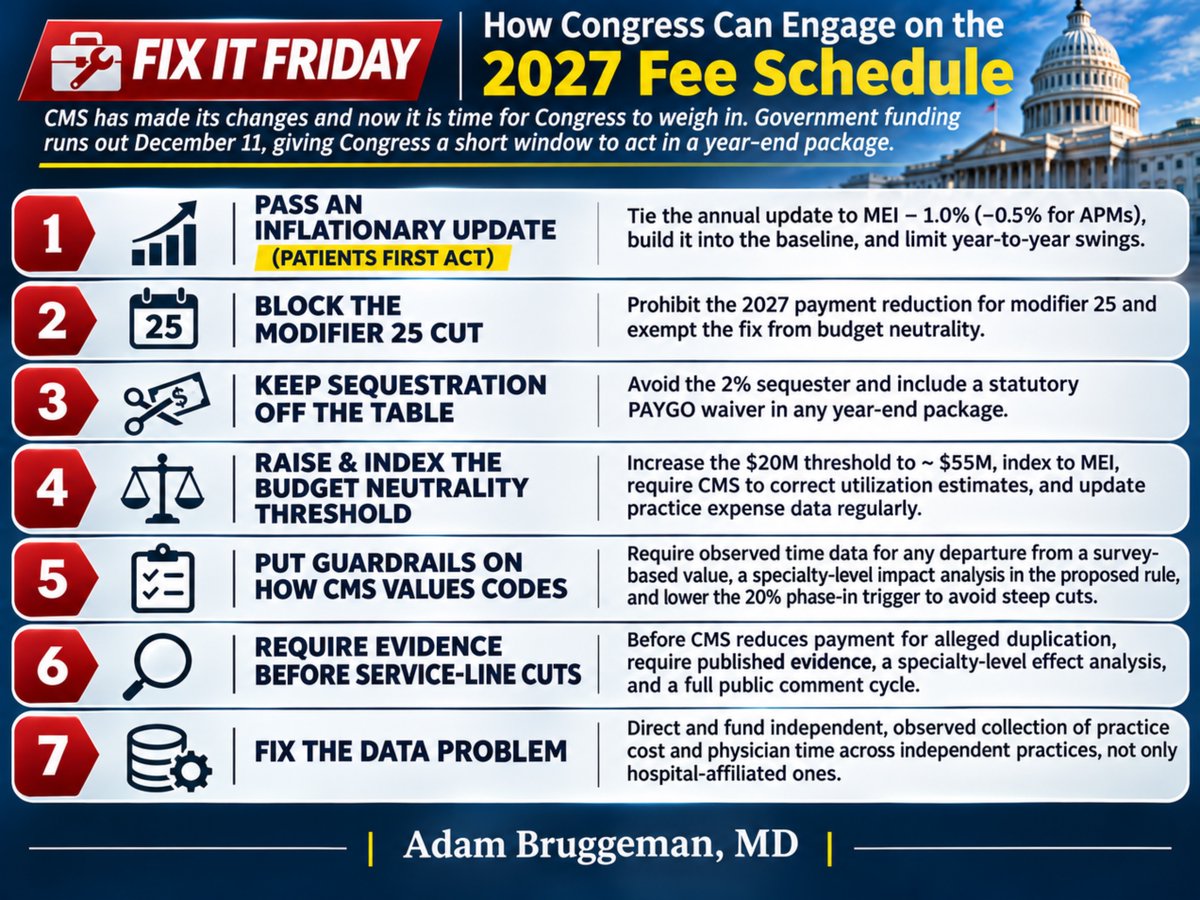
Fix It Friday: how Congress can engage on the 2027 fee schedule
CMS has made its changes and now it is time for Congress to weigh in. Government funding runs out December 11 so Congress has a short window to coalesce around solutions to attach to a likely Continuing Resolution end of year bill.
1. Pass an inflationary update. The Patients First Act is the vehicle.
The medical association ask is to extend the 2.5% update through 2027, but a one-year extension of a one-year patch is how we got here in the first place. The 2026 update expired, so we started in a 2.5% hold, and the statutory 0.25% update does nothing against practice costs CMS projects to grow about 2.5%. Physicians are the only Medicare provider type with no annual update tied to their actual costs. Hospitals have one. Skilled nursing facilities have one. Home health has one. Physicians have a budgetary number that is a political hot potato.
H.R. 9693, the Patients First Act, introduced by Reps. John Joyce, MD, Greg Murphy, MD, and Kim Schrier, MD, (the Republican and Democrat chairs of their respective doctors caucuses) with 65 bipartisan cosponsors as of mid-October and a House Energy and Commerce Health Subcommittee hearing, fixes that. It ties the annual update to the Medicare Economic Index minus one point, with MEI minus half a point for advanced APM participants, builds it into the baseline, and limits year-to-year swings. That is the only proposal on the table that grows the pie instead of re-slicing it, and it is the most direct response to everything the issues raised this week. Inflationary updates prevent us from having to constantly rob Peter (specialists) to pay Paul (primary care).
This fix won’t be cheap. The Committee for a Responsible Federal Budget has estimated MEI indexing at roughly $65 billion over ten years relative to current law. I believe the number will come back substantially higher from the CBO.
2. Block the modifier 25 cut in statute and exempt the fix from budget neutrality.
MGMA has asked Congress to fix modifier 25 alongside the conversion factor. They have asked Congress to prohibit CMS from applying a payment reduction to a separately identifiable E/M service billed with modifier 25 for 2027, and direct CMS to collect observed intra-visit time and cost data before revisiting the question. That being said, if Congress blocks the cut without exempting the change from budget neutrality, CMS simply lowers the conversion factor to recover the money.
3. Keep sequestration off the table.
The 2% Budget Control Act sequester has reduced every Medicare payment since 2013, but Congress has been diligent in extending it every year. Then there is statutory PAYGO. Last November Congress wiped the PAYGO scorecard that the 2025 reconciliation law had loaded with roughly $3.4 trillion in deficits, which is the only reason a 4% Medicare sequester did not happen in January 2026. Any year-end package that spends money, on physicians or anything else, will trigger PAYGO. The package must carry its own PAYGO waiver.
4. Raise and index the budget neutrality threshold.
Earlier this week, we looked at how good CMS decisions can produce a worse conversion factor, which is a function of a $20 million threshold that has not changed since 1992. H.R. 8163, the Provider Reimbursement Stability Act, passed the House Ways and Means Committee on May 21. Its Senate companion, S. 5180 (Boozman, Welch, Marshall, King, Tillis, Shaheen), has similar language, and the Patients First Act incorporates the changes. The bill raises the threshold into the mid-$50 million range, indexes it to MEI every five years, requires CMS to correct utilization estimates that prove wrong, and puts practice expense data on a regular update schedule.
5. Put guardrails on how CMS values codes.
This year CMS proposed to override a RUC survey value for the two highest-volume procedures in orthopaedics with a crosswalk to unrelated codes, then reversed based on overwhelming response from the physician community. Last year it applied a 2.5% efficiency adjustment to thousands of codes using a productivity proxy. Congress should require that any CMS departure from a survey-based work value be supported by published, observed time data, and that any proposed revaluation above a defined threshold come with a specialty-level impact analysis in the proposed rule, not the final one. The statute already phases in RVU cuts of 20% or more over two years. Lowering that trigger would end the whole-number cliffs that hit joint replacement two years in a row.
6. Require evidence before service-line cuts.
The same-day 25 modifier policy is propped up on a theory of duplicate payment that CMS never quantified against its own practice of removing overlap time during valuation. The Patients First Act requires notice and comment before CMS introduces or changes a mandatory payment model. I would extend that concept to other aspects of payment. Before CMS reduces payment for a service on the ground that it duplicates another, it should have to publish the evidence of duplication and the specialty-level effect, and give the public a full comment cycle.
7. Fix the data problem.
CMS's argument on both modifier 25 and practice expense is that the data is old. Congress should direct and pay for independent, observed collection of practice cost and physician time across independent practices, not only hospital-affiliated ones, so the next revaluation is argued over facts rather than crosswalks and theories. CMS cannot build an accurate fee schedule on 2007 surveys and claims data, but it should not be allowed to build one on assumptions either.
Congress must intervene to protect Medicare patients from the 2027 CMS physician reimbursement cuts.
Reductions in work RVUs for total joint arthroplasty and decreased reimbursement for Modifier 25 evaluation and management services place additional financial pressure on orthopedic practices already facing rising costs.
This is not simply about physician reimbursement. It is about PATIENT ACCESS.
When reimbursement fails to reflect the complexity and resources required to deliver high-quality orthopedic care, practices face difficult decisions about their ability to continue providing those services.
Medicare beneficiaries deserve timely access to joint replacement surgery, appropriate evaluations, and comprehensive musculoskeletal care.
I urge Congress to address these cuts before they compromise access to care.
@RepDeSaulnier@GoldStateOrtho
#Medicare #PatientAccess #Orthopedics
I can think of 10 concierge private practice physicians in our local 10 mile radius. (I applaud them) That's somewhere between 20 and 25,000 lives that need to be absorbed by the health systems.
Employed system doctor or concierge. Private practice primary care is gone. Good luck getting into or having any semblance of a relationship with that employed system doctor.......
@DutchRojas Let's remember, reduced postoperative hospital visits does not eliminate the surgeon's postoperative work, it just relocates it. And from an administrative point of view, it puts the financial burden on the independent practice not the hospital. Risk taken, so was the reward.
Breaking: CMS finalized the 2027 physician fee schedule. Most physicians face a 2.31% conversion factor cut Jan. 1, while the modifier -25 same-day cut drops to 20% and traditional MIPS reporting now ends in 2031.
#Medicare#PhysicianFeeSchedule#CMS
🔗 https://t.co/bkvzTZ5kNX
Time will tell but this may be the time the Titanic hits the iceberg for independent orthopedic practices. Arthroplasty practices will no longer be able to care for Medicare patients. Independent practices do not have the facility fees or concomitant commercial contracts to absorb this hit from CMS.
Physician voices helped influence the final Medicare Physician Fee Schedule and mitigate some of the more significant concerns in the proposed rule. That matters, but meaningful challenges remain.
AAOS will keep pushing for a fair, data-driven reimbursement system that values physician services, preserves physician-led decision-making and protects patient access to care.
"If [patients] can't get in to see us, they will lose the ability to be independent in their lives — and that is one thing we all need"
Orthopaedic advocates from California traded the coast for the Capitol during #NOLC2026 as they met with legislators to protect access to high quality musculoskeletal care.
How are you standing up for orthopaedic surgeons in your state?
@COA_Ortho@UCDavisOrtho@shrinershosp
The CY 2027 MPFS final rule is expected by Nov. 6. Have you spoken out yet?
Share how declining Medicare reimbursement has impacted your patients and orthopaedic practice by visiting our CMS Payment Resource Center: https://t.co/SxXbv6BS6Q
The countdown is on. ⏳
25 Yrs Ago: 1st-ever No. 1 vs No. 2 in US.
Hard to believe it's been 25 years since legendary 2001 De La Salle vs Long Beach Poly showdown. A 116-game win streak was on the line vs the top CIFSS program at the time. We were there.
@RonMFlores@HaroldAbend
https://t.co/yTOO7fFq1Y