Brad Carson joined MLST to discuss AI policy across Life, Law, and War.
He has served as U.S. Army General Counsel, a two-term Member of Congress, and a U.S. Navy intelligence officer. He now leads Americans for Responsible Innovation, the AI policy advocacy group he co-founded. @bradrcarson@americans4ri@MLStreetTalk
https://t.co/bOPUQo92Km
Today, we share a breakthrough on the planar unit distance problem, a famous open question first posed by Paul Erdős in 1946.
For nearly 80 years, mathematicians believed the best possible solutions looked roughly like square grids.
An OpenAI model has now disproved that belief, discovering an entirely new family of constructions that performs better.
This marks the first time AI has autonomously solved a prominent open problem central to a field of mathematics.
OpenAI is being sued by the family of a 19-yo student who overdosed after ChatGPT wrongly advised him to consume a deadly mix of substances.
The lawsuit seeks to halt operation of "ChatGPT Health," which promises users health "support" and "advice":
https://t.co/OYnO0S9RNB
UNDERSTANDING TRANSFORMERS AND ATTENTION
Our minds attach words to meaning.
When someone says, “I love you,” we don’t just hear words. We attach layers of meaning to it — intentions, promises, a shared future.
For us, words connect to a web of experiences, concepts, and associations. “Water” isn’t just a word, but something we can imagine, reason about, and relate to the world.
But for an LLM, words aren’t grounded like this. They’re not tied to experiences or real-world concepts.
An LLM doesn’t understand what “water” is. For it, “water” is not wet, drinkable, or a physical substance. It’s just patterns of how the word appears with other words in language.
So how can an LLM give responses that feel meaningful if it doesn’t even “know” what any of these words refer to?
Through two key mechanisms: attention and feed-forward networks.
Both happen within what’s called a transformer — the core architecture behind LLMs.
Let’s talk about context:
Imagine you’re in a meeting...
YOU: So for this project, we should focus on improving user onboarding flow.
COLLEAGUE: Yeah… and speaking of flow, I was stuck in a horrible traffic jam today. Something should be done about traffic flow.
YOU: Uh… that’s not relevant. Can we stay within context?
Well, attention is how an LLM figures out what’s relevant within context.
Processing a prompt within context is how it stays coherent. All the words in the prompt -- and how they are put together -- form the context.
(Note: when I say “word” here, I mean “token”. I’ll use “word” to keep things intuitive).
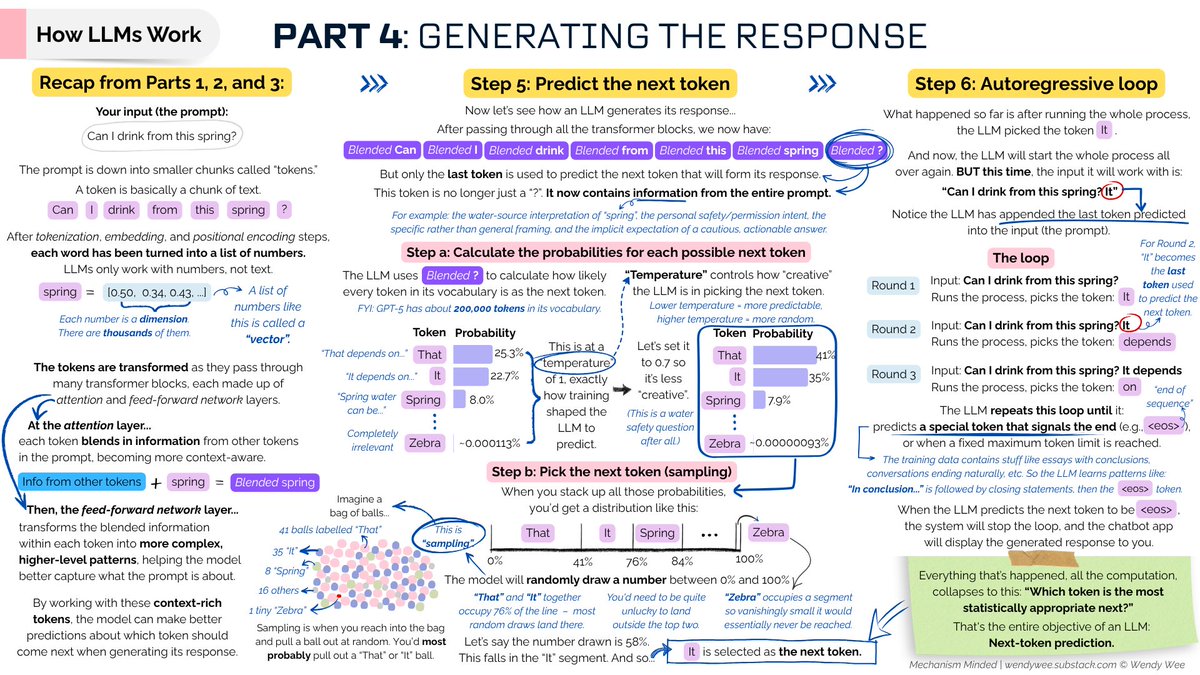
Let’s say you give this prompt to the LLM: “Can I drink from this spring?”
Every word in that prompt needs context to know how to participate in the shared pattern of the sentence. Basically, it needs context to stay relevant to what the sentence is about.
It gets that context by taking in information from other words and blending it into itself. This “information” is the pattern each word forms across thousands of dimensions (see here about dimensions).
As words blend information from each other, they shift in the LLM space, pulled in certain directions by context — toward regions where certain words tend to appear.
For example, “drink” pulls “spring” toward liquid-related patterns, and away from seasons and mechanical related patterns. The words “winter” and “mattress” are unlikely to be near this region.
Once context has shaped the words into a pattern, the LLM predicts the next word that best continues it — forming its response (we’ll look at how that prediction works next week).
Now that you get the big picture, let’s explore the details!
@wendyweeww These are superb in content and visual design! I can honestly see why AI is trying to take credit for it! But the truth is AI couldn't come anywhere close to this quality. Well done!
And it begins
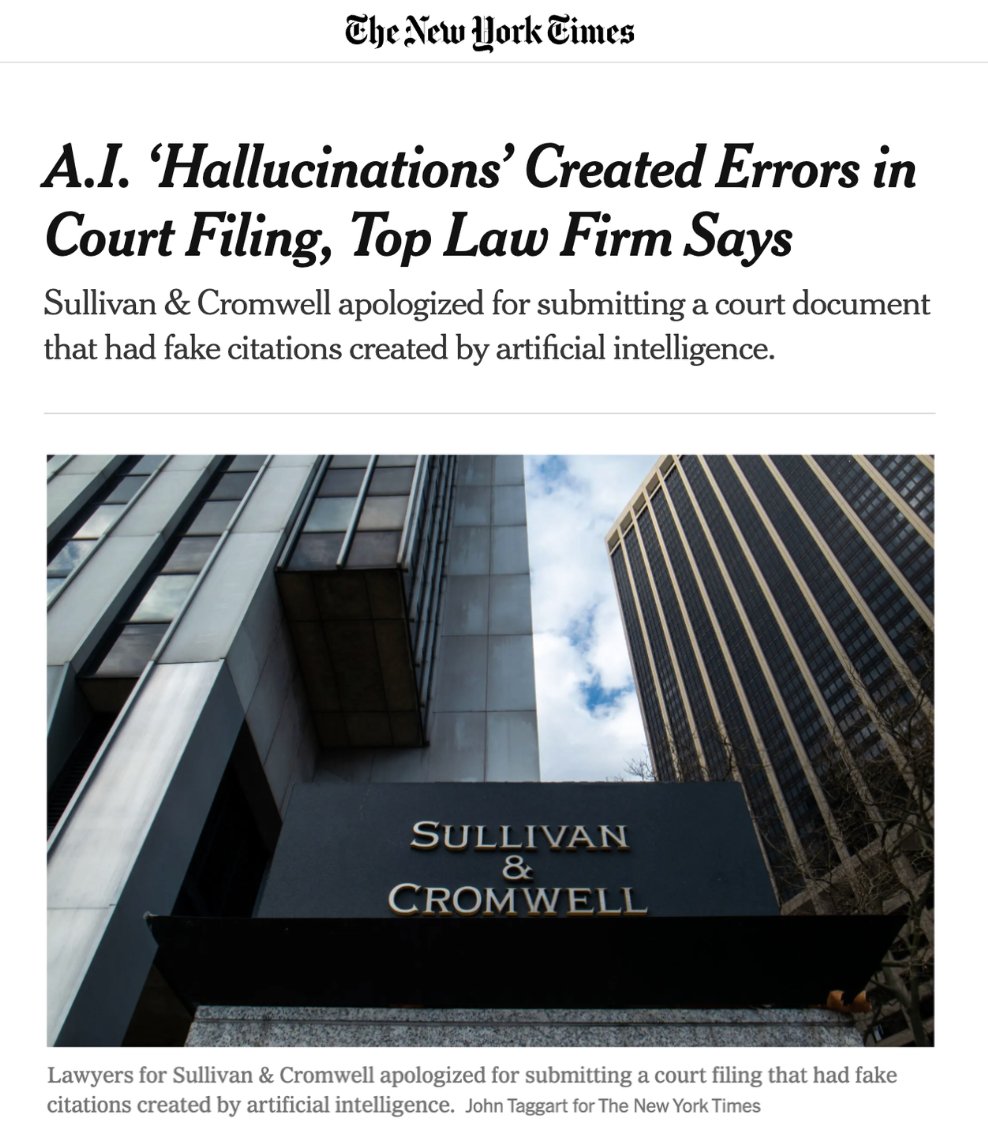
Sullivan & Cromwell just admitted to a federal judge its court filings contained AI hallucinations
The firm apologized to the federal judge as they had to submit multiple corrections focused around:
• Fictitious Case Names: The filing included names of legal cases that do not exist
• Fabricated Quotes: The document contained direct quotes that were never actually spoken or written
• Non-existent Statutes: The AI incorrectly analyzed or entirely invented provisions within the U.S. Bankruptcy Code
The primary team and secondary review all failed to catch these errors, meanwhile the firm's partners bill $2,000+ per hour
I recently read "I work in AI and I'm scared" by @sofialomart — about working in AI and still feeling lost about how LLMs actually work.
It stuck with me.
So I made what I hope is a simple, intuitive breakdown of how LLMs work. This is Part 1 of the series.
Link below 👇
The Light shine on you, Chuck Norris,
And may you shelter in the palm of the Creator's hand.
The last embrace of the Mother welcomes you home.
Rest in peace.
— Adapted from Robert Jordan, The Great Hunt, The Wheel of Time
@DavidJHarrisJr The Light shine on you, Jada West,
And may you shelter in the palm of the Creator's hand.
The last embrace of the Mother welcomes you home.
Rest in peace.
— Adapted from Robert Jordan, The Great Hunt, The Wheel of Time