The Fusion Industry Association has reported that supply chain spending by the fusion industry rose 25% to USD538 million in 2025, but ensuring access to specialist materials and future fusion fuel systems remains a concern.
https://t.co/uhy4McB08J
Cold hydraulic tests are under way as part of the commissioning process at Turkey's Akkuyu 1, after the completion of the construction phase.
https://t.co/1wtnraAxlH
The United Nations called on major artificial intelligence companies to publicly disclose the full environmental cost of their data centers and use renewable power https://t.co/MUBb5cdRAq
The West keeps measuring AI by chatbots.
China is measuring AI by industrial output.
While Silicon Valley fights over subscriptions, personalities, and benchmark screenshots,
China is deploying industry-specific LLMs into power grids, oil and gas, refining, equipment maintenance, energy trading, and production coordination.
CNPC’s Kunlun model covers 152 application scenarios across the oil and gas industrial chain.
China’s energy regulator has already announced 51 AI+ high-value scenarios for the energy sector.
This is why China is hard to stop.
AI is not being treated as a toy, a therapist, or a writing assistant.
It is being turned into infrastructure.
The West sells intelligence.
China industrializes it.
Data centers could use about 10% to 15% of all U.S. electricity by 2030, up from 5% in 2024, Berkeley Lab researchers said in a separate analysis.
https://t.co/AOVKxGyxnx
"There are two versions on the table. The US says it will release $12 billion of those assets, on the condition that the money is used to purchase US goods. Iran rejects this, insisting it will decide how those assets are to be used."
Reports Mike Hanna from Washington, DC.
🔴 LIVE updates: https://t.co/c0CPpOMaE6
China is choking shipments of some critical minerals to Japan, a slowdown that’s hurting companies and prompting calls for Prime Minister Sanae Takaichi to find a diplomatic off-ramp with Beijing https://t.co/BBmjU1hVUn
Traceable vessel traffic through the Strait of Hormuz jumped 270% last week. The surge in transits, however, masks the confused, two-tier system now operating in the strait
US gas turbine maker @GEVernova has secured an order for two turbines and two generators for EVN's Quang Trach II #LNG power plant in Vietnam. #lngprime https://t.co/IfbneCr3yR
Nuclear Power Corporation of India Ltd says the successful unloading of the first End Shield is a major milestone for the Kaiga 5 and 6 construction project.
https://t.co/ujSKQXEPds
🛢️ China just turned its rare-earth control regime into a precision weapon aimed at America's supply-chain ambitions.
China's Ministry of Commerce added 10 US companies to its export-control list, barring Chinese firms from supplying them with dual-use goods, including rare-earth materials and magnets.
The named firms include MP Materials, the top US rare-earth miner, and USA Rare Earth, a magnet maker, both central to Washington's push for a non-Chinese supply chain.
The rules also bar any foreign entity worldwide from passing China-origin material to these firms, and halt existing contracts immediately, turning a licensing regime into a de-facto ban.
In parallel, China banned government procurement from 46 US companies, including Lockheed, Boeing, General Atomics, and General Dynamics.
This builds on controls running since April 2025, when Beijing first licensed seven heavy rare earths, then widened scope in October 2025 to processing tech and foreign magnets using Chinese inputs.
The short-term hit to MP and USA Rare Earth looks manageable, as both have cut their reliance on Chinese inputs, but costs rise and projects slow.
Markets read this as a warning shot, not a full embargo.
The real shift is option value.
The risk of sharper, broader controls later just went up, and that alone moves capex, valuations, and hedging across EVs, wind, and defense.
Beijing isn't cutting the US off.
It's showing it can, one company at a time.
Washington just quietly executed one of the most extraordinary foreign policy U-turns in modern history.
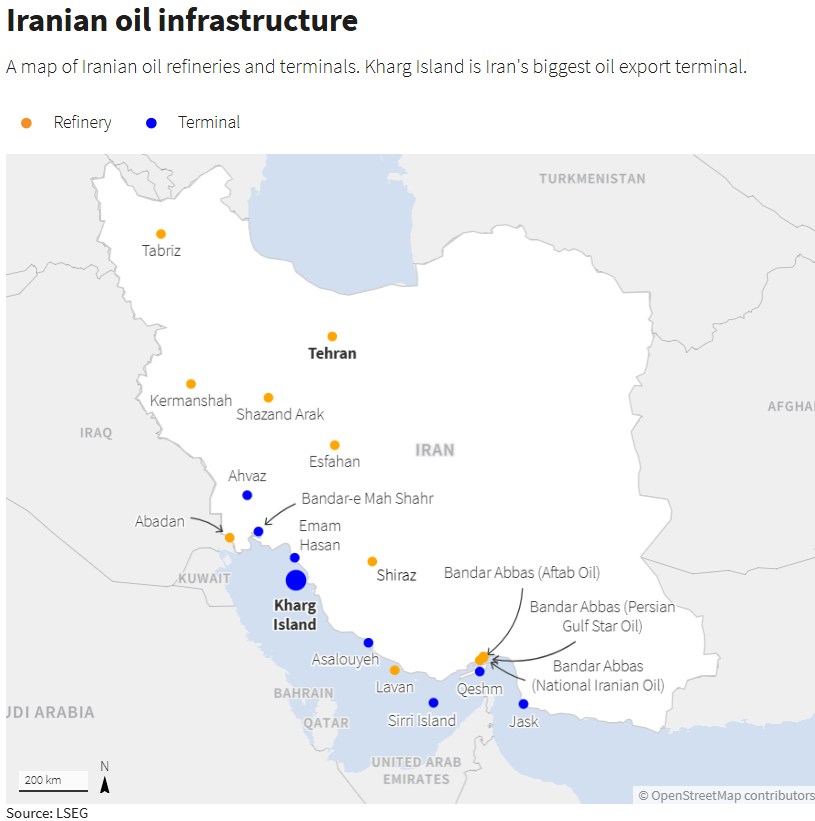
With no warning, the US Treasury has effectively erased a decade of "maximum pressure" on Iran's oil, opening the possibility of Iranian crude exports to the U.S.👇🇮🇷🇺🇸🛢️🧵
The US and Qatar (the world's two biggest LNG exporters) urge the EU to rewrite their methane rules
🇺🇸🤝🇶🇦
US Energy Secretary Wright and Qatari Energy Minister al-Kaabi told the EU in a letter to change its rules to avoid a gas supply crunch, the FT says
https://t.co/XdatBGWDGs
#Russia’s gasoline crunch is worsening, with at least two-thirds of the country’s regions introducing fuel rationing or suffering supply disruptions following relentless Ukrainian drone attacks on refineries.
On an almost daily basis, regional governors from areas bordering Ukraine to the Amur region near China are being forced to limit sales at filling stations and to try to deter panic buying. The scale of disruptions vary across Russia, but are intensifying and risk getting even worse if drone strikes increase. #oott https://t.co/vSxvQJvJ3P