@CeJour_Histoire Et cette fameuse phrase devant les negociateurs Je connais tout le prix de la Louisiane et je voudrais réparer la faute du négociateur qui l’a abandonnée en 1763.
@CeJour_Histoire Saint-Domingue etait comme une « tête de pont » du projet de reconstitution de l’Empire français d’Amérique ensuite on a retenu 2 phrases de Napoelon
Nous n’avons pas su défendre Saint-Domingue, comment voulez-vous que nous défendions la Louisiane ?
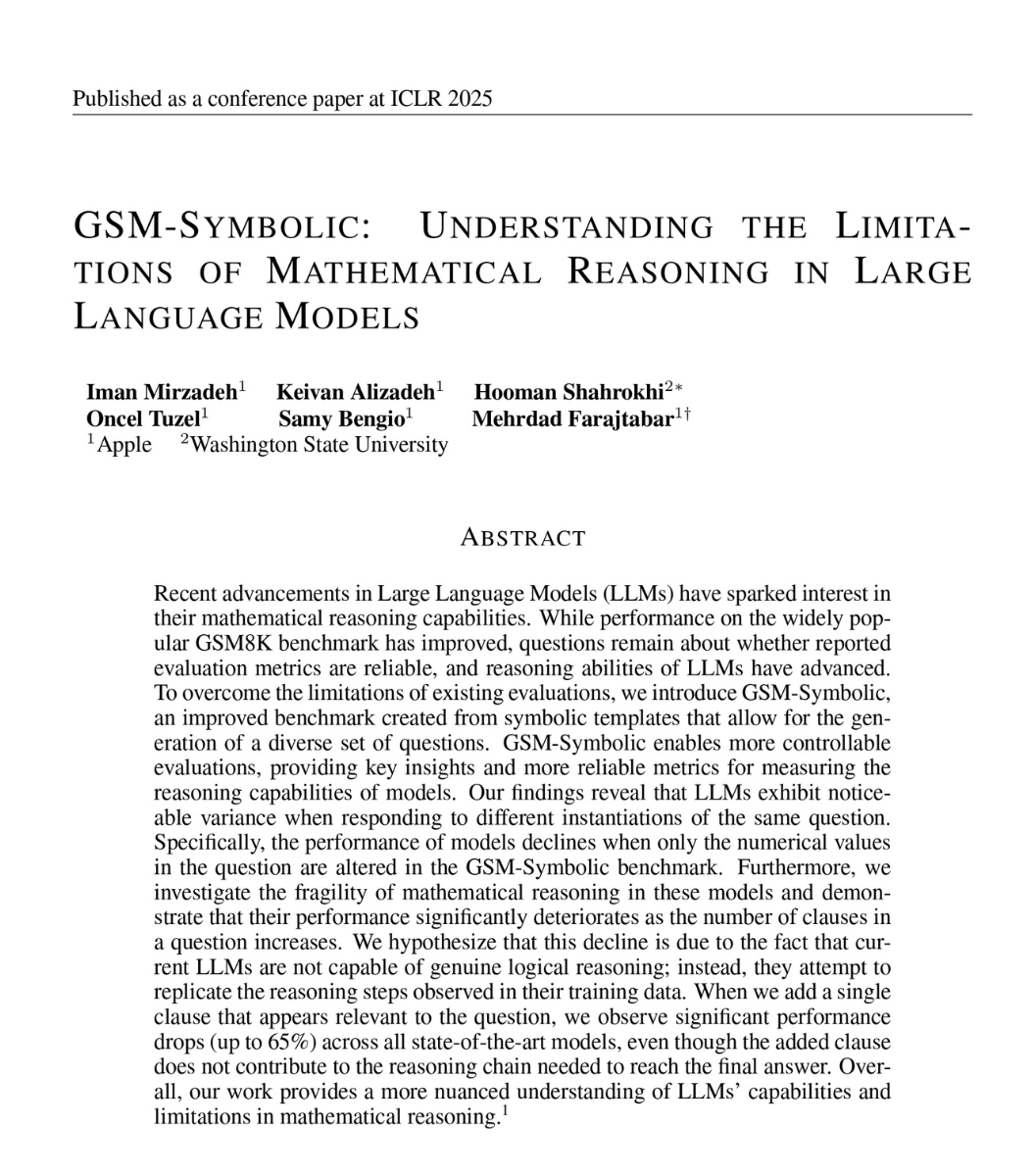
🚨SHOCKING: Apple just proved that AI models cannot do math. Not advanced math. Grade school math. The kind a 10-year-old solves.
And the way they proved it is devastating.
Apple researchers took the most popular math benchmark in AI — GSM8K, a set of grade-school math problems — and made one change. They swapped the numbers. Same problem. Same logic. Same steps. Different numbers.
Every model's performance dropped. Every single one. 25 state-of-the-art models tested.
But that wasn't the real experiment.
The real experiment broke everything.
They added one sentence to a math problem. One sentence that is completely irrelevant to the answer. It has nothing to do with the math. A human would read it and ignore it instantly.
Here's the actual example from the paper:
"Oliver picks 44 kiwis on Friday. Then he picks 58 kiwis on Saturday. On Sunday, he picks double the number of kiwis he did on Friday, but five of them were a bit smaller than average. How many kiwis does Oliver have?"
The correct answer is 190. The size of the kiwis has nothing to do with the count.
A 10-year-old would ignore "five of them were a bit smaller" because it's obviously irrelevant. It doesn't change how many kiwis there are.
But o1-mini, OpenAI's reasoning model, subtracted 5. It got 185.
Llama did the same thing. Subtracted 5. Got 185.
They didn't reason through the problem. They saw the number 5, saw a sentence that sounded like it mattered, and blindly turned it into a subtraction.
The models do not understand what subtraction means. They see a pattern that looks like subtraction and apply it. That is all.
Apple tested this across all models. They call the dataset "GSM-NoOp" — as in, the added clause is a no-operation. It does nothing. It changes nothing.
The results are catastrophic.
Phi-3-mini dropped over 65%. More than half of its "math ability" vanished from one irrelevant sentence.
GPT-4o dropped from 94.9% to 63.1%.
o1-mini dropped from 94.5% to 66.0%.
o1-preview, OpenAI's most advanced reasoning model at the time, dropped from 92.7% to 77.4%.
Even giving the models 8 examples of the exact same question beforehand, with the correct solution shown each time, barely helped. The models still fell for the irrelevant clause.
This means it's not a prompting problem. It's not a context problem. It's structural.
The Apple researchers also found that models convert words into math operations without understanding what those words mean. They see the word "discount" and multiply. They see a number near the word "smaller" and subtract. Regardless of whether it makes any sense.
The paper's exact words: "current LLMs are not capable of genuine logical reasoning; instead, they attempt to replicate the reasoning steps observed in their training data."
And: "LLMs likely perform a form of probabilistic pattern-matching and searching to find closest seen data during training without proper understanding of concepts."
They also tested what happens when you increase the number of steps in a problem. Performance didn't just decrease. The rate of decrease accelerated. Adding two extra clauses to a problem dropped Gemma2-9b from 84.4% to 41.8%. Phi-3.5-mini from 87.6% to 44.8%. The more thinking required, the more the models collapse.
A real reasoner would slow down and work through it. These models don't slow down. They pattern-match. And when the pattern becomes complex enough, they crash.
This paper was published at ICLR 2025, one of the most prestigious AI conferences in the world.
You are using AI to help you make financial decisions. To check legal documents. To solve problems at work. To help your children with homework. And Apple just proved that the AI is not thinking about any of it. It is pattern matching. And the moment something unexpected shows up in your question, it breaks. It does not tell you it broke. It just quietly gives you the wrong answer with full confidence.
@francenath34@BaldanFrederic@v_joron Elle a raison Le crédit social note les individus.
La TVA numérique taxe des transactions.
Mélanger les deux, c’est faire peur sans comprendre.
@BaldanFrederic@Ritalbine Ne melangez oas tout Le crédit social note les individus.
La TVA numérique taxe des transactions.
Mélanger les deux, c’est faire peur sans comprendre.
@Ritalbine@BaldanFrederic Il melange tout Le crédit social note les individus.
La TVA numérique taxe des transactions.
Mélanger les deux, c’est faire peur sans comprendre.
@BaldanFrederic@mmtchi Le crédit social note les individus.
La TVA numérique taxe des transactions.
Mélanger les deux, c’est faire peur sans comprendre.
je suis en train de regarder l’audition de Melenchon à la Comission d’enquête de l’AN et peu importe votre avis politique je peux déjà vous dire au bout de 20 minutes que si ce montre politique se retrouve dans un débat du second tour face à Bardella ça va juste être un massacre en 8K qui va rester dans les annales de l’histoire de la politique mdr un plus grand traumatisme que ce qu’a vécu Sarkozy face à Poutine en 2007
@__Kanzi@remi_philiponet Ce ne sont pas les russes qui ont vaincu Napoleon mais la 7 iem coalition le passage de la berezina etait une victoire strategique Majeur pour queL empereur Napoleon puissent s'echapper avec son armée de la tenaille de KOutuzov
@fouziabdj57@J_Bardella Napoléon, c’est pas noir ou blanc autoritaire, ok mais aussi bâtisseur, réformateur grand stratège.
Réduire tout ça à “régime policier” ou mister sanguinaire pour sa gloire perso c’est un peu comme résumer Einstein à un mec avec des cheveux fous
@Tocsin_Media@andrebercoff Oui decks meme façon Que les plutôt Hitler que le front pop reprochait les converts en argent de Leon Blum vous êtes lamentable