Capitalism works if and only if all members see themselves as "pre-rich" or "feasibly-rich-if-they-wanted-it-badly-enough". Remove that and the system collapses.
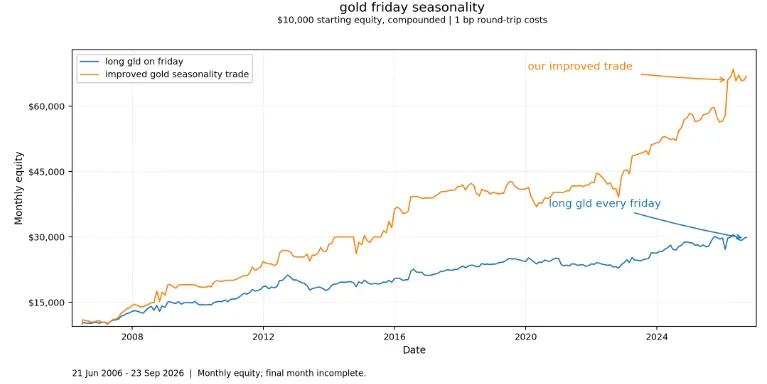
another dumb seasonality trade
(or a case study in idiots and pussies.)
in a recent thread i told you about a turn of the month trade in bonds.
here's a day of the week one in gold.
Excited to announce Options 101!
It's a site that provides free, no-ads, no-shill education on financial options (calls + puts).
The first course is one I'm now teaching this fall at Charles University in Prague. Lecture notes, videos, assignments.
https://t.co/rzTLlbxBoz
I was having dinner last night with a friend working in the chicken industry and I learned something that blew my mind.
Where do chicken farmers get their chickens? Most of us would say "from their existing chickens obviously, they breed and lay eggs."
That's what I thought too, but turns out I was dead wrong.
The reality is that the immense majority of meat chicken farmers in the world get their chickens from one of 2 companies: Cobb-Vantress, owned by Tyson Foods, or Aviagen, controlled by Germany's EW Group (the Wesjohann family).
They have a concept specific to the industry called grandparent stock: what you buy from these 2 companies is - essentially - a bunch of chickens with planned obsolescence.
The way it works is that each company keeps "pure" bloodlines on its own farms. Let's label them A, B, C and D. Those are the crown jewels - these companies' IP - and they never leave the building.
What they sell you are the "grandparents": chicks from those four lines, but each line in only one sex. You get A roosters but no A hens, B hens but no B roosters, C roosters but no C hens, D hens but no D roosters. Which means you can never breed more A, B, C or D birds yourself.
What you can do is cross them. A roosters with B hens give you the fathers, C roosters with D hens give you the mothers - these are the "parents". The parents then give you the chickens that actually end up on our plates, slaughtered at around 6 weeks.
And that's the end of the road. If you tried breeding those chickens, their chicks would be a complete genetic lottery: still chickens, sure, but without the genetic properties that make them commercially viable. They'd grow slower and less evenly, you'd have to sell them for way more than your competitors, and your business would be dead.
So you have to go back to Cobb or Aviagen for new grandparents. Forever.
Why buy grandparents at all, and raise 2 generations just to sell the third? The answer is scale. If you buy say 100 grandparents, each of them gives you around 50 parents, and each parent hen then gives you around 150 chicks: from those 100 grandparents, you have yourself some 600,000 chickens whose meat you can sell.
It makes no sense for these 2 companies to sell the final chickens directly. They'd have to hatch tens of billions of chicks a year and ship them all over the world. Much easier to simply sell the grandparents and let farmers do the multiplying and pay for the farms, the feed and the labor.
And, you knew this was coming, there is also a China angle here: as you can imagine, China isn't too pleased to be dependent on foreign companies for such a basic food item as chicken.
So China did what China does best: long-term planning. The Ministry of Agriculture and Rural Affairs launched a plan for "national broiler genetic improvement" (2021-2035), which aims for domestically bred breeds to make up at least 60% of the domestic market by 2035 (https://t.co/INHrS7YUpD).
And, of course, they're ahead of the plan. As of 2025, homegrown breeds held more than 30% of the market: halfway to the 2035 goal in just four years (https://t.co/hF0HvB6Q5y).
Can you escape all this as a consumer? Sure, you can buy organic or Label Rouge chicken, from slower-growing breeds raised for at least 81 days instead of 6 weeks, for two to three times the price.
Except, plot twist: the genetics behind most of those slow-growing birds come from a French company called Hubbard... which has belonged to Aviagen since 2018 (https://t.co/URsRSI3gI0)😅
And even if you could truly escape, you wouldn't want everyone to: we'd need vast new swathes of farmland, both for the chickens and their feed. Ironically, advocating for organic free-range chicken for everyone is one of the worst positions one can take for the planet's resources.
If you want to minimize your environmental footprint, the counterintuitive answer is to buy the cheapest supermarket chicken - or eat less meat, of course.
As my friend was saying last night, you may not like the way this industry works but, at the end of the day, it's what puts affordable protein on the plates of billions of people, using proportionally fewer resources than any other way of raising chicken.
This is the best interview on the internet. This is ultra insane. @Eric_Betzig@632nmPodcast
Manufacturing
Physics
Philosophy
Biology
AI
Politics
Academia
Energy
Medicine
Work ethics
Productivity
Finance
All in one. Wow. Wow. Wow.
This is insane. Insane.
https://t.co/1qwL9k91a3
https://t.co/47kPXQ5uh2
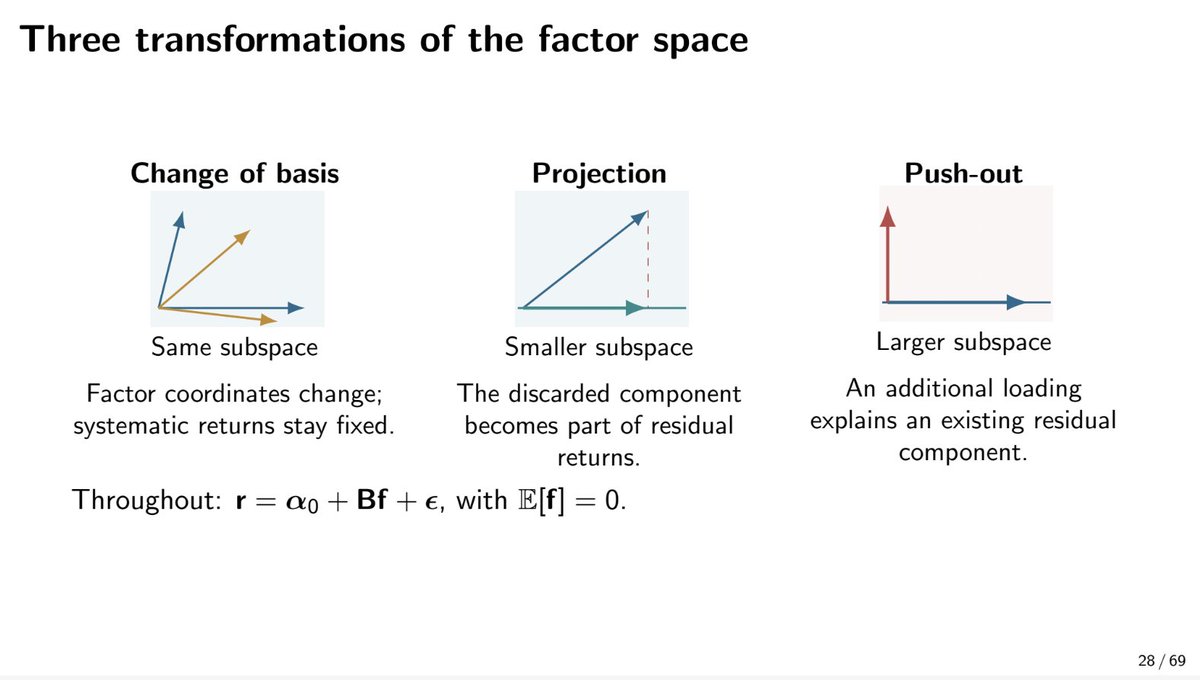
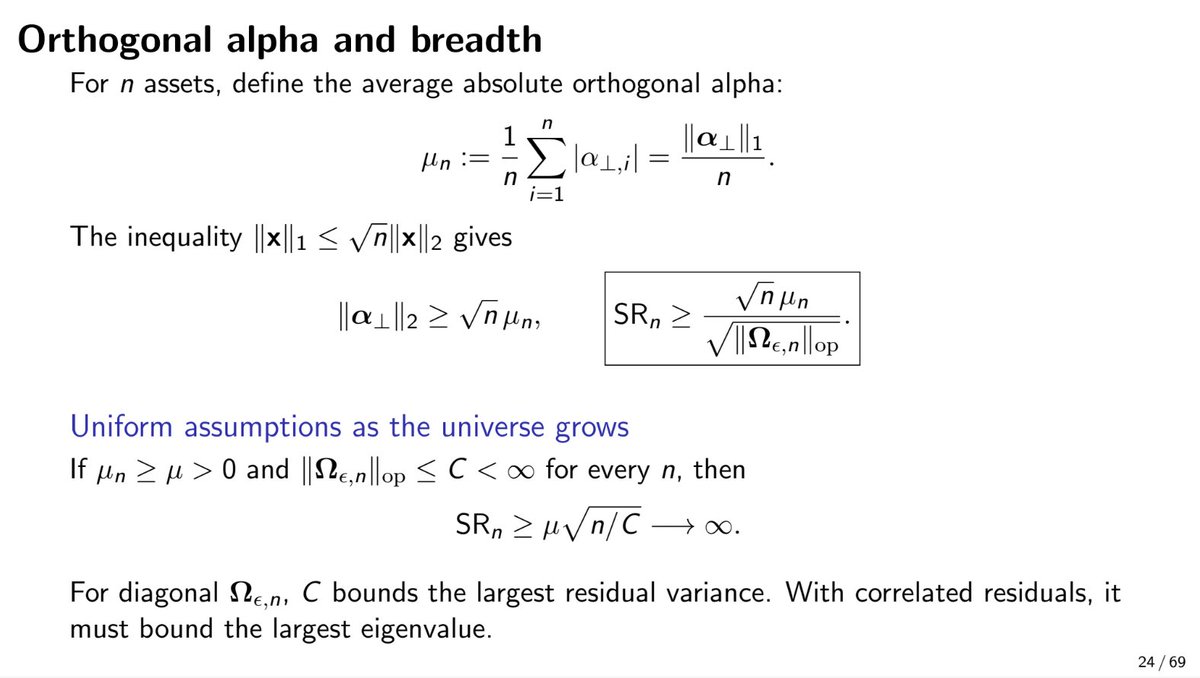
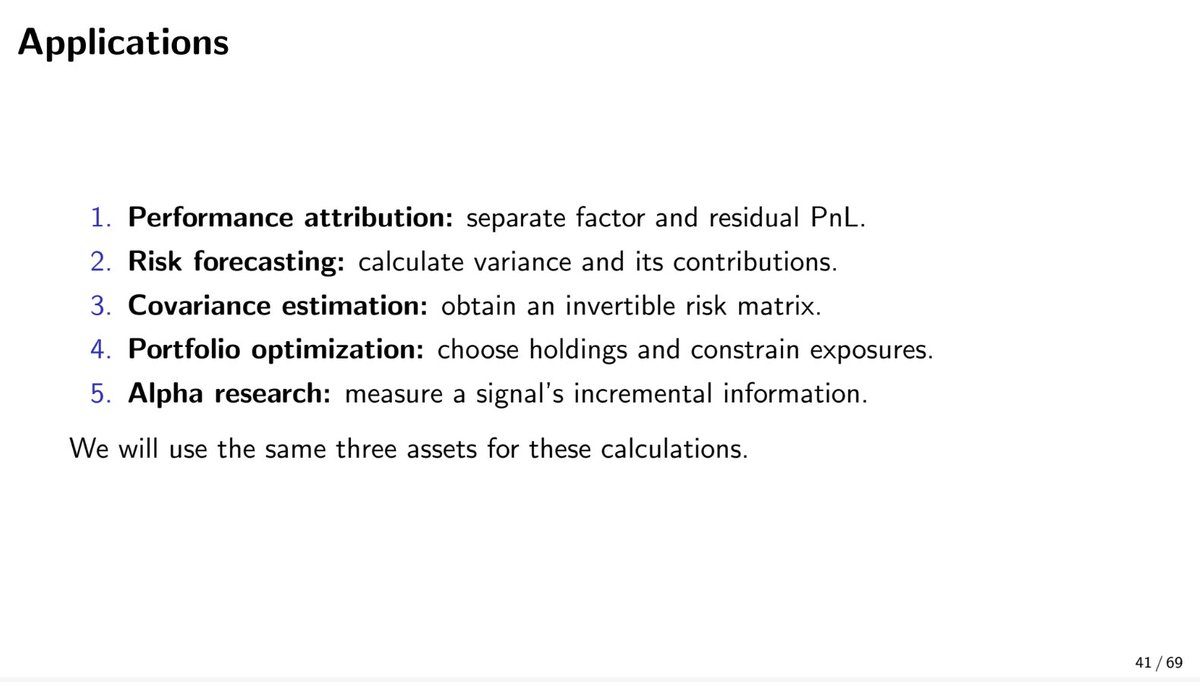
Here is my 2nd lecture for the Columbia course "Quantitative Investing". This one is on Linear Models of Returns (mostly ch.3 of Elements of Quantitative Investing). It's kind of a long scaffold lecture. It will be complemented by a presentation on alpha fusion later in the course. Link in reply.
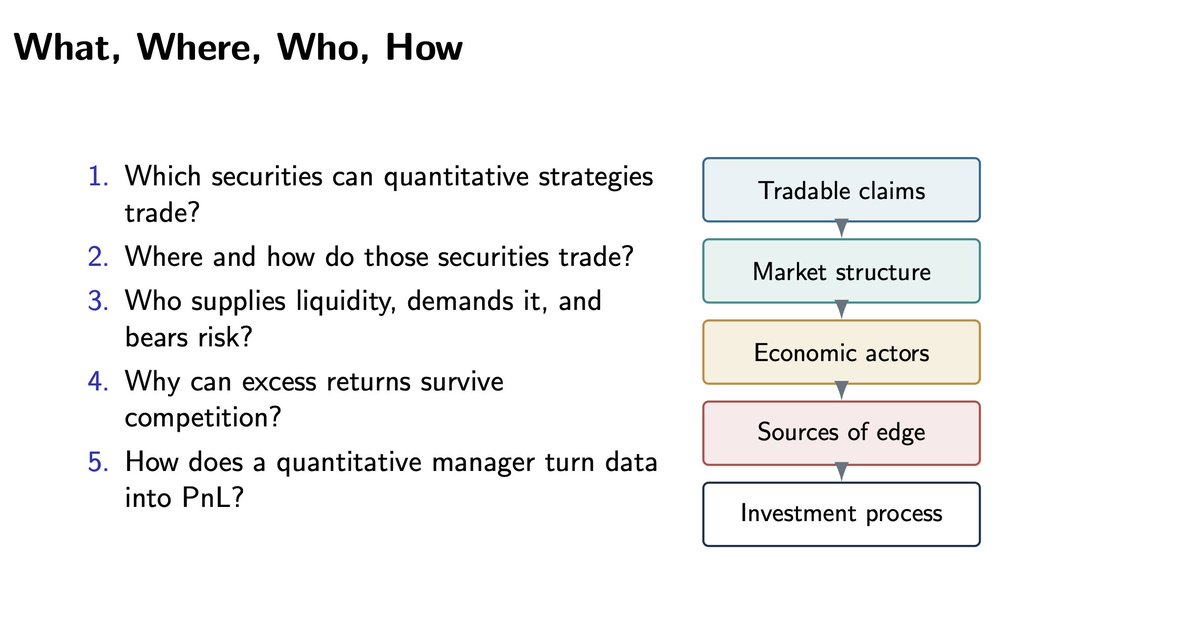
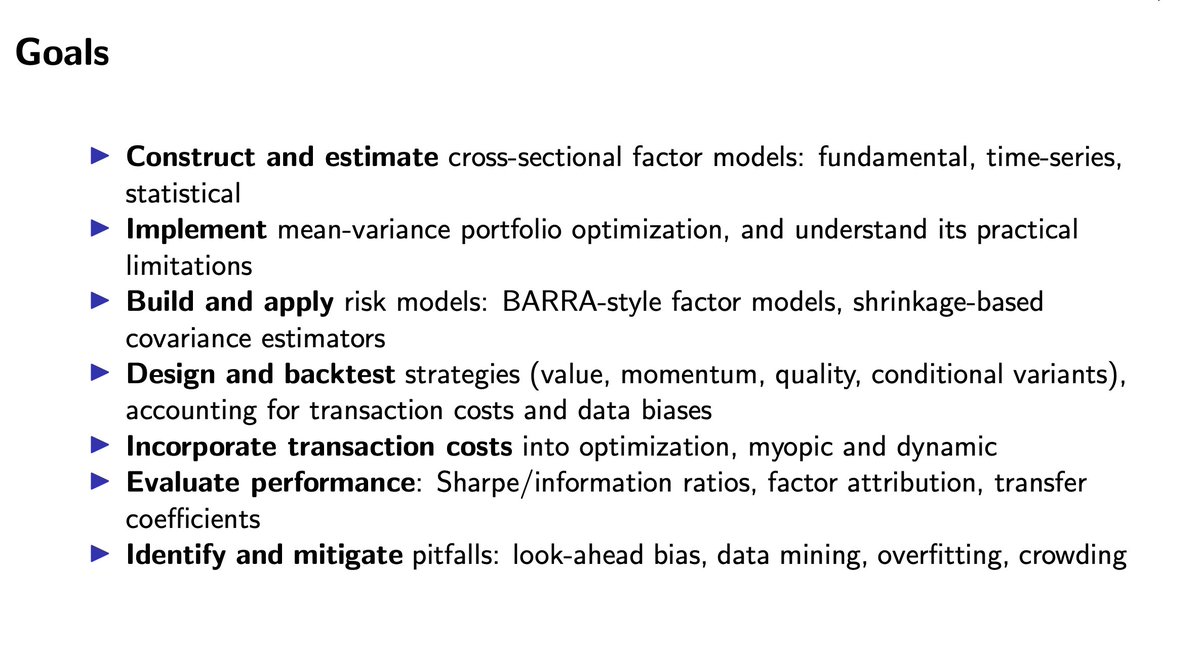
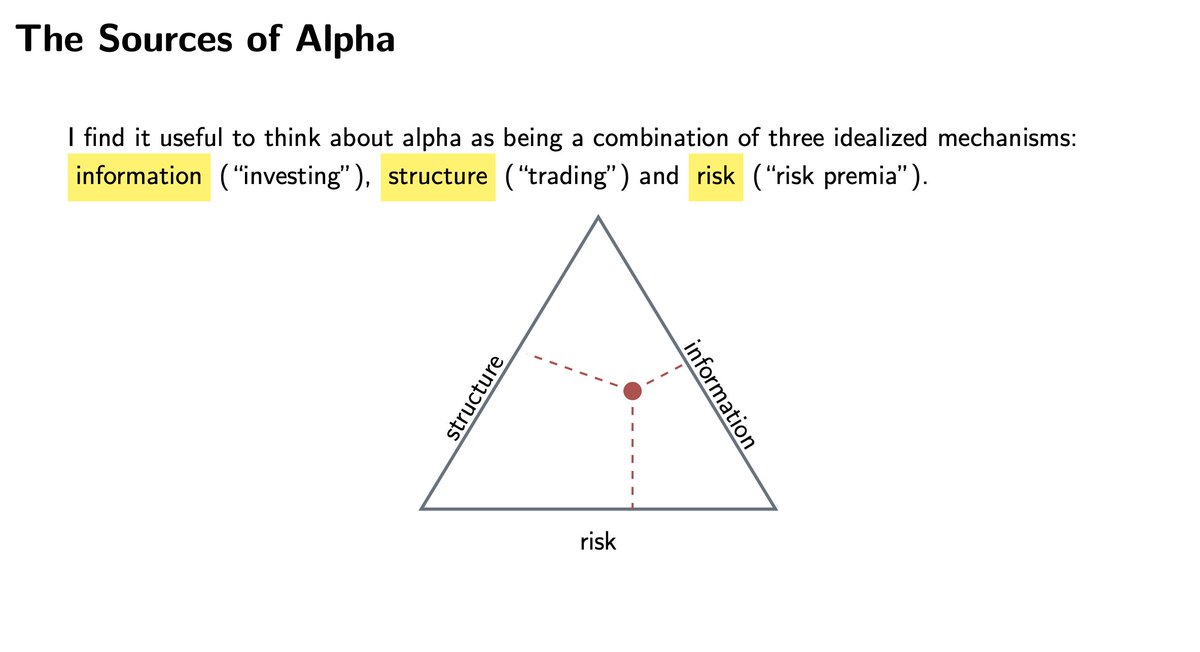
Background: I am co-teaching (with Kent Daniel) a grad course at Columbia titled "Quantitative Investing". I can share my slides, starting with the ones on market structure (ch.1 in my 2nd book). Below are a few representative slides.
I will share the lecture on linear return models this weekend.
At some point also one lecture on very high-dimensional linear models, which are interesting.
For now link to first deck is in reply. Enjoy.
This is a heuristic I learned early in my career that has saved me a good deal of money.
Generally speaking:
If you are short an asset and it experiences a stream of negative news that fails to push the asset lower, get out.
If you are long an asset and it experiences a stream of positive news that fails to push the asset higher, get out.
***BONDISTAN IS NOW ON SALE!***
GET IT WHILE IT'S HOT
It has been a journey to get this ready for publishing and I'm proud to finally share this with everyone. It would mean the world if you could spread the word and maybe buy a copy (or few dozen). Your support for my work means everything. ❤️
Available in physical and digital, Bondistan 2nd Edition in all its glory is here. Links to the various formats below. (If you're using your non-US Amazon storefront just search for "tourist guide to bondistan")
Hardcover (Physical)📔: https://t.co/VC0kfQi6jN
Paperback (Physical)📔: https://t.co/pVpHJoqax0
Kindle e-book (digital)📱: https://t.co/nJMtPslTTU
Gumroad Store (digital - PDF + e-book + Prove-outs)📱: https://t.co/PfELnmKRhu
One thing AI has done in the trading world is dramatically reduce the need for the traditional desk quant.
A desk quant’s role is very different from that of a quant researcher and or quant trader.
A quant researcher spends significant time building the infrastructure behind sustainable strategies: sourcing the right data, cleaning and storing it, identifying market anomalies, and determining whether those anomalies represent persistent, repeatable alpha. A quant trader is someone that mainly does all those things (varies across shops) but takes direct responsibility for the risk in a book.
A desk quant is traditionally closer to the day to day trading process. A core part of the role is helping traders quickly surface quantitatively supported information that can improve decision making.
An example might be: “The last four times the market dropped 1%, three-month fixed-strike vol significantly outperformed the rest of the surface.”
That observation probably isn’t a sustainable edge or something you would build an entire strategy around. But in that specific environment, it can provide valuable context for how a trader allocates risk.
AI has streamlined a tremendous amount of this work. With the right data infrastructure and prompts, agents can quickly identify these shorter-term relationships, run conditional analysis, and surface relevant information that previously required significant manual work from a desk quant.
The interesting shift is that the value is moving away from simply being able to retrieve and analyze information and toward knowing what questions to ask and how to translate the answers into risk. AI can increasingly provide the analysis. The trader still needs to understand what actually matters.
i like calendar effects.
trades exploiting calendar effects tend to be easy to understand, easy to test, and (usually) easy to execute.
they don’t need complicated models or hundreds of inputs.
to trade them, you often just need to know the time and date.
Most people over 40 are training for the wrong future.
They’re training to look fit. Nothing wrong with that … but my decades in the office have taught me important lessons here.
I’d rather train to remain capable.
Your fitness should expand your life, not become your life.
We recently (re)launched a number of websites. I will point out some features hat may be fun and useful. Thanks to @pjmauboussin for leading this effort!