Elucidating the Proton Source for CO2 Electro-Reduction on Cu(100) Using Many-Body Perturbation Theory | Journal of the American Chemical Society @UclaCBE@UCLA https://t.co/kwdQjwh9V5
New paper! Using Random Phase Approximation (RPA), we show that surface water, not solvent water, protonating CO—challenging DFT-GGA conclusions. Check it out! 👇
ChemRxiv - https://t.co/4mSTfCbK1a
Hydrogen-induced Cu adatom/ad-cluster formation triggers CO electroreduction in acidic media, which are supported by statistical analysis of surface populations and ensemble-based kinetic modelling. @DongfangCheng@UclaCBE
https://t.co/wuajrW3x7q
Check out our recent intriguing discovery: H-Induced Restructuring on Cu(111) Triggers CO Electroreduction in an Acidic Electrolyte | The Journal of Physical Chemistry Letters https://t.co/EGzv8cgrdJ #AcidicCORR#EnsembleCatalyst
Our cooperative work with @morales_guio in @Joule_CP We identified the origin of carbon source in reactive carbon capture(RCC) by combining a well-defined transport model and GCDFT. https://t.co/ZKhmw7TP74
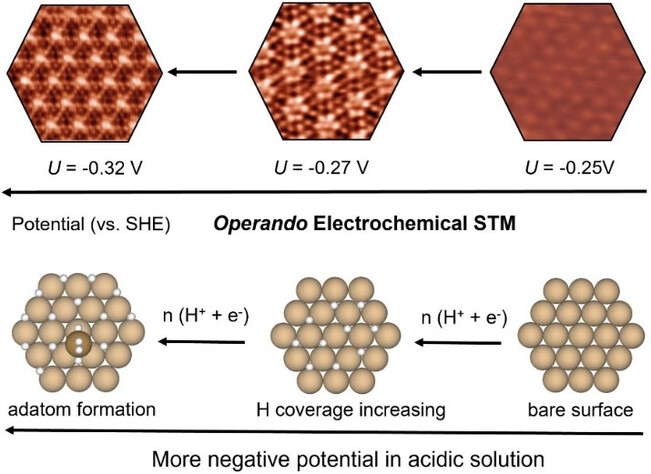
Check out our new paper in Angew Chem @angew_chem! We @zisheng_zhang_ ,Ziyang, Peter, Anastassia and Philippe decoded the surface restructuring of Cu(111) in the electroreduction condition by joint GCDFT and ECSTM. #compchem https://t.co/x0xpnemzmo
Restructuring and Activation of Cu(111) under Electrocatalytic Reduction Conditions (Philippe Sautet and co-workers) @DongfangCheng@zisheng_zhang_@UclaCBE@uclachem https://t.co/PbUe44DnJs