Historian Stephen Kotkin returns to @UncKnowledge with @P_M_Robinson for another round of five questions, this time on Iran, China, Ukraine, and the future of the American republic.
Kotkin argues that America still possesses unmatched strengths—economic, technological, military, and cultural—but warns that self-inflicted political dysfunction could squander them. He dissects Trump's Iran strategy, explains why China wants Taiwan "for free," argues that Ukraine has already won the sovereignty war against Russia, and delivers a powerful defense of America's founding ideals at a moment when both authoritarian regimes abroad and political extremism at home are testing them.
Sharp, provocative, and deeply informed, this is classic Kotkin: history as a guide to the geopolitical storms of the present. Watch the full conversation here:
Passive defenses — bunkers, hardened shelters, dispersal — aren't glamorous. The Pentagon has underfunded them for decades. Now, with U.S. troops under fire in the Middle East, DoD is scrambling to find vendors who can ship prefabricated shelters within 30 days. 🧵
"The only major system designed in the last 15 years that has been used in combat [Operation Epic Fury] is LUCAS — which we had to reverse engineer!" @PeteModi
Many of these old platforms have had glow ups in recent years, but still - it's very bad that we don't design and deploy new systems regularly
Hard hitting graphic from Defense Tech and Acquisition Substack
ICYMI: ISW's @nataliabugayova and @KatStepanenko warned in July that China, Russia, Iran, and North Korea are increasingly using cognitive warfare against the United States in order to shape US decision-making.
Russia is a key player in the cognitive warfare space and a model for China, Iran, and North Korea. Read ISW's primer on Russian Cognitive Warfare⬇️
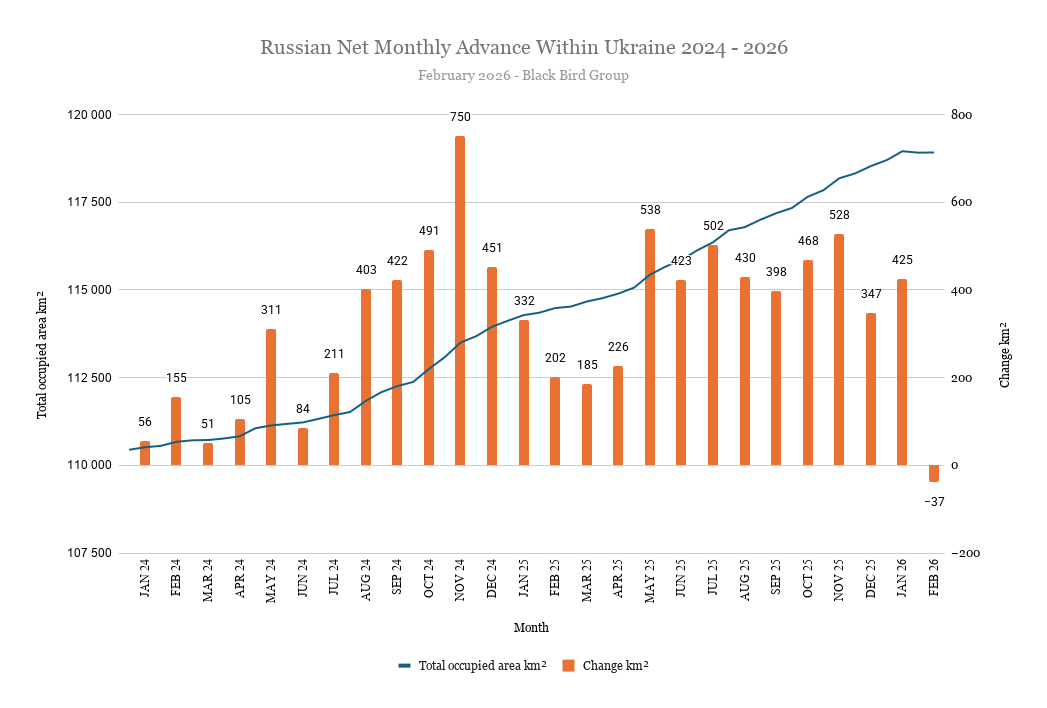
In February, the Russian monthly net gains in Ukraine turned negative. Over the whole month, the Russians lost 37 km² of territory in Ukraine.
This is the first net loss since November of 2023, and the worst month for Russia in terms of territory since August of 2023.
1/
You'll have read reports on how badly Russia's economy is doing. Yet they now make *7m shells a year*. Estonia's excellent foreign intel service says: "Given this production growth and substantial imports, Russia is highly likely to be able to replenish part of its strategic artillery ammunition reserves even while engaged in the ongoing war against Ukraine."
Russia also got est 5–7 million rounds from North Korea & Iran. According to Ukrainian assessments, North Korean ammunition accounted for roughly half of all Russian artillery expenditure on the Ukrainian front in the second half of 2025.
Moscow's also ramping up drone production & "training one million specialists and providing UAV-related coursework in 75% of Russian schools by 2030" while NATO, US included, is asleep at the wheel when it comes to drone warfare.
Breaking News: The number of Russian and Ukrainian troops killed, wounded or missing during nearly four years of war has reached nearly two million, a study says. https://t.co/Yqby3MmoFu
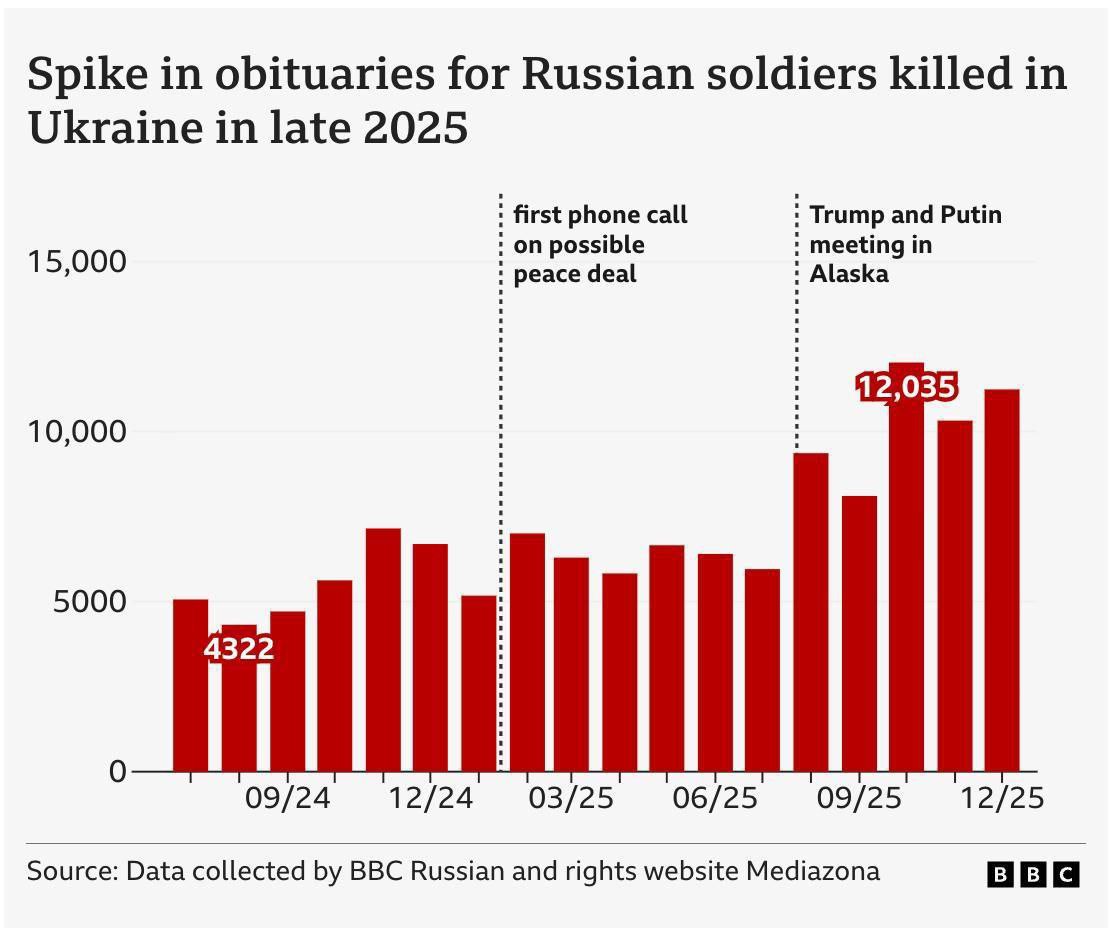
According to the BBC, in 2025 Russia lost 40% more soldiers on the front line than at any other time since the start of the full-scale invasion. The BBC has confirmed the names of approximately 160,000 dead Russians; at the same time, journalists say the real number of deceased Russian occupiers is likely to be twice as high.
https://t.co/wAY7xRPuBs
🚨🚨🚨 China is methodically chipping away at America’s Pacific defense architecture, and Yap’s Woleai airfield is the latest warning sign.
Despite the Federated States of Micronesia’s Compact of Free Association with Washington, Beijing has secured a deal to refurbish the airfield — just 450 miles from Guam.

That puts a potential dual-use Chinese facility inside the second island chain, complicating US plans for agile air dispersal in a Taiwan war.
Interior, regional commands, and legal advisers have all failed to enforce CoFA protections, risking billions in US investments and eroding America’s positional advantage in Micronesia.
📍 How a Remote Yap Airfield Could Undercut US War Plans on China
War this decade over the fate of Taiwan looks increasingly likely, making it vital for the US to hold important terrain to increase the odds of victory. China knows this, which is why it’s been waging a positional competition for advantage.
The latest example: an airfield in Yap.
Yap is an island group within the Federated States of Micronesia, which stretches over 1.500 miles across the central Pacific and is tied to the US within the Compact of Free Association (CoFA).
This association is critical, as it affords the US veto privilege over any third-party presence — like, say, a Chinese-built and -managed airfield or casino.
Yap is strategically located approximately 450 miles from the US territory of Guam, home to massive naval and air bases critical to deterring and waging any war in East Asia. As such, what happens in Yap is of significant military concern.
That’s why, in a March statement, Secretary of War Pete Hegseth told the President of the Federated States of Micronesia that our military infrastructure there will be increasing.
Yap’s military value is a function of its strategic location. Its atoll of Ulithi proved vital in World War II for naval operations supporting the invasion of the Philippines, Okinawa and preparations for invasion of Japan’s home islands.
In a modern war these islands will be important again and has attracted senior-level visits — from, for example, the Indo-Pacific Commander — and substantial resourcing through the Pacific Deterrence Initiative ($10 billion planned this fiscal year).

Almost on cue, China secured a deal to refurbish Woleai airfield on Yap in May, two months after Secretary Hegseth’s statement. For the US Air Force’s concept of Agile Combat Employment, it will need access to airfields in places like Yap to disperse when under Chinese missile attack.
A Chinese airfield in the middle of the second island chain would seriously complicate these plans, which is why it’s surprising more hasn’t been done to prevent or find alternatives to a Chinese presence there.
So, who is dropping the ball?
The Chinese activities at Woleai, to be clear, are not a surprise. It ranks almost as bad as the 2022 secret security pact the Chinese secured with the Solomon Islands.
Since Yap is in CoFA, the Department of Interior’s office for insular and international affairs and its troubled deputy should be at the tip of the spear.
And, the nearby Joint Region Marianas and Joint Task Force — Micronesia should have been aggressively raising alarms.
Given the stakes, an investigation is needed to determine how another Chinese investment in dual-use military facilities has proceeded unimpeded for so long.
Questions need to be asked about why regional legal counsels failed to contest this Chinese investment and to represent and ensure that US interests were met through CoFA.
Left unaddressed, US leadership responsible for the region will continue to fail in identifying and addressing problematic Chinese encroachment and influence in Micronesia.
The consequence of continued inaction will render years of effort and billions of dollars in military investment and planning useless.
https://t.co/3MpRU55UOB
Pentagon To Contract Fleet Of Seaplanes For The Pacific
The lack of an American amphibious aircraft capability has become more glaring as the possibility of a conflict with China looms larger.
Story: https://t.co/HZ7smz7Kyy
China’s Mysterious Sea-Skimming Ekranoplan Seen In Full View
The first full image of China's "Bohai Sea Monster" wing-in-ground effect craft has emerged, but major questions remain.
Story: https://t.co/k3RPbeF32p
For over a decade I have outlined the exact scenario as we just saw in Russia. It could happen in the U.S. tomorrow. This was a pivotal event. U.S. military and political leadership cannot live in partial denial of this threat anymore. Our most prized aircraft are sitting ducks.
Ukrainian "Pavutyna" (spider net) operation is today's attack launched simultaneously on four russia's strategic aviation airbases has reportedly destroyed 40 (forty) strategic bombers on 4 (four) airbases: Belaya (4700 km from Ukraine), Dyagilevo (700 km), Olenya (2000 km), Ivanovo (900 km). Drones were launched in swarms from cargo trucks. Ukrainians are gods of warfare. History is written today.


![Madeline_Zimm's tweet photo. "The only major system designed in the last 15 years that has been used in combat [Operation Epic Fury] is LUCAS — which we had to reverse engineer!" @PeteModi
Many of these old platforms have had glow ups in recent years, but still - it's very bad that we don't design and deploy new systems regularly
Hard hitting graphic from Defense Tech and Acquisition Substack](https://pbs.twimg.com/media/HDuDcmIW0AAdCPW.jpg)