Incredibly excited to finally announce what our team has been working on at Dotwork - and over the next couple of months, to start showing some of the game-changing capabilities of this platform.
In short, we’re shifting the power to practitioners and leaders within organizations whose ways of working have emerged from thoughtful design, culture, and craft.
What if a tool mirrored this approach? Designed by you, not sold to you.
An erector set of familiar capabilities for planning, prioritizing, documenting, tracking (and much more) mixed with capabilities unique to your context and strategy. A future-proof solution that acts as a rudder for transformation, but is adaptable to change.
In engaging with complexity, we need a platform designed to support emergent ways of working - not react to mainstream frameworks.
That’s Dotwork.
And that’s why we’re kicking off a design partnership - because we want to test our limits.
If you’re currently drowning in docs, templates, spreadsheets, dashboards, and decks to get the job done, let’s talk!
Read the announcement: https://t.co/1HbmKAu6kO
What are we talking about when we talk about portfolios?
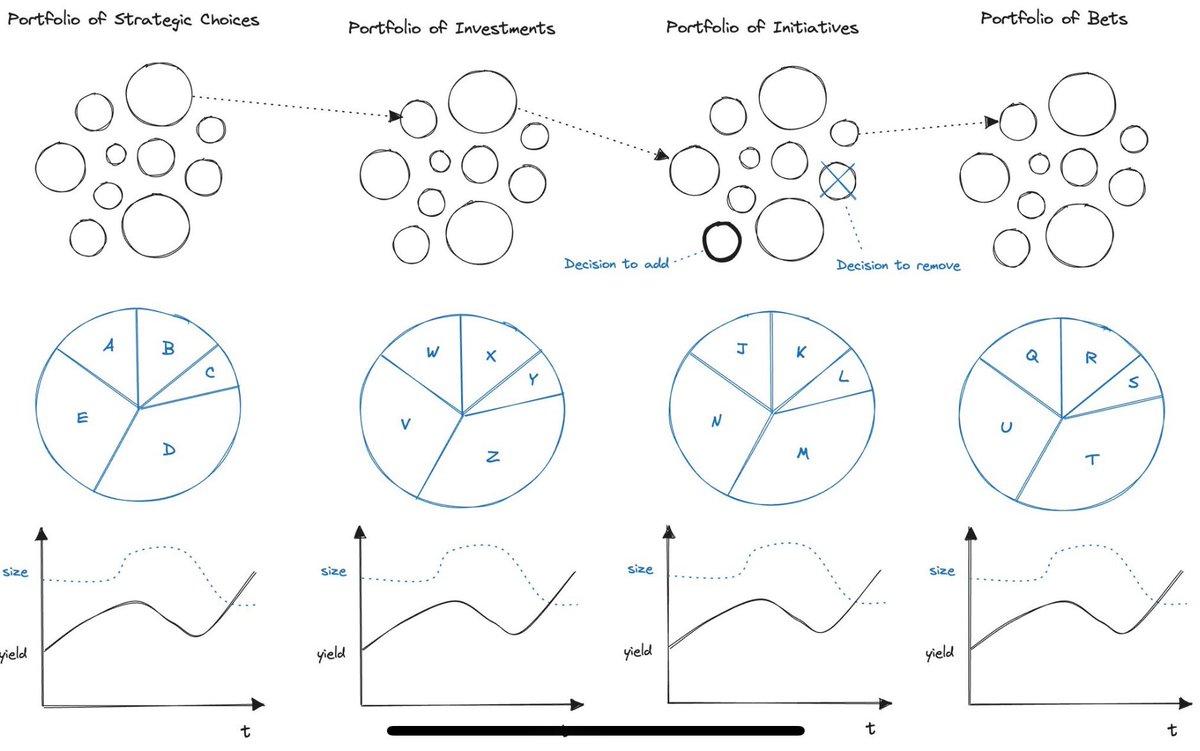
In an enterprise, we have many different portfolios of many different kinds. What they have in common is that they are a collection of assets or investments for which we seek an optimal return, for a given level of risk. These investments could be in the form of products, projects, applications, or experiments, just to name a few examples.
We look for relationships between the elements in a portfolio to drive those optimal returns. We leverage those relationships to make the "whole" bigger than the sum of the parts. Try to avoid "putting on blinders" when assessing an individual element.
We also seek to keep the elements balanced, when diversification helps us minimize risk. PIe charts are good for that.
Since there are multiple portfolios, we can draw connections between elements in each portfolio, to tell a larger story of alignment. For example, we can trace high level strategic choices all the way down to small bets made by a team (in their "innovation portfolio").
And the story changes over time, as the overall size (and the returns) of the portfolio rises and falls.
Punctuate your portfolio management with decisions - e.g. record the rationale when you add or remove elements. As trends emerge across the risks and returns, you'll be able to reflect back on the choices made (and the information that was available at the time).
Meetings may be crippling our ability to make effective assumptions
Take any major market shift as an example (e.g. Generative AI) - with any major, sudden, and uncertain change, we ask questions like:
"Does this pose an existential threat to our business?"
"Is this the catalyst for some new opportunity?"
"What do we think our competitors will do?"
We might reach out to a few people, schedule a meeting, and discuss - but unknowingly, we're poisoning the well.
How?
Imagine in that meeting, the first person to speak gives a pessimistic outlook. "Generative AI will render our business obsolete!". At that moment, and largely subconsciously, everyone's perspective has readjusted. (even if ever so slightly)
Due to cognitive biases and information cascades, research suggests that there's only one way we can reveal our true perspectives - to share what we think before we reveal what others think.
It's simple, yet powerful.
The mini-Delphi method is a simple and effective way to 'query' perspectives and deliberate AFTER everyone's point of view is collected.
This leads to more complete and diverse information, better forecasts, and ultimately, stronger assumptions - primarily by asking questions in a structured, asynchronous way.
👉https://t.co/O0601krYAT
Discussing predictions in meetings is crippling our ability to make effective assumptions.
Take any major market shift as an example (e.g. Generative AI) - with any major, sudden, and uncertain change, we ask questions like:
"Does this pose an existential threat to our business?"
"Is this the catalyst for some new opportunity?"
"What do we think our competitors will do?"
We might reach out to a few people, schedule a meeting, and discuss - but unknowingly, we're poisoning the well.
How?
Imagine in that meeting, the first person to speak gives a pessimistic outlook. "Generative AI will render our business obsolete!". At that moment, and largely subconsciously, everyone's perspective has readjusted. (even if ever so slightly)
Due to cognitive biases and information cascades, research tells us that there's only one way we can reveal our true perspectives - to share what we think before we reveal what others think.
It's simple, yet powerful.
The mini-Delphi method is a simple and effective way to 'query' perspectives and deliberate AFTER everyone's point of view is collected.
This leads to more complete and diverse information, better forecasts, and ultimately, stronger assumptions - primarily by asking questions in a structured, asynchronous way.
Have you tried running a mini-Delphi or worked in nominal groups before? We're curious to know what you've learned!
https://t.co/O0601krYAT
What makes a good decision, good? 🤔
A good decision is not necessarily one that leads to a positive or expected outcome, but rather one that is the result of a thoughtful and explicit process.
“Improving decision quality is about increasing our chances of good outcomes, not guaranteeing them.” - Annie Duke, Thinking in Bets
https://t.co/rIJXjixYSI
"The art of decision-making isn’t always about capturing some elusive “best” decision — it’s about making the most of information available, garnering trust across stakeholders and executing with conviction."
https://t.co/3bBqibdC2G
What's the difference between Data Science and Decisions Science? Chris Dowsett explains how Instagram fills different needs with these roles.
https://t.co/4nCkHmYiuE
11/ So let's go to "how to ask for a decision"
1: What is the decision?
2. What data is needed for the decision?
3. Do you have the data? (if not, go get it)
4. What decision would YOU make with that data?
5. Do you still need to ask for a decision or did you just make it?
Understanding biases and heuristics can change the way we interact with others and help build empathy.
Using models and frameworks to actively combat their effects can help teams work better ...and more importantly, be happier.
We made a (non-exhaustive) visual list here 👇
"In this roundup, we’ve gathered six time-tested tools, frameworks and principles for making high-quality decisions at fast-moving startups."
https://t.co/cPDCZwgUdN
"Most discussions of decision making assume that only senior executives make decisions or that only senior executives’ decisions matter. This is a dangerous mistake."
- Peter Drucker
Developing a decision architecture (or deciding how to decide) will be what differentiates high performing teams in the coming decades
https://t.co/48UVarBW9c