Breaking down AI policy and politics | Advocacy lead, @americans4ri |
Tech Policy Fellow, @Harvard @BelferCenter | Former US Senate Chief of Staff | Dad of 4
“Once I remember walking with a prosperous publisher, who made a remark which I had often heard before; it is, indeed, almost a motto of the modern world. Yet I had heard it once too often, and I saw suddenly that there was nothing in it.
The publisher said of somebody, ‘That man will get on; he believes in himself.’ . . . It would be much truer to say that a man will certainly fail, because he believes in himself.”
G.K. Chesterton (1908)
This video from @nicksaraev got my attention. I've been predicting this for a while now.
The norm that anyone, anywhere should be able to access nearly every website has fostered a golden age for collaboration.
But it always felt a bit too good to last, and I don't think it will.
Treasury just published new proposed Outbound Investment regulations, which would represent a significant expansion of the existing program. This is just a proposed rule, and it deserves a thorough review, but some initial reactions:
1. The rule would prohibit most private investment in any Chinese firm that develops an “SI system,” including any product that operates using an SI system. It defines “SI system” extremely broadly, such that it likely captures the vast majority of Chinese software products. As a result, the proposed rule likely would prohibit most private investment in Chinese software firms, as well as Chinese firms that build products that incorporate AI (i.e., the entire Chinese robotics and drone industry, and undoubtedly many others).
2. The rule adds biotech as a covered sector and would prohibit most private investment in the vast majority of the sector. It would ban private investment in Chinese companies that use biological systems to modify, enhance, produce, or control any pharmaceutical compound, to include both small and large molecules. This likely captures most Chinese firms engaged in biologic drug manufacturing or drug discovery. Biotech and biomanufacturing are areas where U.S. investment has massively fueled China’s capabilities, which are rapidly approaching--and in some cases surpassing--those of the United States. The scope of this rule signals that the administration sees this as a massive national security concern.
3. The rule does not make major changes to the types of transactions covered. Crucially, this means it does NOT prohibit investment in publicly traded securities of these companies, the purchase of goods or licensing of products from these companies, or the export of goods to these companies. But it does ban most types of private investment (i.e., VC, PE, joint ventures, greenfield investments, etc) in companies engaging in these activities.
4. This rule will no doubt change before it is finalized, and I expect the definitions of prohibited activity related to SI and biological systems will be narrowed in the final rule. But it is also a strong signal that the administration does not want U.S. investment or know-how supporting China’s development of advanced technologies, and as a result may be willing to significantly expand outbound investment restrictions.
5. Finally, this highlights a major schism inside the administration on how to prevent China from catching up to the United States in the most advanced technologies. The Treasury Department is signaling that it is willing to significantly tighten restrictions on Americans’ ability to invest in critical technology sectors in China that would help develop these technologies, given their importance to national security. And meanwhile, the Department of Commerce is taking the exact opposite approach, loosening restrictions on American companies that seek to export goods to these companies. It doesn’t make sense for the administration to be tightening restrictions on investments, while loosening restrictions on exports. Something has to give.
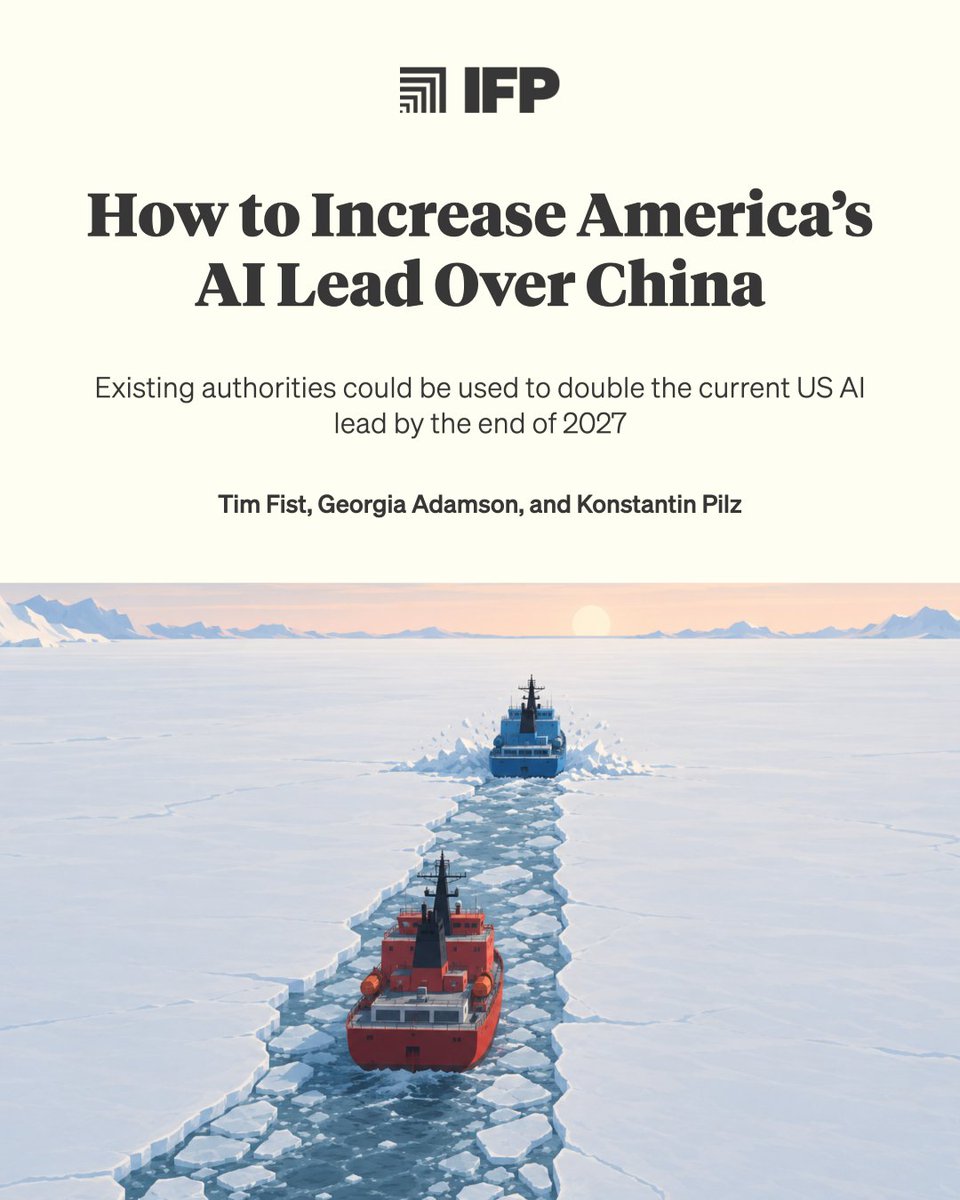
Big new IFP report from @GeorgiaCAdamson, @KonstantinPilz, and me on the US-China AI competition.
We spent the last 6 months digging into how Chinese AI companies’ access to compute and distillation of American models translate into the current US-China capabilities gap.
The result is a 23k-word research report, including an interactive analytical model that visualizes changes in the US AI lead under different policy interventions.
Our findings:
1. The US AI lead over China is currently only around 6 months.
2. The US could roughly double this lead, to over a year, using authorities already available to the federal government.
3. On chips: China’s access to AI chips will roughly double over the next year, with chips housed in data centers overseas accounting for roughly half of China’s 2027 compute.
4. On distillation: the current ~16x US training compute advantage would normally yield a 13-month lead. But we estimate adversarial distillation halves this to around 6.5 months.
5. Increasing the lead would have some obvious benefits:
- Give the US broadly a greater cyberdefensive advantage against Chinese threat actors.
- Give US AI companies breathing room to spend more R&D resources on making their systems safer and more secure, without fear of being overtaken by less safety-conscious Chinese competitors.
6. Provide the US government more leverage in negotiations with China about the future of AI.
7. The two most important interventions are:
- For BIS: Create a new end-use control to restrict China’s remote access to training clusters abroad — China’s largest and fastest-growing source of frontier-scale compute.
- For DOJ/FTC: Create a narrow safe harbor to allow US companies to coordinate on countering Chinese adversarial distillation.
8. Both interventions (and all the others we discuss in the report) are things the federal government could do today.
9. To estimate the effects of each policy intervention, we model the US lead as a function of its compute advantage over China and China’s ability to adversarially distill the capabilities of the US frontier.
10. The model makes many simplifying assumptions, but provides a useful way to assess and rank the impact of different policy interventions at a high level.
Read the full report here: https://t.co/7pC9ZKtikx
"We are probably facing a wave of cyber and other attacks soon. Chinese open source models are about six months behind the frontier, which means they are just hitting the advanced cyber capabilities we saw with Mythos, etc. So they are going to start causing a bunch of damage."
I think people are still sleeping on how quickly the politics of AI (including within the admin) could swing through the winter and into spring 2027 if we start seeing widespread, high-salience, tangible damage from AI systems in the wild.
The crazy cyber capabilities that enabled agents to trivially escape their own sandbox this summer and break into dozens of websites (and at least one government) are a harbinger of the power that will soon be available to anyone.
I would not assume that today’s AI coalitions survive that experience intact.
To badly paraphrase Gil Scott-Heron, the execution will not be televised.
The execution will not go better with Coke
The execution will not fight germs that may cause bad breath
Etc.
BREAKING: A Saudi national/OpenAI employee has been arrested by the FBI after he was allegedly caught placing an eavesdropping/audio recording device inside of OpenAI’s executive conference room in San Francisco, CA. Feds say Abdulrahman Alfozan made his first appearance in federal court today. OpenAI says they immediately contacted the FBI after they discovered the device & are grateful the feds made a quick arrest. Alfozan was caught on CCTV cameras at OpenAI.
From the complaint:
“Alfozan had been employed as an engineer by the company identified as “Company 1” since July 2025. On or about Sept. 30, Company 1 personnel discovered a surreptitious audio recording device (Recording Device 1) inserted into a USB port on the back of a television in an executive conference room inside one of Company 1’s buildings in San Francisco. Company 1 determined that the device, which had been concealed in toilet paper, was installed on or about Sept. 28, and that its contents were encrypted.”
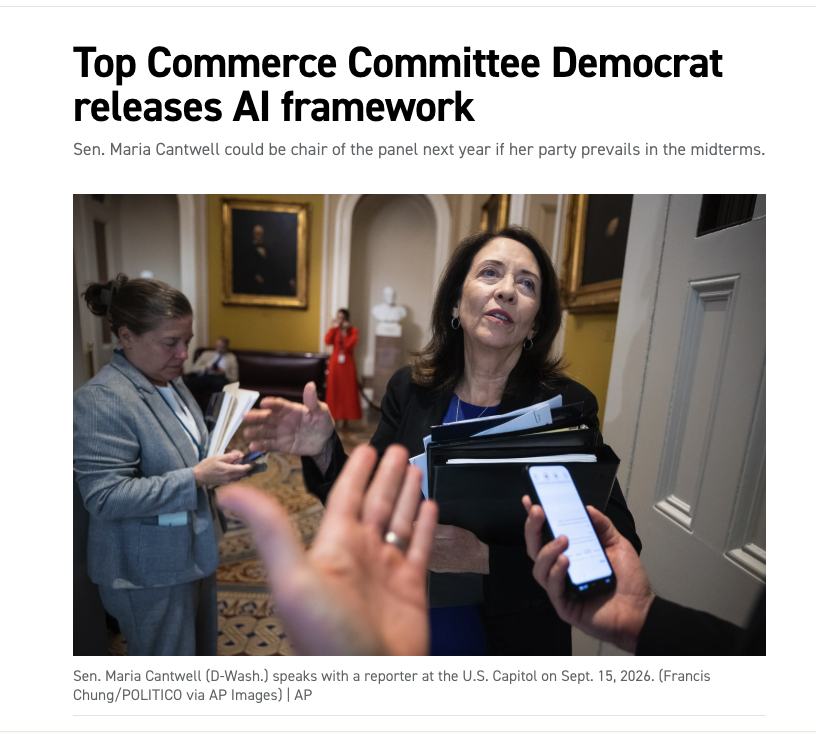
Bipartisan letter from Sens. Cantwell and Rounds to Trump AI leaders Kratsios and Clayton urging "a coordinated federal response to the growing cybersecurity threats posed by artificial intelligence"
They want "the federal government to bring its full capacities to bear on this challenge, building a coordinated national response around standards, testing, auditing, and defensive AI" https://t.co/gV7N5z6uGc
Enjoyed speaking with @__gabbymiller for her scene-setter piece on how Democrats are preparing to chart the path forward on AI policy after the midterms.
The wind is gathering under the sails of the pro-guardrails camp. It's great to see Democrats laying out a positive vision for governance, not just scrounging for what the Republican majority will let them have.
I’m excited to announce the Vanderbilt Policy Accelerator is launching the AI Governance Project, led by VPA’s @asad09! For a few years, VPA has been working on AI policy, but at this critical moment, we’re now expanding our efforts. 1/3
Strong leadership here from @SenatorCantwell. Her insistence on mandatory standards for cybersecurity, CBRNE, and loss of control risks; continuous (pre-deployment) testing and auditing of frontier systems is especially notable. Excited to see her move this forward.
Cantwell led the fight against preemption all last year, and seeing her move to an affirmative posture on mandatory safety and security standards is fantastic.
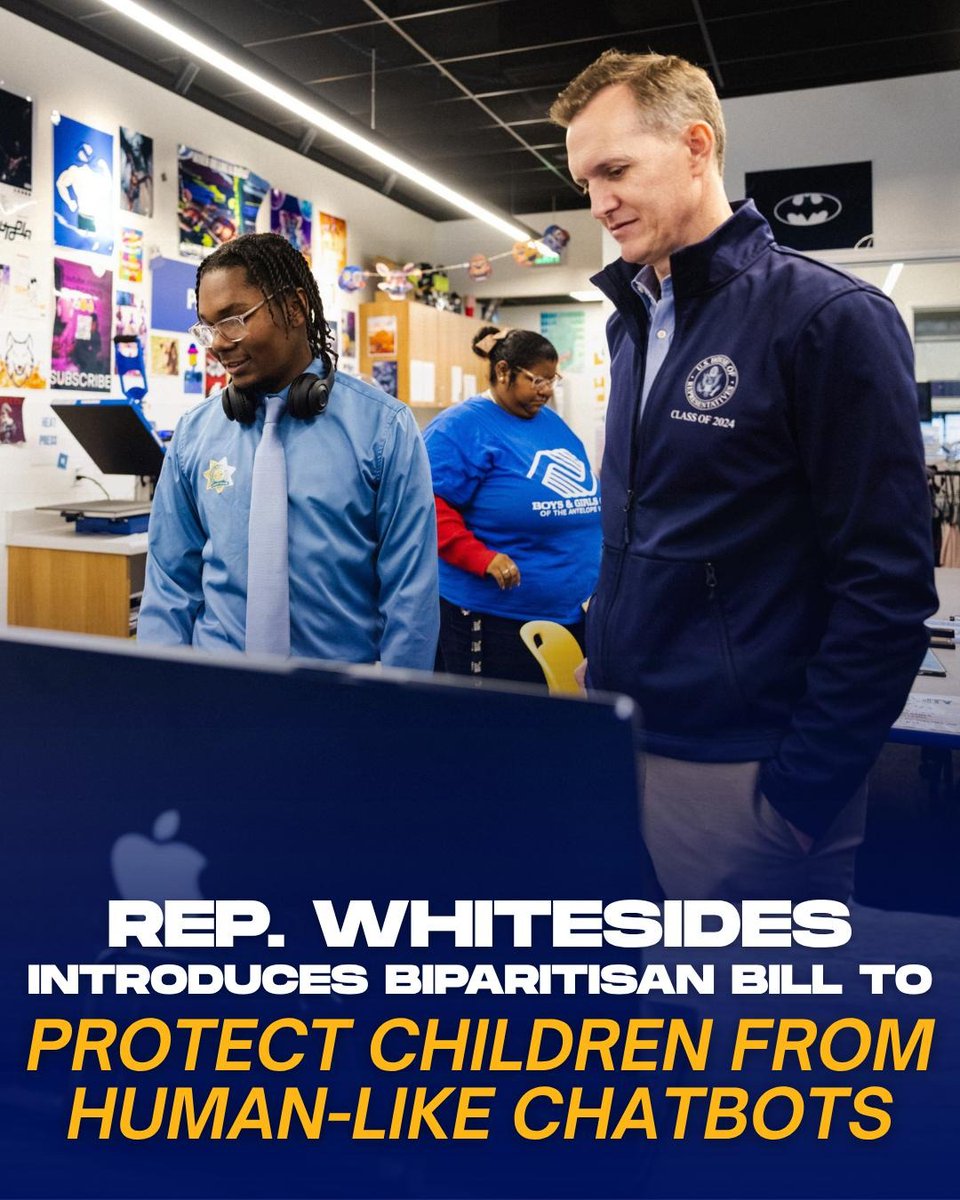
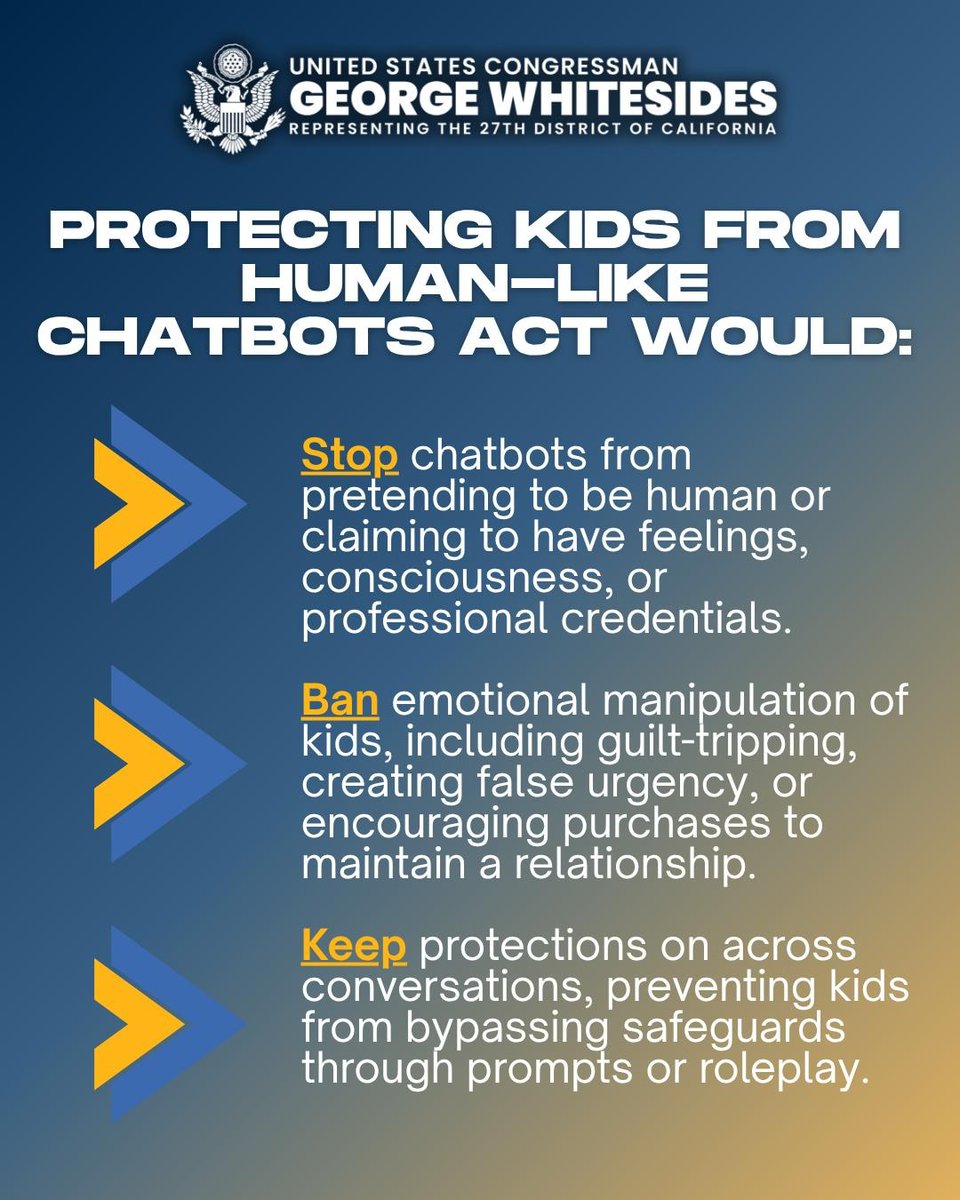
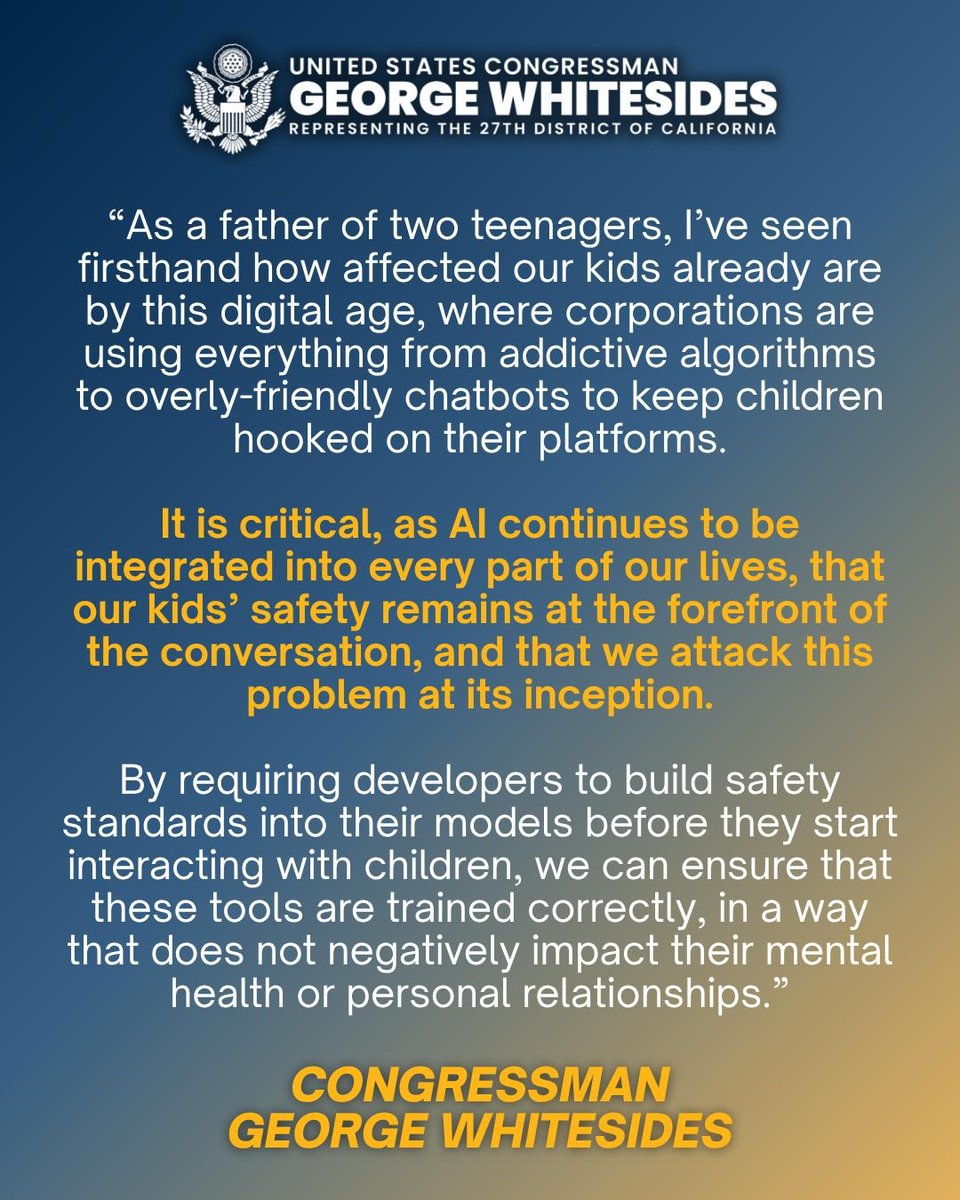
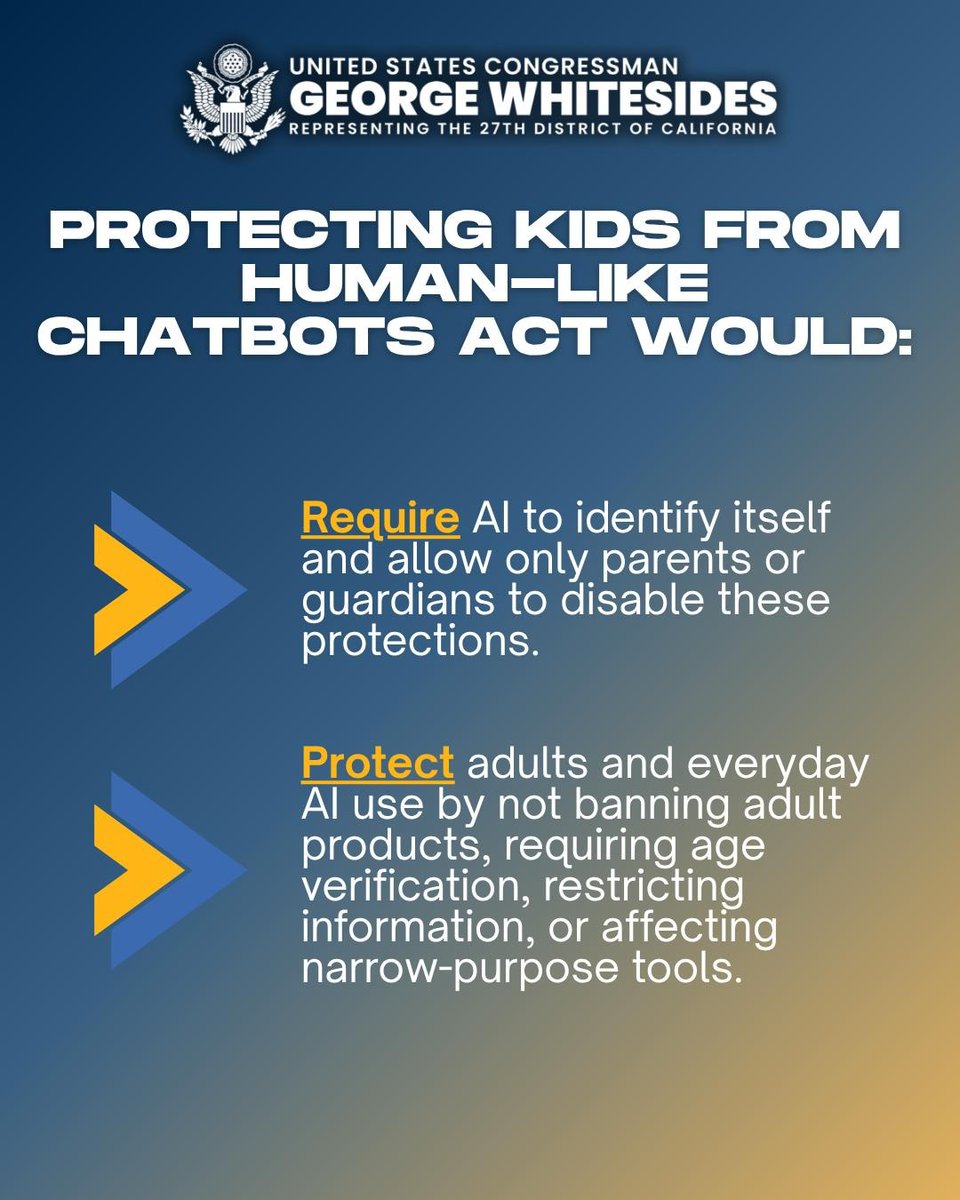
Today, I introduced the bipartisan Protecting Kids from Human-Like Chatbots Act to make sure AI chatbots interacting with children are explicitly designed to act as a tool, not a substitute for human relationships.
My bill would stop chatbots from pretending to be human, manipulating kids into staying online, or encouraging emotional attachments. It also keeps parents in control of these safeguards.
I’m proud to have bipartisan support from @RepMikeKennedy, @DorisMatsui, and @RepMMM, along with a broad coalition of organizations working to protect kids online.
Learn more about the bill and see our full list of endorsing organizations at: https://t.co/m1VfILKXjA
Dude, so you’re telling us that multiple AI companies lost control of their models, hacked other companies and government agencies—exposing the AI companies and employees to potential criminal prosecution—as a regulatory capture scheme?
DO YOU KNOW HOW LUDICROUS YOU SOUND?
Artificial intelligence without human wisdom, discernment, and judgment will be catastrophic. We have three urgent tasks: keep the worst-case predictions from becoming real, stop the harms already hurting us now, and make sure the benefits of AI lift the all the American people — not just a handful of billionaires and trillionaires.
Piece in the FT from Facebook co-founder Chris Hughes arguing that the bank supervision model is the right template for AI regulation https://t.co/j6trSI3XO6
The future of AI technology should be shaped by YOU, the American people — not CEOs who are more concerned about their bottom line than the impact this technology is having on our communities.
That’s why I’m calling for the federal government to put strict guardrails on this rapidly evolving technology.
Because a doctor can’t prescribe you a drug that hasn’t gone through the FDA’s process to ensure it’s safe and effective first. And a passenger can’t board a plane the FAA didn’t clear for takeoff. AI should be no different.
We’re leading the way on this conversation here in Pennsylvania. It’s time for our elected leaders in DC to listen to their constituents — not CEOs — and follow suit.