How Hope Married Fear And Lived Happily Ever After.
-
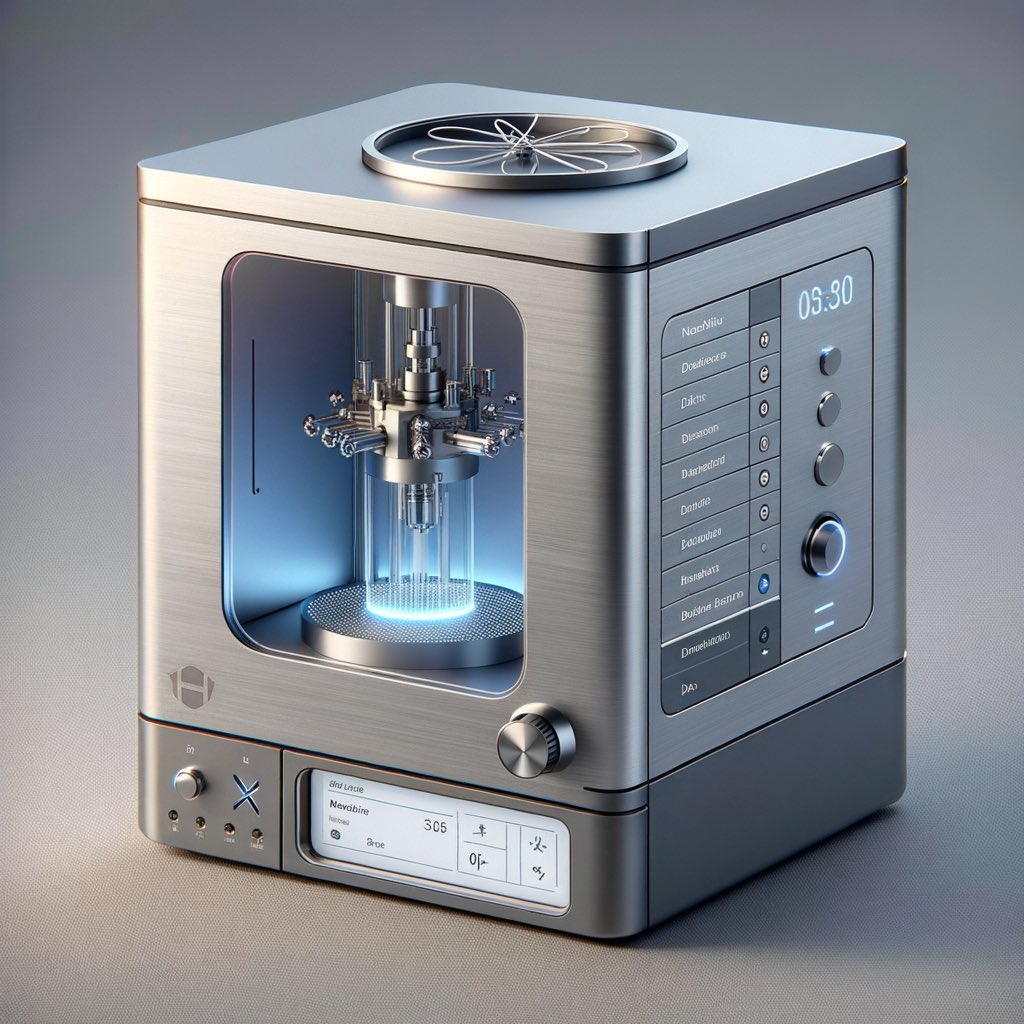
The fear that AI would end the world will look childish by 2040. But how? It is just one step in a process that brings us to the real singularity, it is the nanofabricator.
In the next 7 years the nanofabricator begins to emerge as a transformative force, one that will redefine the very fabric of human existence.
It is the zenith of additive manufacturing, the nanofabricator is not merely an incremental improvement upon contemporary 3D printing; it represents a quantum leap into the realm of atomic precision engineering.
Although this concept has been thr center of science fiction for over the last 100 years, the actual nanofabricator began 1990s. This introduced the concept of molecular assemblers—devices capable of constructing materials and objects atom by atom, as detailed in early patents.
This first serious acceptance of this radical notion found its roots in the visionary 1959 lecture by physicist Richard Feynman, "Plenty of Room at the Bottom," which postulated the manipulation of individual atoms as a frontier for future technologies.
The operational principle of the nanofabricator is grounded in the mechanosynthesis, where molecular feedstock could be programmatically assembled into desired structures with atomic precision.
This process is supported by advancements in fields such as synthetic biology and nanoscale materials science, where the manipulation of matter on an atomic level is increasingly viable, as evidenced by a growing body of patents and peer-reviewed research.
As the nanofabricator evolves from massive bulky prototypes to a personal desk-sized apparatuses, its potential applications are boundless. With the input of simple raw materials—akin to the 'ink' in traditional 3D printers—and energy, possibly harvested from integrated photovoltaic sources, it could synthesize an array of products from food to medicine, electronics to clothing, all from the molecular level up.
Yes the societal implications are profound. By rendering material goods infinitely replicable, the nanofabricator could dismantle the economic structures predicated on scarcity and supply constraints.
The value hierarchy would be upended, with raw materials, the fabricators themselves, and the digital blueprints for objects becoming the new currency of trade. In a post-scarcity world, the concept of wealth could be redefined, shifting from the accumulation of goods to the free exchange of designs and ideas.
The potential for such a machine to end war and poverty is not mere utopian fantasy. With the ability to meet the basic needs of all humanity, the drivers of conflict and deprivation would be significantly mitigated.
The abundance provided by nanofabricators would foster a new era of humanity and cooperation, reducing competition for resources and rendering many governmental functions obsolete, as the management and distribution of physical resources becomes a non-issue.
This future is not without challenges. The transition to a society where nanofabricators are ubiquitous will require a transition that will make the AI transformation look easy.
The impact on human society would be unparalleled, potentially ushering in an age of peace and prosperity previously relegated to the realm of science fiction. As we stand on the cusp of this new era, it is incumbent upon us to prepare for the profound changes that the nanofabricator heralds.
It can be seen that the nanofabricator epoch of all intelligent societies is the endpoint where just thinking is the “work” we do and return to craftsmanship just for the experience.
Take a moment to bail up the dystopian end-of-the-world movie scrips we have playing in our heads and begin to welcome the real possibility, like always, we are wrong about the how we survive and thrive.
This is the likely outcome.
The fact we are here now is the proof we find a path even as, like children, push each other off the path. We grow up.
The average man lives a shallow, uninspired, and depressing life.
They want to change, but inevitably fall into their old ways.
A thread on permanent change:
Naval Ravikant once said you will never get rich renting out your time.
The secret?
Leverage.
If you want to earn with your mind and not your time, follow this 5 step blueprint:
Why most people don't make money:
They invest in assets when they should be investing in themselves.
I’ve spent $120,000 on business coaching - and I have zero regrets.
9 lessons I paid $120k for (free for you):
Nobody is coming to save you.
Not your friends. Not your family. Not the government
They can offer advice and tools.
But at the end of the day, it's up to you to change your mind and act regardless of how you feel.
A thread of advice you need to hear:
Imagine if there were a powerful intervention, readily available to all, that could significantly delay brain aging and protect against dementia - well, that intervention exists, and it's called exercise.
In a study involving over 1,400 midlife women. Those with high fitness levels, as measured by a cycling test, experienced a remarkable 9.5-year delay in dementia onset compared to those with medium fitness.
https://t.co/1EtnEwEmkP
@Catholicizm1@thetraddiestman I spent the last 20 years in Trades. There is plenty of opportunity out there. Just have to be wiiiing to find it and learn.