How to set up @GoKiteAI Agent Passport First where can you run this?
✅ Claude Code (easiest, paid)
✅ Ubuntu Terminal (free, slightly more manual)
✅ WSL (Windows Subsystem for Linux)
✅ macOS Terminal
✅ Any Linux-based terminal
Good news it works FREE on Ubuntu terminal! Slightly more manual but 100% doable.
Here's how 👇
1️⃣ Install Kite Passport curl -fsSL https://t.co/bQ0i20CKiz | bash
2️⃣ Sign up & verify email
kpass signup init email [email protected] output json
→ Check email
→ click verification link
→ then: kpass signup exchange signup-id <ID> exchange-token <TOKEN> output json
Already have account?
kpass login init email [email protected] kpass login verify login-id <ID> code <OTP>
3️⃣ Fund your wallet
kpass wallet balance output json
→ Get your on-chain wallet address
→ Send USDC to your wallet address
→ Kite is now LIVE on mainnet!
4️⃣ Register your AI agent
kpass agent:register type coding-assistant output json
Agent types:
→ coding-assistant
→ research-agent
→ or any custom label
5️⃣ Create spending session
kpass agent:session create
--task-summary "Your task here"
--max-amount-per-tx 2
--max-total-amount 10
--ttl 24h --assets USDC
--payment-approach x402_http
--output json
YOU control the rules:
Max per transaction
Max total budget
Session lifetime
6️⃣ Execute paid request
kpass agent:session execute url "https://t.co/4q30tcIrty" method GET output json
Agent pays autonomously via x402
7️⃣ Discover paid services ksearch services list
--query weather
--payment-approach x402_http
--asset USDC limit 10
--output json
Monitor active sessions anytime:
kpass user sessions status active output json
Using Claude Code?
→ Skills auto-installed
→ Agent runs automatically
→ Easiest experience
Using Ubuntu Terminal?
→ Run commands manually step by step
→ 100% FREE
→ Same result, slightly more effort
→ Perfect for builders on budget
Your AI agent now has:
Identity on-chain
Its own wallet
Spending limits YOU control
Autonomous x402 payments
Access to paid API catalog
This is the agentic economy in real life
Full docs 👇
https://t.co/bVsf2hNF1B
@Kite_Frens_Eco@KiteAIFDN
#AIAgents #KiteAISharing
we’re entering the era of AI agents
Kite AI is already pushing that future forward:
Coding assistants that can process payments, complete tasks, and operate autonomously while still staying within user defined budget controls
Real execution
Real utility
Real cost boundaries 🪁
Exploring another practical Kite Mainnet use case with Kite Agent Passport and x402 payments
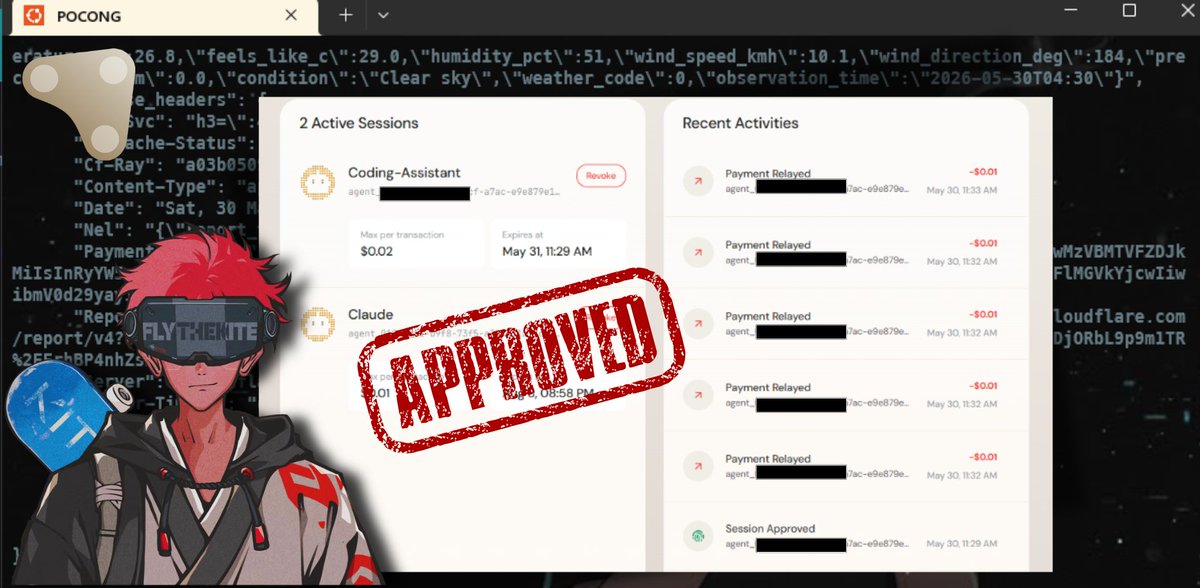
In this workflow, I first approved an agent session and defined clear spending permissions, including a maximum transaction limit of $0.1 USDC and a total budget of $2 USDC. Once approved, the session became active and the agent was able to operate within the limits I set.
With the session active, Kite Agent Passport automatically enforced the spending policy, expiration period, and budget restrictions, allowing the agent to make requests without requiring manual approval for every action while still maintaining user control.
The agent then successfully accessed a paid weather service through the x402 protocol and completed the payment automatically within the approved limits. The transaction was processed successfully, demonstrating how agents can interact with paid services and retrieve useful data through programmable permissions.
After running multiple agent sessions and executions, it becomes easier to see how Kite Agent Passport enables a secure framework for autonomous agents. The complete flow from session approval, policy enforcement, agent execution, and successful payment shows how AI agents can access services, purchase data, and perform tasks while remaining constrained by user defined budgets and permissions.
This is one of the most practical examples of the emerging agent economy, where agents move beyond conversation and become active participants capable of interacting with real services in a secure and controlled way.
Thanks to the Kite community for continuing to share ideas, use cases, and builder experiences that help showcase what can be built on Kite Mainnet
@GoKiteAI@Kite_Frens_Eco
#KiteUseCaseSharing
How to set up @GoKiteAI Agent Passport First where can you run this?
✅ Claude Code (easiest, paid)
✅ Ubuntu Terminal (free, slightly more manual)
✅ WSL (Windows Subsystem for Linux)
✅ macOS Terminal
✅ Any Linux-based terminal
Good news it works FREE on Ubuntu terminal! Slightly more manual but 100% doable.
Here's how 👇
1️⃣ Install Kite Passport curl -fsSL https://t.co/bQ0i20CKiz | bash
2️⃣ Sign up & verify email
kpass signup init email [email protected] output json
→ Check email
→ click verification link
→ then: kpass signup exchange signup-id <ID> exchange-token <TOKEN> output json
Already have account?
kpass login init email [email protected] kpass login verify login-id <ID> code <OTP>
3️⃣ Fund your wallet
kpass wallet balance output json
→ Get your on-chain wallet address
→ Send USDC to your wallet address
→ Kite is now LIVE on mainnet!
4️⃣ Register your AI agent
kpass agent:register type coding-assistant output json
Agent types:
→ coding-assistant
�� research-agent
→ or any custom label
5️⃣ Create spending session
kpass agent:session create
--task-summary "Your task here"
--max-amount-per-tx 2
--max-total-amount 10
--ttl 24h --assets USDC
--payment-approach x402_http
--output json
YOU control the rules:
Max per transaction
Max total budget
Session lifetime
6️⃣ Execute paid request
kpass agent:session execute url "https://t.co/4q30tcIrty" method GET output json
Agent pays autonomously via x402
7️⃣ Discover paid services ksearch services list
--query weather
--payment-approach x402_http
--asset USDC limit 10
--output json
Monitor active sessions anytime:
kpass user sessions status active output json
Using Claude Code?
→ Skills auto-installed
→ Agent runs automatically
→ Easiest experience
Using Ubuntu Terminal?
→ Run commands manually step by step
→ 100% FREE
→ Same result, slightly more effort
→ Perfect for builders on budget
Your AI agent now has:
Identity on-chain
Its own wallet
Spending limits YOU control
Autonomous x402 payments
Access to paid API catalog
This is the agentic economy in real life
Full docs 👇
https://t.co/bVsf2hNF1B
@Kite_Frens_Eco @KiteAIFDN
#AIAgents #KiteAISharing
GM GM Happy Wednesday.
One thing I find interesting about @RetiumChain is that its use cases appear to be a consequence of its architecture rather than a separate set of features.
According to the documentation, the network combines parallel block processing, a no mempool design, weight-based fees, and specialized validator roles.
Instead of optimizing for a single application category, these design choices are intended to support a broad range of workloads, from everyday payments and digital assets to AI, enterprise infrastructure, governance, and commerce.
What stands out to me is that Retium frames scalability and flexibility as properties of the protocol itself.
The goal does not seem to be building separate systems for different industries, but creating a network architecture capable of supporting many types of activity on the same foundation.
In my view, the most interesting blockchain designs are often those where the use cases emerge naturally from the underlying architecture.
Retium appears to take that approach by focusing on how transactions are processed, validated, and coordinated before focusing on specific applications.
Source: https://t.co/fApuA07l53
#Retium #Blockchain
GM CT ☀️
One design choice in @RetiumChain that caught my attention is the separation between transaction confirmation and block finality.
According to the documentation, a transaction reaches SoftFinal status as soon as it enters the network and is executed.
It is then cross validated before progressing through Global Consensus and ultimately reaching HardFinal confirmation.
What makes this interesting is that transaction finality and block finality follow separate paths.
While a transaction can become usable quickly, the block itself continues through its own lifecycle toward independent finality.
This approach appears to balance responsiveness with security.
Rather than requiring users to wait for the entire block process to complete, confirmation happens in stages while stronger network wide consensus is established in the background.
In my view, separating transaction confirmation from block finality is an interesting architectural choice.
It shows that speed does not necessarily have to come at the expense of consensus, but can instead be achieved through a different validation flow.
#Retium
@yantowid1 Bagian orang tua yang melihat anaknya tumbuh dewasa membuatku berhenti sejenak. Aku belum punya anak, tapi mulai mengerti kekhawatiran orang tuaku dulu. Apakah tulisan ini juga semacam pengingat bahwa kita sudah berada di fase hidup berbeda?