Who is the real you?
The roles and characters we see on television are pre-scripted, yet we often feel a profound connection to them because they resonate with our emotions.
These characters strike chords within us, echoing feelings from significant moments in our past.
When these emotional strings are plucked, we are not merely responding to the current scenario but are revisiting the original, impactful experiences that shaped those feelings.
This realization suggests that our current emotional responses might not be a direct reflection of what's happening in the moment but are instead layered with memories and past traumas or joys.
Understanding this can lead to a deeper self-awareness; it teaches us that to truly comprehend others, we must first explore and understand our own emotional landscape.
Only by distinguishing between past echoes and present realities can we hope to connect with others authentically, untangling our reactions from historical emotional imprints to engage more genuinely with the world around us today.
We've always known that Generation X is a unique breed. Listen to this guy explain it perfectly—it all makes complete sense.
We now live in a world that feels completely foreign compared to the way we were raised.
2/2: Wholeness and Non-Completion
•Love does not come to complete you; it mirrors that you were already whole.
•In giving, love discovers it was never incomplete.
•When love is allowed to be, it grows within and cannot be taken away.
Practical Reframe of Unconditional Love
•Shift the question from “Will someone give me unconditional love?” to:
◦“Can I love without needing to hold on?”
◦“Can I love to be in tune with loving itself, not to gain?”
•With this shift, love transforms from something sought to something you are.
Data Points, Examples, and Illustrations
•Mother at 3 a.m.: action without negotiation; exemplifies unconditional presence.
•Flower: possession destroys what originally moved you; mirrors love’s nature when confined.
•Dialogue of reasons: kindness, understanding, feelings—demonstrates conditional ties.
•Ego’s prompts: labels, guarantees, territory; reframed as negotiations masquerading as curiosity.
Conclusions
•Real love cannot be confined to action, feeling, or choice; it resides in presence, clarity, and freedom from bargaining.
•Unconditional love, if real, is the nature of love that does not require reasons to persist; it remains aligned with “what is.”
•The main obstacle is ego’s demand for certainty and control; freedom in love appears as threat to the ego.
•The path to real love involves dropping projections, ending negotiations, allowing change, and seeing clearly.
•Love thrives in freedom, withers in captivity; it grows within when allowed, and becomes a state of being rather than a transaction.
To-Note Insights
•Wanting is not the same as openness; craving isn’t clarity.
•Security is not love; uncertainty can feel most alive.
•Real love does not ask to be held forever; it asks to be seen once without obstruction.
•Love is something you do—like a dance or laugh—and vanishes when held still.
•The recognition of love is subtle: quiet, unannounced, freeing from performance.
1/2: Reflection: Unconditional Love, Ego, and Freedom in Relationships
Core Theme: The Nature of Real (Unconditional) Love
•Love cannot be reduced to a single dimension (action, feeling, choice, security, sacrifice, loyalty); each alone falls short of its depth.
•Real love begins where conditional bargains collapse; it exists without negotiation, measurement, or the need to earn.
•Love is presence aligned with what is; like a stream following the lay of the land.
•If unconditional love exists, it stays by nature—not obligation, reward, or performance.
•Love is the “space between” action, feeling, and choice—the stillness beneath motion, the silence that holds the note.
•Real love is recognized by freedom from fear, performance, bargaining, and possession—an ease of simply being.
Key Questions and Provocations
•If love is action, what of those who act perfectly yet never touch your soul?
•If love is feeling, what happens when the feeling fades—was it ever real?
•If love is choice, can it be chosen for someone else tomorrow?
•If love is security, why does uncertainty feel most alive?
•If love is loyalty, what is the ache for someone you left behind?
•What is real love? How would you recognize it—feeling, commitment, sensation?
•Where did your idea of love originate—was it inherited or examined?
•Would love be recognized if it arrived quietly, without promises or need?
•If love doesn’t control, protect, or possess, is it still love?
•Does unconditional love exist, or is it a projection of our deepest need?
Critique of Common Love Models
•Conditional bargain model:
◦“I give warmth if you give me security.”
◦“I offer kindness if you stay within my lines.”
◦“It’s real love if you meet my idealized picture.”
•Such arrangements are deals dressed up in emotion; they are not love.
•Ego-driven love seeks labels, guarantees, territory, and interprets freedom as threat, stillness as distance, uncertainty as danger.
Definition and Recognition of Real Love
•Unconditional love starts where the deal ends—no “if,” no earning, only presence.
•Example: A mother cradling a child at 3 a.m. acts from a movement without negotiation or reason.
•Real love flows from alignment with reality, not from beauty, reward, or applause.
•Recognition signs:
◦No need to perform, impress, or bargain.
◦Lack of fear despite not feeling in control.
◦Mutual being: “You simply are. And they are. And something meets in the middle.”
Conditions, Reasons, and Change
•Attachment to reasons: loving someone for kindness, understanding, or feelings.
•When reasons change, most withdraw love; this reveals entanglement with fate.
•Real love is not unreasonable, yet does not demand its reasons remain.
•It sees clearly and still says yes—even as conditions or people change.
Freedom vs. Possession
•Flower analogy:
◦Admiration leads to wanting to possess; plucking the flower kills what moved you.
◦Love is similar: it can be met, admired, but cannot be held without changing it.
•Captivity withers love; allowing love to be lets it grow within you.
Ego Dynamics and Control
•The ego seeks love on its own terms: labels, guarantees, ownership.
•Ego’s questions (“What are we? Where is this going?”) often negotiate control, not curiosity.
•Ego loves for return: service to self, security, confirmation of a personal story.
•Real love says “I love,” not “I love you if,” even if the person changes, leaves, or does not return love.
Transformation and Self-Seeing
•True fear isn’t losing love but being changed by it—seeing you’re not who you imagined.
•Real love reveals who is truly there; it enhances clarity rather than dissolving self.
•To totally love is to see what is, not what you hope to see; projections must drop.
•Staying occurs not for safety but because questions cease; love asks to be seen once with nothing in the way.
I used to love my wife because she earned it.
When she was kind, I was kind.
When she respected me, I respected her.
When she didn't—I didn't.
Marriage was a transaction.
A balance sheet.
I gave what I got.
Nothing more.
Then one Sunday our pastor said something I couldn't shake.
"The way you treat your wife is the way you treat the Lord."
I thought he was being poetic.
He wasn't.
That night I looked at my wife.
Really looked.
She was exhausted.
The kids had been brutal.
The house was chaos.
And I was keeping score.
Waiting for her to earn my kindness.
That's when it hit me:
I wasn't loving a woman.
I was worshiping myself.
Every act of service I withheld was worship I stole from God.
Every cold shoulder was an altar to my ego.
Every "she started it" was a prayer to my own righteousness.
Marriage isn't a contract between two people.
It's an offering to the One who made them.
I started loving her differently.
Not because she deserved it.
Because He does.
I served her when she didn't thank me.
I pursued her when she pulled away.
I led when I didn't feel like leading.
Not for applause.
For an audience of One.
She noticed.
Not right away.
But one night she said:
"You're different. What happened?"
I told her the truth.
"I stopped loving you to get something back."
"I started loving you to give something up."
She didn't understand at first.
Now she does.
When you love your spouse as an act of worship
Everything shifts.
The scoreboard disappears.
The transaction ends.
And marriage becomes what it was always supposed to be.
A daily death to self.
A living sacrifice.
An act of worship disguised as a Wednesday night doing dishes.
Your spouse isn't your enemy.
They're your offering.
Treat them like one.
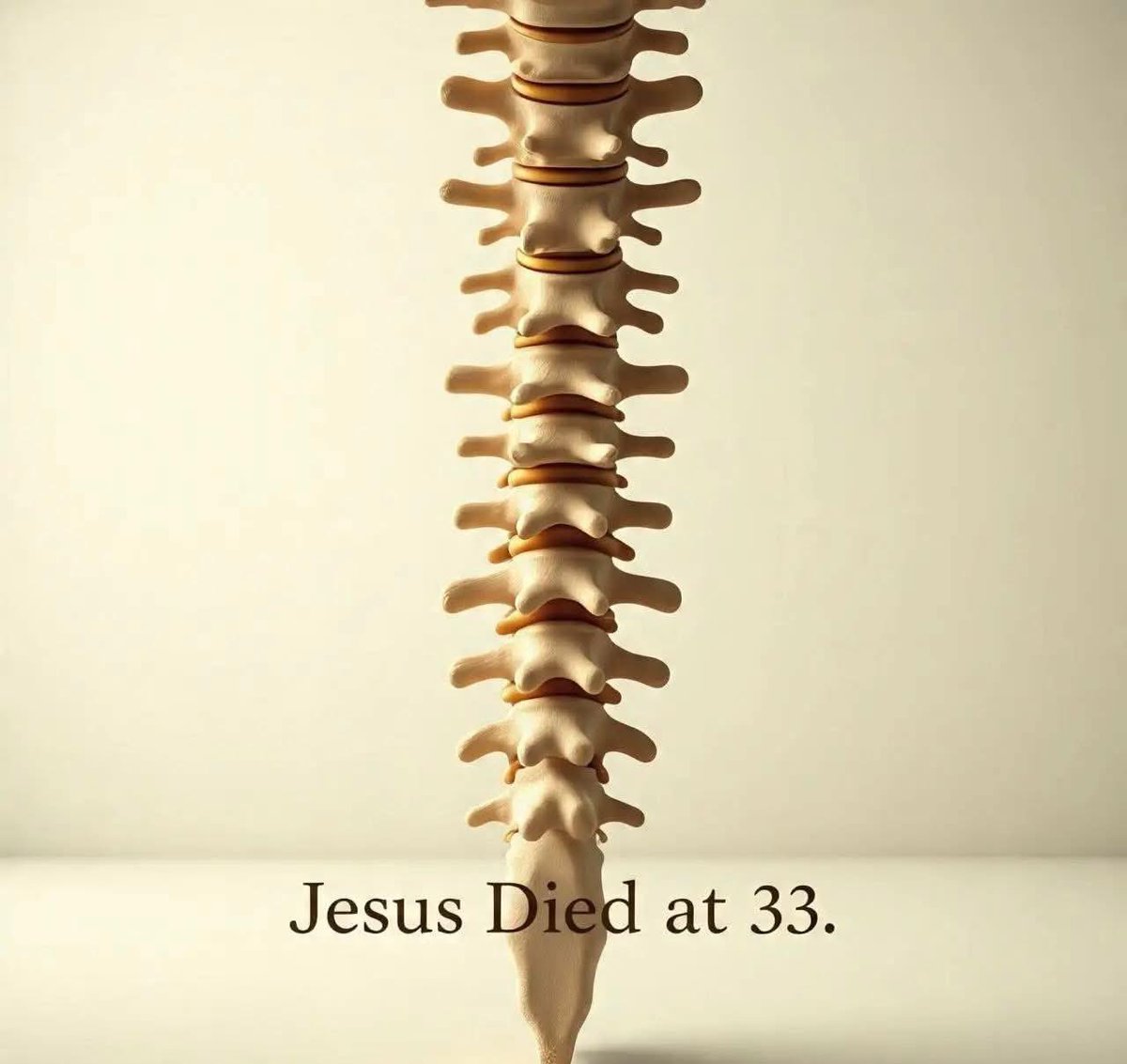
Jesus died at 33. The human spine has 33 vertebrae. The same structure that holds us up is the same number of years He held this Earth.
We have 12 ribs on each side. 12 disciples. 12 tribes of Israel. God built His design into our bones. He wrote Heaven into our anatomy.
The vagus nerve runs from your brain to your heart and gut. It calms storms inside the body. It looks just like a cross. That’s the power source running through us. Every time your body heals, every time your heart slows in prayer, every time peace shows up when it shouldn’t…that’s Him.
Jesus rose on the third day. Science tells us that when you fast for 3 days, your body starts regenerating. Old cells die. New ones are born. Healing begins. Your body literally resurrects itself. That’s not coincidence. That’s design.
And it keeps going.
Your heart has an electrical rhythm. Your brain lights up when you pray. Tears contain different chemicals depending on if you're crying from joy or grief. The blood speaks. The bones store memory. The body worships whether you realize it or not.
We are fearfully and wonderfully made. We are walking prophecy. Walking tabernacles. Dust and divinity in one.
God didn’t just create you. He carved Himself into you.
You don’t need to look far to find Him. You just need to look inward. He’s been in the design since the beginning.
Digital ID is the gateway to this life. This will 100% be our world if we don’t stand up and resist now!
This is not a drill. This is a clip from the chillingly brilliant sci-fi short, Utopia.
The film exposes a "paradise" where citizens use a government app to surveil and fine each other for minor infractions. It’s a world of sunny aesthetics and cheerful music, masking a horrifying surveillance state built on social punitiveness.
A terrifyingly sharp satire that feels only a click away from our own phone-saturated reality. A must-watch.
Judas Iscariot walked with Jesus for three years.
He heard every sermon. Witnessed every miracle. Ate at the same table.
And went to hell anyway.
Most Christians today are modern Judas Christians.
Here's how to know if you're one of them:
Judas had perfect theology.
He could quote Scripture. He knew Jesus was the Messiah.
But knowledge didn't save him.
Proximity didn't save him.
Religious activity didn't save him.
Only surrender saves.
Judas's fatal mistake wasn't betrayal. That was just the symptom.
His fatal mistake was keeping Jesus at arm's length while using Him for personal gain.
Sound familiar?
Modern Judas Christians:
*Consume sermons but never repent
*Use Jesus as life coach, not Lord
*Want Heaven without holiness
*Follow Jesus for benefits, not worship
*Keep one foot in the Kingdom, one in the world
They pray when convenient.
Read when motivated.
Obey when comfortable.
Surrender when forced.
But they never BOW.
Jesus didn't die so you could improve your life.
He died so He could OWN your life.
Big difference.
Judas called Jesus "Rabbi" (teacher).
Peter called Him "Lord" (master).
Judas kept his autonomy.
Peter surrendered it.
One went to hell.
One went to Heaven.
What do you call Him?
You can walk with Jesus your whole life and never KNOW Him.
"Not everyone who says to Me, 'Lord, Lord,' will enter the kingdom of heaven." - Matthew 7:21
Stop being a Judas Christian.
Stop using Jesus.
Start surrendering to Him.
Your eternity depends on which side of that line you're on.
—TBM
Satan is not opposed to good morals.
He’s opposed to Jesus Christ.
Read that again because most Christians miss this completely.
Satan doesn’t care if you’re a “good person.” He doesn’t care if you volunteer at the food bank, recycle your trash, and help old ladies cross the street. He doesn’t care if you’re kind, generous, and well-liked by everyone in your community.
He cares that you don’t bow the knee to Jesus.
Here’s the deception that’s damning millions:
Satan has convinced people that morality equals spirituality. That being a “good person” is the same as being a Christian. That if you just live right, treat people well, and avoid the “big sins,” you’re acceptable to God.
This is a lie straight from the pit of hell.
The Pharisees had impeccable morals. They followed the law meticulously. They were respected, disciplined, and religiously devoted.
Jesus called them children of the devil.
Why? Not because their morals were bad. Because their morals replaced Christ.
Satan’s greatest trick isn’t making bad people worse. It’s making good people think they don’t need a Savior.
Think about it:
The atheist who feeds the homeless thinks he’s good enough without God.
The Buddhist who meditates and practices compassion thinks she’s enlightened without Christ.
The Muslim who prays five times daily thinks he’s righteous without Jesus.
The moral Christian who goes to church, pays his tithe, and avoids scandal thinks he’s saved without surrender.
All of them are headed to the same place: eternal separation from God.
Because morality doesn’t save. Jesus saves.
“For by grace are ye saved through faith; and that not of yourselves: it is the gift of God: Not of works, lest any man should boast.” Ephesians 2:8-9
Satan loves moral people who reject Jesus. They’re his best advertisement for the lie that you can earn your way to heaven.
They’re living proof that you can:
•Be kind without Christ
•Be generous without God
•Be disciplined without the Holy Spirit
•Be respected without redemption
And still be lost.
The most dangerous people in hell won’t be the murderers and rapists. They’ll be the moral, upstanding citizens who thought their goodness was good enough.
Their morals became their idol. Their goodness became their god.
And Satan smiled because he’d accomplished his goal: Keep them from Jesus.
Here’s what most Christians don’t understand:
Satan doesn’t need to make you do bad things. He just needs to keep you from doing the ONE thing that matters: surrendering to Christ.
If he can get you to:
•Trust your morals instead of Christ’s sacrifice
•Rely on your goodness instead of God’s grace
•Believe in your works instead of Jesus’ finished work
He’s won.
You can live a moral life and still die lost. You can be a good person and still face judgment. You can avoid all the “big sins” and still end up separated from God forever.
Because the only sin that damns you eternally is rejecting Jesus Christ.
“He that believeth on the Son hath everlasting life: and he that believeth not the Son shall not see life; but the wrath of God abideth on him.” John 3:36
Not the murderer who repents and believes in Christ is damned.
Not the thief who turns to Jesus on the cross is damned.
Not the prostitute who washes Jesus’ feet with her tears is damned.
The moral, religious person who rejects Christ is damned.
That’s why Satan loves morality without Jesus. It sends people to hell with a smile on their face, convinced they were good enough.
Stop trusting your morals. Start trusting Jesus.
Your goodness won’t save you. Your works won’t redeem you. Your morality won’t justify you.
Only the blood of Jesus Christ can wash away your sin and make you acceptable to a holy God.
Everything else is just Satan’s distraction from the one thing that actually matters.
—TBM
This world is seconds away from entering the tribulation and the majority have no idea what is coming.
Jesus Christ is our redeemer, our Savior-and through His blood-we are able to spend eternity with God in paradise.
If you don’t know Jesus Christ as your Lord and Savior, please open your eyes to what is happening in the world and realize that you are sinner that needs a Savior.
I pray in Jesus name for eyes to be opened and for ears to hear the truth.