And just like that ... it's a 🥳new🥳 textbook for Computational Communication Science #CCS. It's the first of its kind in German, it's geared toward students and early-careers, and it's meant to get the basics straight to subsequently be able to dive into online tutorials. 🧵
Is communication research in crisis?
This thematic issue discusses challenges in replicating communication studies due to the field's unique methods and topics. It also highlights efforts to improve replicability and trustworthiness.
Issue: https://t.co/TH6dwDyjqk
Findings 🧵
I had a great and intensive week at @ifkw_lmu , where I had the opportunity to exchange experiences about digital data research with local colleagues. Thank you for the invitation @DrFollowMario @hase_va
🚨An meinem Lehrbereich für Computational Social Science in München habe ich ab 1.10. eine PostDoc Stelle zu besetzen: https://t.co/cmFWoijTiR
Wir bieten umfangreiche Ressourcen, Home Office Möglichkeiten & andere Benefits.
Bitte teilen & eure Fragen gerne direkt an mich.
In our new episode, we discuss the impact of digital media on well-being with @dougaparry. We look in particular at measuring media use and the new opportunities offered by digital data and CCS methods, but also the challenges involved. Listen here: https://t.co/skVvZwKy9Q
We just released a new episode, together with the wonderful @Ognyanova, on networks (of friends and peers, but also of mis- and disinformation). Listen to it now, via your preferred 🎧player or through our new website https://t.co/aPRiDuZSIU!
Hey look, we have a website now. Finally, that is! https://t.co/aPRiDuZSIU But even more importantly, we are growing: The wonderful @jana_bhard will host our #aBitofCCS series and is already preparing several upcoming episodes! 🥳🎧
In our latest episode, we discuss with @wrahool how powerful platforms are. The global perspective is particularly relevant here and calls not only for more diverse methods for CCS, but especially for appropriate theory building. Listen here: https://t.co/21ReNrr2H9
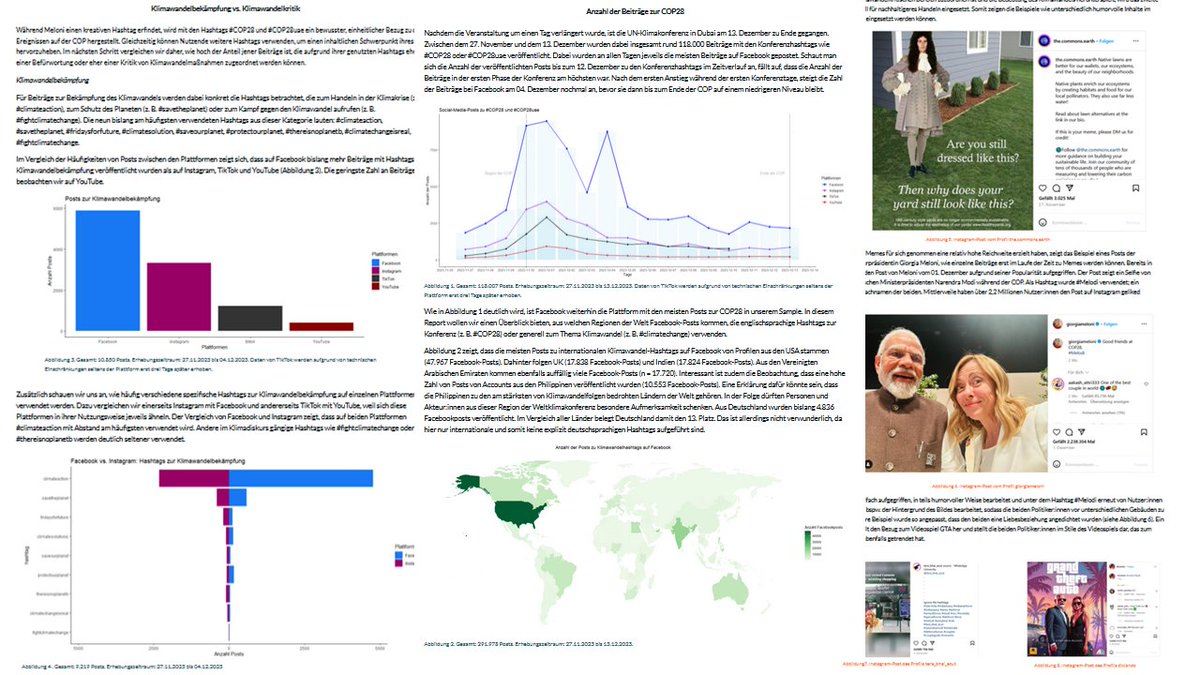
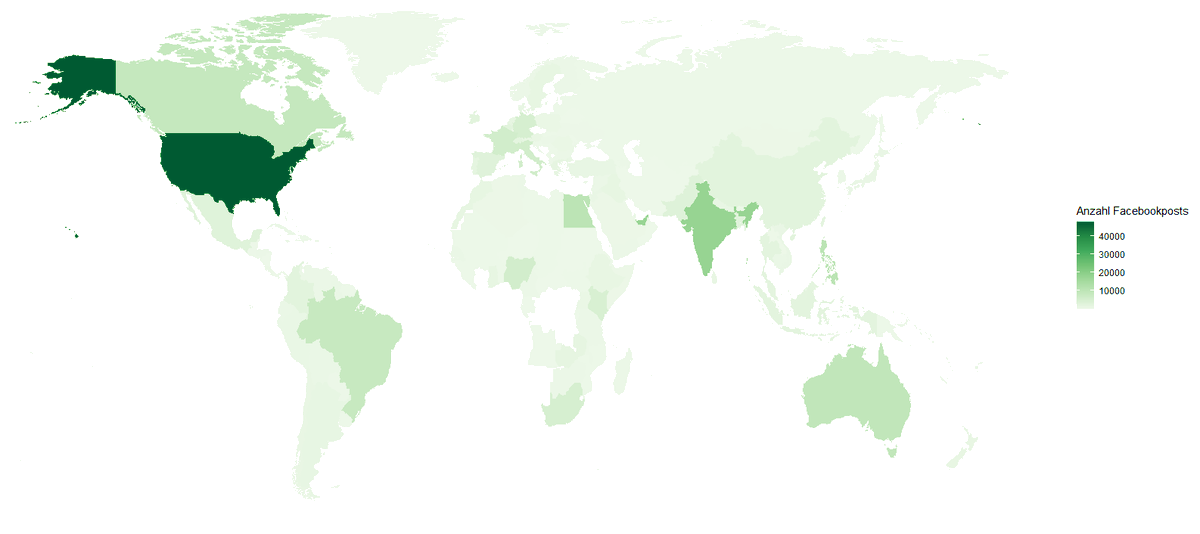
Unser 3. Bericht zur #Cop28 ist online! Eine Woche nach Ende der Klimakonferenz schauen @joerg_hassler_ @DrFollowMario@nadja_oz und ich vom @ifkw_lmu speziell auf humorvolle Inhalte zur Konferenz. Alle Analysen gibt es wieder unter: https://t.co/yfL91neYHE
Short 🧵👇
Hot off the press: Das Sonderheft zur FG Tagung 2022 herausgegeben von @DrFollowMario, @hase_va, @joh_schindler, @Bachl & @MissEsi ist in @scm_editor erschienen. Wir wünschen viel Spaß beim Lesen: https://t.co/9oYo01v8QB
Unser zweiter Bericht zur #COP28 ist jetzt online! Darin analysieren @joerg_hassler_ @DrFollowMario@nadja_oz und ich vom @ifkw_lmu die Social-Media-Kommunikation von relevanten Akteur:innen im Klimadiskurs während der UN-Klimakonferenz:
https://t.co/yfL91neYHE
Short 🧵👇
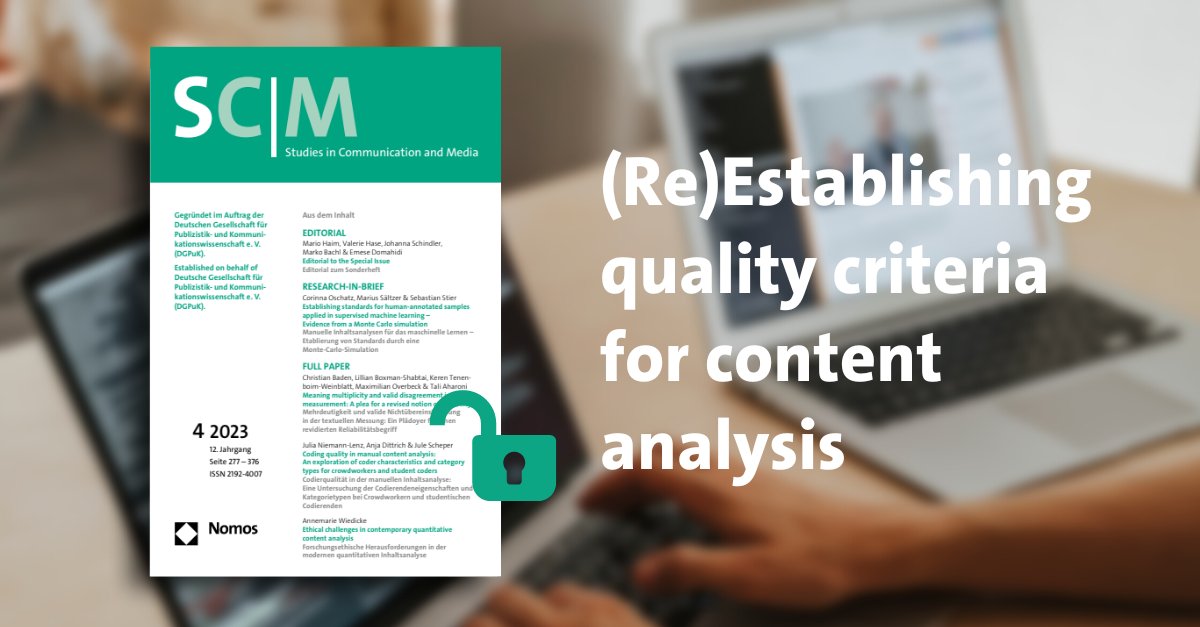
SCM Special Issue: (Re)Establishing quality criteria for content analysis: A critical perspective on the field’s core method
Read the special issue now - open access 🔓 👇
How to study "contemporary" news? Join our discussion with the wonderful @JosephineLukito on hybrid media systems, different forms of political language and their impact, and the role of CCS. Listen in here: https://t.co/CDOq5MS90Q
In our latest episode, we engage in an insightful conversation with @c_baden, delving into the nature and prevalence of online disputes. We examine their implications for research methods and theories, and place a special focus on CCS. Listen in here: https://t.co/lyu85GTQoj
Congratulations to ICA’s newest President-Elect-Select, Thomas Hanitzsch!
A full listing of election results can be found here: https://t.co/fraE9meCbP
Thanks to everyone who participated by voting, and especially to those who ran for office! #icacommunity
Der DSA soll Online-Dienste sicherer und transparenter machen. Dafür soll die Wissenschaft einen möglichst freien Zugang zu den Daten digitaler Plattformen erhalten. Aus Sicht von Forschenden müssen dafür jedoch 20 Bedingungen erfüllt sein.
https://t.co/b7XcLi0JlY