This graphic is expertly engineered for human psychology. It's designed to make people fear, obey, and vote for left-wing fanatics that pretend to care.
It weaponizes color: blue feels safe and calm, red screams alarm and heat. The entire crisis spans a mere ~2°F total over 140+ years (barely noticeable day-to-day). Yet the stacked red layers and funnel shape make recent warming look like an apocalyptic pile-up. It also uses Fahrenheit so there's more than just a mere 1 degree change in Celsius.
It exploits recency bias by compressing older years and dominating the top with vivid red. Minimal text, no uncertainty ranges, no context, no absolute temperatures ... just raw emotional manipulation designed to bypass your analytical brain.
Applause.
And, it doesn't work anymore.
People often claim 1.7% of the population is “intersex,” neither male nor female, but here’s the actual data.
88% of that number involves late onset congenital adrenal hyperplasia, an adrenal gland issue causing higher testosterone in unambiguous, usually fertile males or females!
The next most common one is 47:XXY Klinefelter Syndrome, making up only around 5% of the total. This is a male specific sex chromosome disorder, resulting in unambiguous males with testes that have lower T and impaired sperm production.
The next most common is 45:X Turner Syndtome, making up around 2.35% of the total. This is a female specific sex chromosome disorder, resulting in underdeveloped ovaries, heart issues, and more.
Further down the list we get to something like XY Swyer Syndrome, so rare it makes up only 0.05% of the total. This involves an XY embryo that is unable to differentiate the gonads into testes due to gene mutations, so the embryo develops no differentiated gonads. Genetic networks then develop the Müllerian duct system—oviducts, uterus, cervix, vagina, vulva—resulting in a female.
We could go on, but you get the point. The claim that 1.7% of the population is neither male nor female is a complete lie. Not only is the majority of this statistic made up of unambiguous males or females, but even the rarer disorders in the list result in male or female pathways.
To solve aging, we first need to measure it. Excited to share our study in @NatureMedicine! Different cell types age at different rates within our body. From a tube of blood, we track aging across 40+ cell types, from immune cells to neurons, revealing signatures that forecast disease risk and resilience. @wysscoray 🧵1/9
All blue-eyed people on Earth descend from a single common ancestor.
One person had a mutation 6,000–10,000 years ago that switched off melanin production in the iris, creating blue eyes for the first time. That trait spread because it was considered attractive.
Green eyes are even rarer, while brown was the original human eye color.
A 2008 University of Copenhagen study confirmed that nearly all blue-eyed people share the exact same mutation in the HERC2 gene — strong evidence of a single founder.
One tiny genetic change in one individual thousands of years ago created a visible trait now carried by hundreds of millions of people today.
Disease causing mutations in each of these 11 genes are implicated in at least three different chronic diseases or lifespan in humans. #Aging#Longevity#Genetics
https://t.co/FszNqf5Y8z
Today in @NatureGenet new paper introduces PHBC -- method for estimating how much of a disease’s SNP heritability is shared with other diseases or traits. Applying it to UK Biobank and GWAS meta-analysis data, the authors find that a large share of common disease heritability is pleiotropic—about 27% across 15 UK Biobank diseases, rising to roughly 48% when more auxiliary diseases and traits are included.
https://t.co/ggxTFqqB3Q
🚨It's always a great day when a new FinnGen summary statistics comes out☺️ Data Release 13 covers 500,186 individuals and 2755 endpoints.
https://t.co/xPnMPc7G3e
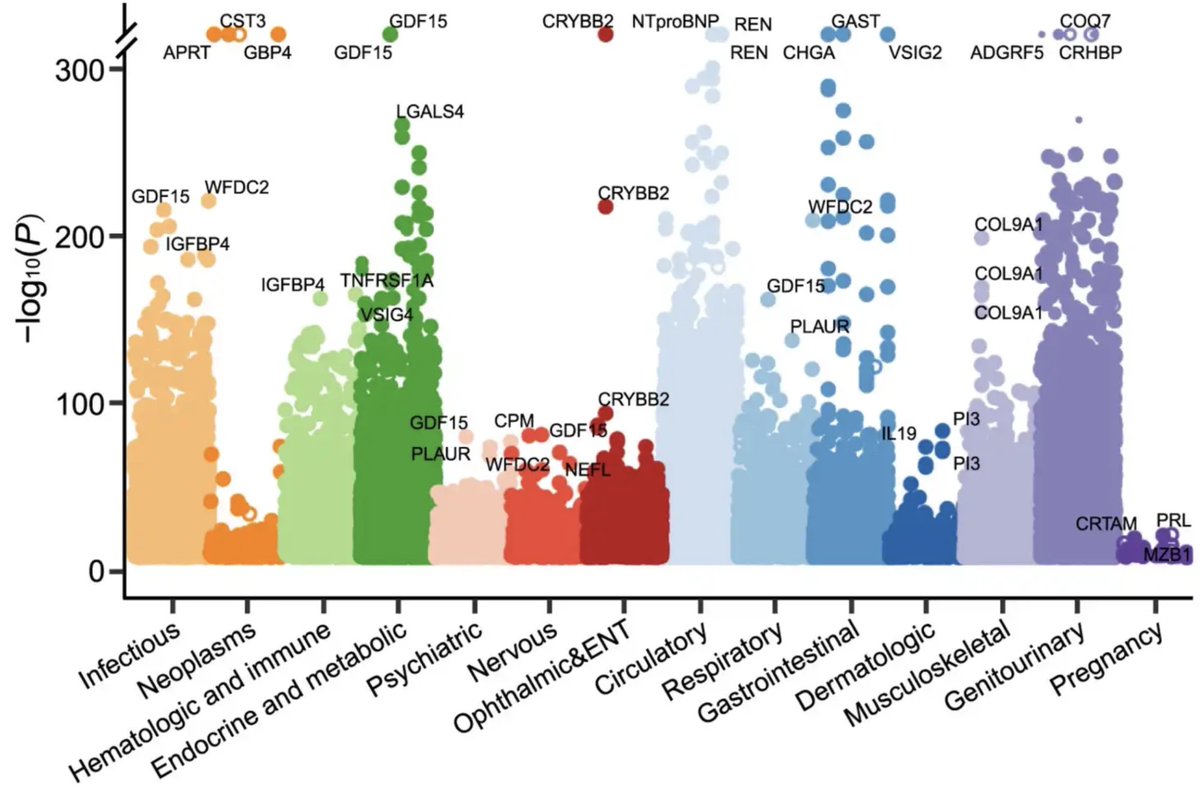
A year ago, the UKBB released >53k plasma proteomes, allowing cross sectional analysis across hundreds of diseases and traits.
Using a 2920-plex panel, we can quantify thousands of potential biomarkers.
What is the best way to analyze this dataset?
long-lived species and humans living 100+ years are known to have increased DNA repair capacity
but how DNA repair could be boosted to extend human lifespan is largely unknown
our research in Nature Aging today proposes a target to enable such a boost: the DREAM complex
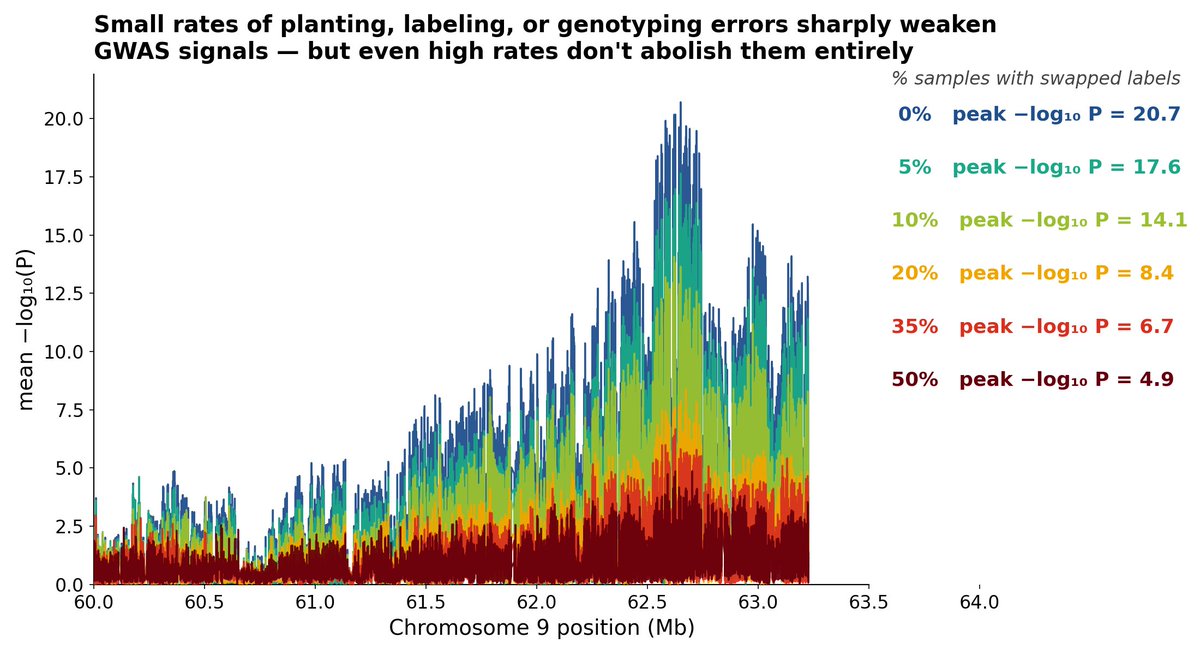
Even small amounts of mislabeled data -- genotyping mix ups, planting errors, data entry mistakes -- can drop the significance of a GWAS signal by three orders of magnitude.
This preprint and accompanying browser provide another fantastic resource for exploring causal biology, with genotype–phenotype associations for both common and rare variants across 3,602 traits in the All of Us cohort (N=392,030)!
At most a human male or female might be born with what’s called Ovotesticular Disorder, where the gonad has elements of both testicular and ovarian tissue to varying degrees due to genetic mutations—one dominant system with vestigial elements of the other. However, they are not fully developed, and the mutually antagonistic genetic and hormonal systems inhibit its development.
A hermaphrodite is a species specific reproductive strategy where an individual has a reproductive system with the function to fulfill both roles. No human meets these criteria.
Calling human with rare sex specific disorders hermaphrodites would be flat Earth level nonsense.
Are you tired of people making vague claims about “intersex”?
See our Sex Development Charts, which map the development paths of around 20 DSDs, showing that each disorder is unique and not “between sexes.”
https://t.co/grg65JQkVv
A Sunday read on the LDL/ApoB story that set the standard of how human genetic data can be used to establish causal biology and prioritize therapeutic targets.
https://t.co/zMciCf9xss