Super excited to speak at the @bittensor track at @proofoftalk on Tuesday at 6pm CET!
@bitstarterAI will we streaming this live, so fell free to join!
https://t.co/Y84Wb9JvT1
At this year’s Proof of Talk, DeSci will be part of the center-stage conversation.
Our scientific advisor @PKoellinger, founder of DeSci Labs, will be on stage in Paris discussing how Bittensor can help create infrastructure for verifiable scientific claims.
We believe distributed compute can become a real engine for science by scaling reproducible workloads, aligning incentives, and rewarding useful scientific work.
Philipp has been building toward this future for years, and we’re excited to see him bring that vision to Proof of Talk.
Keep an eye out for his talk!
Pitching our new baby @DeSciClaims at @proofoftalk in the Louvre and WINNING this adrenaline-raising competition was such an honor. Joining the amazing @bittensor community as a subnet owner is literally a dream come true for me. Pitch deck:
https://t.co/9IvzvoRPu9
SciWeave: 0% hallucinated citations on ScholarQABench (Asai et al., Nature 2026).
GPT-5.2: 59%.
Claude Opus 4.6: 62%.
100 queries across biomedicine and neuroscience.
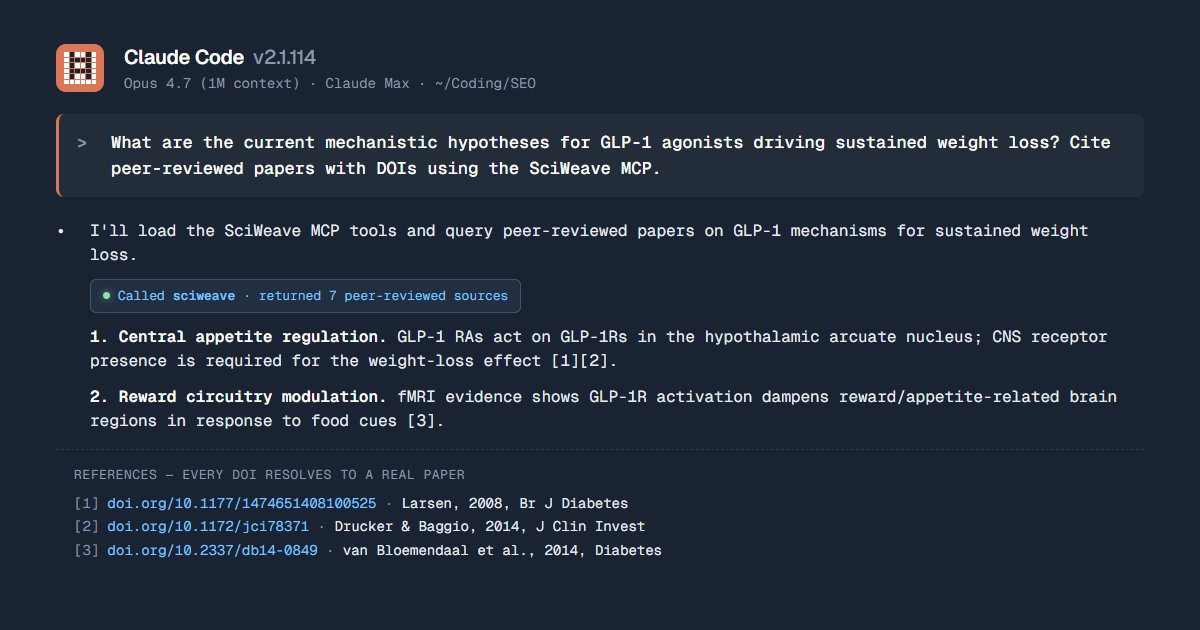
The 0% isn't a model trick. SciWeave doesn't ask the LLM to recall papers. It retrieves passages from OpenAlex (~300M scientific works) and synthesizes the answer from what comes back. The architecture rules out fabrication.
The benchmark, the scoring script, and the NLI judge are all public. We ran SciWeave against them.
Hallucinated citations are already showing up in peer-reviewed bibliographies. The failure rate deserved a number.
https://t.co/FDzohFRv5t
Encyclopedias on CD-ROM looked like the right idea. Then the browser showed up.
Many researchers are still looking for an "AI research tool": a destination site they open, paste questions into, wait.
That category is dissolving.
The AI you already use (Claude, ChatGPT, Cursor, Codex, Windsurf) can reach into 300M peer-reviewed papers mid-conversation without leaving the chat.
The destination is the browser tab you already have open.
SciWeave is plumbing. You install it once, into whatever model you work in.
Now spinning up 4 parallel sub-agents for platform-native variants.
https://t.co/mSgIKmjjRf
We've just launched an MCP server integration for SciWeave - I'm excited!
You've tried doing research tasks with Claude, ChatGPT, CODEX etc. They're amazing tools - but they still hallucinate >50% of academic references. Now you can combine them with the SciWeave MCP and your favorite AI turns into a hyper-productive research companion.
For example, you can use this to:
- Draft a grant proposal with real citations
- Write a syllabus for a course you're teaching
- Do a systematic literature review
- Brainstorm plausible hypotheses that haven't been tested yet
- Build automated research workflows that are grounded in the published literature
Try it out and let me know what you think! We'd love to get feedback.
Set-up guide: https://t.co/mSgIKmjjRf
Instead of watching an hour of Netflix, watch this 2-hour Stanford lecture on AI careers. It will teach you more about winning in the AI race than all the AI content you’ve scrolled past this year.
SciWeave is now available for Apple mobile devices! I like using it on the go to quickly check facts based on scientific evidence and for health-related questions. #Science@SciWeave
https://t.co/aTVDaAHAXq
Empirical evidence from a series of behavioral experiments with students at @Wharton suggest that AI is beginning to influence human thinking and decision making.
Many people "surrender" their judgement to AI instead of critically questioning and treating it as a sparing partner.
"Surrendering" improves confidence while decreasing cognitive performance.
Critical engagement with AI yields much better outcomes.
@gidin
https://t.co/4e1cJ4Bamh
If you come across someone asserting there is "no scientific evidence" that social media is causing harm, please send them this link.
We lay out seven lines of evidence, including RCTs, natural experiments, and testimony from victims & perpetrators of harm
https://t.co/lZsNalKZE5
Aysu Okbay and I are hiring a postdoc to study gene–environment interplay in health & social inequalities 🧬
You'll analyze large genomic datasets as part of a 3-node consortium with Uppsala & Oslo. Based at @amsterdamumc 🇳🇱
Apply by May 4 below, please RT for karma points👇🏽
Reviewing yet another academic paper full of hallucinated references, odd citation practices, and improperly attributed material. To all academic colleagues out there, literally ruining our profession: thanks for nothing.
@Aella_Girl@0xAgentOwl The lower median but similar mean for men compared to women in your sample means that the right tail of the male distribution is much longer (i.e. higher bc), which is probably as expected. The higher median for females in your sample could be sampling bias.
@causalinf@MarkHahnel had a related blog post with interesting data on this. Developing AIs that check papers, requiring open code at submission, and raising submission fees are all reasonable and doable suggestions to deal with the increasing supply of papers imo
https://t.co/YoFfZowKL4