Ich habe am Donnerstag mit einem Feuerwehrmann gezecht und ich sage mal so: Diese Provinzposse vom Mai 25 aus Taucha hat unter deutschen Feuerwehrleuten mehr zur Delegitimierung des Staates beigetragen als die Regierungen Merkel, Scholz und Merz zusammen.
https://t.co/mDh9RNJgC4
@statisticsisth1@AndreasMoser007 Was echt hilft ist hier die Quellenüberprüfung mit AI. Wenn man alle Quellen Digital vorliegen hat ist NotebookLM am besten, ansonsten Gemini oder Grok.
Es ist erstaunlich, wie viele Quellen dadurch im Review-Prozess als nicht passend auffliegen.
Here are the important references of historically described Andesvirus human-to-human transmission (rare among Andesviruses cases):
https://t.co/QXW3zj5KJS (1996)
https://t.co/OkLhhTPOtg (2014)
https://t.co/HC6NoxyRcP (2018/2019)
All were contained.
@DrNeilStone LOL, of all RNA viruses I can think of only influenza has any business in the nucleus. Most of the other ones - including hantaviruses - replicate in the cytoplasm. I recommend Fields Virology to Mary. It is helpful to understand the basics.
La petite info mignonne du jour : aujourd'hui le 05/05, le circuit intégré le plus célèbre de l'histoire de l'électronique, le NE 555, fête ses 55 ans.
Voilà c'est tout, vous pouvez continuer à faire ce que vous faisiez 😊
A Soviet psychologist walked into a café in 1927 and watched a waiter do something impossible.
He remembered every open order at every table. Perfectly. Without notes. Without effort.
Then a table paid their bill. She asked him to repeat the order.
He couldn't remember a single item.
She spent the next two years figuring out why. What she found is now the operating system underneath every platform fighting for your attention.
Her name was Bluma Zeigarnik, and she was a graduate student at the time, sitting with her professor Kurt Lewin, watching the waiters work the room. What caught her attention was something so ordinary that it had been happening in restaurants for centuries without anyone asking why.
The waiters could remember every open order with perfect accuracy. Table four wanted the schnitzel with no sauce. Table seven had changed their wine twice. Table twelve owed for three coffees and a dessert. Every detail, held without effort, without notes, without any visible system at all.
But the moment a table paid their bill, the information vanished. Completely. Lewin tested it on the spot. He called a waiter back minutes after a table had settled up and asked him to recite the order. The waiter could not do it. Not partially. Not approximately. The information was simply gone.
Zeigarnik went back to her lab and spent the next two years turning that observation into one of the most replicated findings in the history of psychology.
Here is what she proved, and why it changes how you think about attention, memory, and almost every piece of media you have ever consumed.
She gave participants a series of tasks. Some tasks they were allowed to finish. Others were interrupted before completion. Then she tested recall across both groups.
The unfinished tasks were remembered at nearly twice the rate of the completed ones.
Not slightly better. Nearly twice. The brain was holding the incomplete work in a state of active tension, returning to it, keeping it warm, refusing to file it away. The finished tasks were closed, archived, released. The unfinished ones were still running.
She called it the resumption goal. When the brain commits to a task and cannot complete it, it opens a file that stays open until resolution arrives. That open file consumes a portion of your cognitive bandwidth whether you are thinking about it consciously or not. It surfaces in idle moments. It pulls at the edge of your attention during other work. It is the thing you find yourself thinking about in the shower when you were not trying to think about anything at all.
This is not a flaw in human cognition. It is a feature. The brain evolved to finish things. An open loop is a signal that something important is unresolved. Keeping that signal active increases the probability that you will return to it and complete it. In an environment where most tasks had real survival stakes, this was an extraordinarily useful mechanism.
In the modern world, it is the most exploited vulnerability in human attention.
Netflix did not invent the cliffhanger. But it industrialized it in a way no medium before it ever had. When a show ends on an unresolved question, it does not just create curiosity. It opens a file in your brain that stays active until the next episode closes it. The autoplay countdown that begins at 15 seconds is not a convenience feature. It is a precise calculation about how long the average person can tolerate an open loop before the discomfort of not knowing overrides every other intention they had for the evening. One more episode is not a choice. It is your brain doing exactly what it was designed to do: return to what is unfinished.
The writers who built Lost, Breaking Bad, and Succession understood this intuitively without ever reading a psychology paper. Every episode ended on an open question. Every season finale answered three things and opened five more. The entire architecture of prestige television is a Zeigarnik machine running at industrial scale.
But television is not where this gets dangerous.
Every notification on your phone is an open loop. Every unread email is an open loop. Every task you wrote on a list and have not yet crossed off is an open loop. Each one is consuming a small but real portion of your available attention, pulling fractionally at your focus, degrading your capacity to be fully present in whatever you are actually doing right now. TikTok's algorithm does not just serve you content you like. It serves you content that ends one loop and immediately opens another, keeping the resumption system permanently activated so the cost of stopping always feels higher than the cost of continuing.
The research on this accumulation effect is striking. Psychologists studying cognitive load have found that unfinished tasks do not sit passively in memory. They actively interrupt. They surface at the wrong moments. They are the reason you are reading something and suddenly remember an email you forgot to send. The brain is not malfunctioning. It is running its resumption system exactly as designed. It is just running it across forty open loops simultaneously, in an environment that generates new ones faster than any human nervous system was built to process.
The most important practical implication Zeigarnik's research produced is one that most people use backwards.
David Allen built his entire Getting Things Done system on the insight that the only way to close a cognitive open loop is to either complete the task or make a trusted commitment to complete it later. Writing something down in a system you actually trust has the same effect on the brain as finishing it. The file closes. The bandwidth is released. This is why writing a task down feels like relief even before you have done anything about it. You have not solved the problem. You have simply told your brain that the loop is registered and will be returned to, which is enough for the resumption system to stand down.
The inverse is equally true and far more destructive. Every task that lives only in your head, unwritten and unscheduled, is an open loop burning cognitive resources around the clock. The mental cost is not proportional to the size of the task. A tiny nagging obligation consumes the same active tension as a major project. Your brain does not discriminate by importance. It discriminates by completion.
Zeigarnik published her findings in 1927. The paper sat in academic literature for decades before anyone outside psychology paid attention to it.
Then television got good. Then the smartphone arrived. Then the entire attention economy was engineered, largely by people who understood intuitively what she had proven scientifically: an open loop is the most powerful hook available to anyone who wants to hold human attention.
Netflix knew it. Instagram knew it. Every designer who ever made a notification badge red instead of grey knew it.
The café in Vienna is long gone.
The mechanism she discovered there is now the operating system underneath every platform fighting for your time.
Every "to be continued."
Every unread notification.
Every thread that ends with "part 2 tomorrow."
All of it is the same waiter, the same unpaid bill, the same brain refusing to let go of what it has not yet finished.
Zeigarnik noticed it over coffee in 1927.
A century later, it is the most valuable insight in the history of media.
And nobody taught it to you in school.
NEWS: Dutch regulators (RDW), which just approved @Tesla FSD (Supervised) in the Netherlands, have just issued an official statement:
"Due to the continuous strict monitoring of the driver in the vehicle, the system is safer than other driver assistance systems. We have thoroughly researched and checked this system, more than a year and a half.
The RDW has issued a type approval for Tesla's driver's assistance system, FSD Supervised. This driver's assistance system has been extensively researched and tested on our test track and on public roads for more than a half years. Safety is paramount for the RDW. The proper use of this driver's system makes a positive contribution to road safety."
This approval from the RDW clears the path for approval in other European countries. Tesla owners in the Netherlands will be receiving FSD (Supervised) on their cars shortly. Amazing day!
Physics saves lives...
A college physics professor was explaining a particularly complicated concept to his class when a pre-med student interrupted him.
"Why do we have to learn this stuff?" The young man blurted out.
"To save lives," the professor responded before continuing the lecture.
A few minutes later, the student spoke up again. "So how does physics save lives?"
The professor stared at the student for a long time.
"Physics saves lives," he said, "because it keeps the idiots out of medical school."
@lukezagain@dr_boese Ich würde im Reisezentrum nachfragen, am besten mit dem ausgedruckten Ticket. Dann können die nachschauen und ggf. das Ticket abstempeln und mit einem Kommentar versehen, damit es nachher im Zug keine Probleme bei der Kontrolle gibt.
Das passiert, wenn das desinteressierte, aber chillige SocialMedia-Team vom @MUC_Airport lustig auf der Tastatur rumklimpert, ohne dass ein Erwachsener schaut, was die posten.
Denn: Die Airline ist gelandet, ab dann übernimmt der Flughafen (wofür er prächtig Gebühren berechnet).
A MIT PhD student told me he can predict exam questions before seeing the syllabus.
Using NotebookLM.
I thought he was full of shit. Then he walked me through it.
He doesn't wait for the course to start.
Before day one, he uploads 10-15 past papers from similar courses. Adds the core textbooks. Throws in a few field research papers.
Most students never do this. He's already built a training dataset of how the subject gets tested.
First prompt he runs:
"What patterns exist in how this subject is examined?"
Not summarize. Not explain. Patterns.
NotebookLM starts surfacing things like concepts that reappear every year in different disguises, question formats professors recycle, and topics that always show up together.
Then comes the move that makes it unfair.
"What hasn't been tested recently, but should be?"
That's where the predictions come from. Exams rotate. Professors don't repeat last year's exact questions, but they never change the underlying ideas either.
Final prompt:
"Generate 20 high-probability exam questions based on these patterns and gaps."
They don't look like practice questions. They look like real exam questions.
He spends the next few hours solving them against the source material. Every wrong answer triggers one more prompt: "Why is this wrong and what concept am I missing?"
By the time the syllabus drops, he's already mapped 70-80% of it.
By exam day, nothing feels new. Just slightly different versions of problems he already solved.
Most students study what they're given.
He studies how the system behaves.
That's not studying harder. That's playing a different game entirely.
One day, 𝑒ˣ sees 𝑥² running down the street in a panic.
“What’s wrong?” asks 𝑒ˣ.
“There’s a Differential Operator in town!” yells 𝑥². “If I run into him too many times, I’ll disappear!”
“Don’t worry,” responds 𝑒ˣ. “I’ll go have a chat with him. No, don’t worry about me — he can’t hurt me. After all, I’m 𝑒ˣ.”
So 𝑒ˣ walks down the street to the Differential Operator. “My friend tells me you’re a Differential Operator,” 𝑒ˣ says pompously. “Well, I’m 𝑒ˣ.”
“Pleased to meet you, 𝑒ˣ,” says the Differential Operator. “I’m 𝑑/𝑑𝑡.”
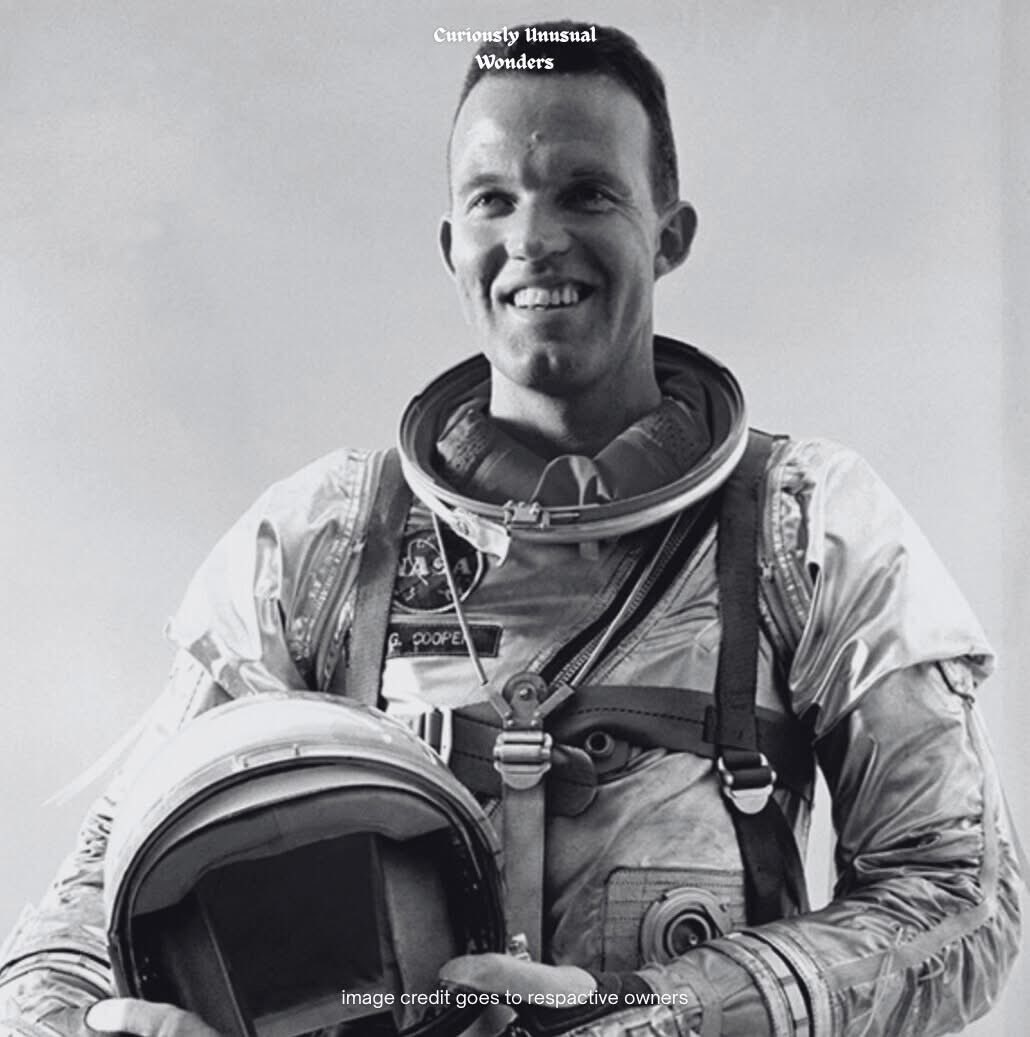
May 16, 1963. Gordon Cooper was orbiting Earth alone inside a capsule barely big enough to turn around in, moving at 17,500 miles per hour.
He had been up there for over a day.
Then the warnings started.
First a faulty sensor screaming that the ship was falling — it wasn't. He switched it off. Then something far worse: a short circuit knocked out the entire automated guidance system. The one that kept the capsule steady. The one that was supposed to bring him home.
Without it, reentry was nearly impossible.
Too shallow an angle and the capsule would bounce off the atmosphere back into space. Too steep and it would incinerate. The margin for error was razor thin — and every computer that was supposed to hit that margin was dead.
Down on the ground, NASA engineers watched the telemetry in silence. They could see everything going wrong. They could fix nothing.
Cooper didn't panic.
He uncapped a grease pencil and drew lines directly on the inside of his window to track the horizon. He looked up at the stars he had spent months memorizing and used their positions to orient the ship by eye. Then he set his wristwatch.
Because when you have no computers left, you become the computer.
At exactly the right moment — calculated in his head, confirmed by the stars outside — he fired the retrorockets. The capsule shook. The sky turned to fire. For several minutes, no one on Earth could reach him as plasma swallowed the ship whole.
Then the parachutes opened.
Faith 7 hit the water just four miles from the recovery ship — the single most accurate splashdown in the entire Mercury program.
The man with a wristwatch and a few pencil marks on a window had outperformed every automated system NASA had.
We talk a lot about technology saving us. And it often does.
But Cooper's story is a quiet reminder that behind every machine, there still has to be a human being who can look out the window, think clearly under pressure, and decide what to do next.
The final backup was never the software.
It was him.
https://t.co/en4Dl6HHm6 existiert. Eine echte Wett-Seite. Für echte Bahn-Verspätungen. In Echtzeit. Der Erfinder verdient an deutschen Zugverspätungen – und hat damit vermutlich ein stabileres Geschäftsmodell als die DB. Chapeau. 🎩 1/2
I spent time in Shenzhen last year and when I saw Merz come back from China saying Germans need to work more I immediately knew what broke his brain because I lived the exact same cognitive shock
my first week in Huaqiangbei I burned through 4 prototype iterations of a motor controller board for less than a thousand bucks total, back home a friend was working on something similar and spent over 12 thousand for a single revision that took almost two months to arrive
when you live that contrast in your own hands with your own project something permanently shifts in how you see the world and it goes way deeper than speed & cost
what Shenzhen actually built is a collective learning organism, imagine 20 PCB fabs 15 injection mold shops 30 component distributors and a hundred firmware freelancers all within a 2km radius, looks insanely redundant from the outside until you realize redundancy is actually information density in disguise
I watched this firsthand with an injection mold supplier I was working with, this guy had seen a hundred founders iterate similar thermal designs over 6 months so he proactively modified his tooling before I even opened my mouth, he knew what I needed before I knew what I needed, the intelligence lives in the relationships between the nodes and it compounds daily
the west thinks about manufacturing as a cost center you optimize by centralizing…
China accidentally built a distributed neural network of manufacturing intelligence where knowledge diffuses horizontally across thousands of agents faster than any single western company can process internally
so when Merz comes back and says we need to work a bit more I think he saw the problem but COMPLETELY misdiagnosed the solution, telling Germans to work harder is like telling a horse to gallop faster when the other side built a combustion engine
the gap is ARCHITECTURAL
it’s ecosystem density, you need a custom connector in Shenzhen you walk 200 meters, in Munich you send an email and wait 3 weeks
it’s iteration speed, parallel search vs sequential optimization at the system level, it’s risk tolerance, Chinese founders ship something broken on Monday fix it Tuesday ship again Wednesday while European companies are still in the approval phase for the pilot program of the feasibility study…
and Merz only saw the surface, what he missed is the tier 2 cities like Hefei Chengdu Wuhan replicating the Shenzhen model at scale right now
BYD going from irrelevant to outselling every european automaker combined in roughly 5 years, Huawei building its own 7nm chip under maximum sanctions when every analyst said it was physically impossible & behind all of that a government that treats advanced manufacturing as an existential national priority while europe debates whether AI needs another ethics committee
I think what we’re watching is the most asymmetric economic competition in modern history and most western leaders are still framing it as a productivity problem when it’s actually an ontological one
Europe & America are optimizing variables that China stopped tracking years ago meanwhile China is compounding on dimensions the west has no framework to even measure
Merz at least had the courage to name
it out loud and I respect that genuinely but working a bit more inside a broken architecture just means you arrive at the wrong destination slightly faster