Researcher exploring #energypoverty, housing, and energy use through a public health lens. Mixed methods, participatory, qual. she/her RTs ≠ endorsement
Great decision by Contact Energy to drop disconnection & reconnection fees that hurt households experiencing energy hardship https://t.co/0Hd4CORVtW
Any rollback of our insulation standards will cost industry, energy savings and our health according to public health researchers. @LucyTelBar and coauthors lay out the evidence.
https://t.co/RIBzeNrz3X
Thanks for your mahi Kirsty Wynn, with @nzherald's series Power to the People, drawing attention to the lived experience of energy hardship in Aotearoa: Grandmother says house so cold and damp mokopuna’s teeth are chattering https://t.co/VGEVWlCR5S
Great writing from some of our @HeKaingaOranga team @publichealthUOW this morning @TheSpinoffTV explaining 'how no-cause evictions make a farce of healthy homes standards' https://t.co/xn5gHxaimV
Energy poverty has range of causes - eg housing inefficiency, electricity price & payment plans, needs. People manage differently - stay cold & get sick, use heating & go into debt, keep lights on & go hungry. The number feeling cold at home 'a lot' underestimates the problem.
When all of the evidence points to increasing energy hardship it is not the time to stop trying to measure the number of households in Aotearoa NZ who are struggling to keep warm this winter https://t.co/VXBFbuBUnp
Stepped away from climate to write about my other obsession: cost of living.
Power companies are disconnecting vulnerable people, then forcing them on to expensive prepay plans
Meanwhile the CEOs of our four largest companies each earned $2m last year
https://t.co/bvpc4MSRIw
"There's a real tension around using a market structure to provide an essential service - and electricity is essential, for protecting health" - @DrKimOS on energy poverty for @radionz Thanks @kirsty_johnston for your mahi!
https://t.co/qogWZWeA1U
“There are lifelong consequences – but there’s no need for disconnection to cause this much hardship... You could alleviate a lot of these experiences with some simple changes.” @publichealthUOW's @DrKimOS on energy poverty https://t.co/9aZqJ1D71B
This morning I'm speaking at Common Grace Aotearoa's petition launch https://t.co/4V8qrUetPh asking the Electricity Authority to 1) ban disconnection fees 2) end the 'penalty for prepay' 3) make consumer care mandatory for retailers. Join us https://t.co/lOWCPaXHEm
Ngā mihi @CACouncilNZ for commissioning this compelling report by FinCap showing again that current electricity consumer protections are insufficient: Consumers 'vulnerable to whims of power companies', even in a crisis https://t.co/O7NnWuKTeW
It's gotten pretty cold across the motu, and since so many of our homes still only meet (or not) bare minimum standards the outside temperature has a huge influence on indoor temperatures: 'I'm cold, Mama': The NZers struggling to stay warm this winter https://t.co/IHeOFovAtr
@HeKaingaOranga@publichealthUOW Some of our kōrero with disability advocates suggests that opening windows is less possible for those with disabilities due to their housing situation or if the home they're living in isn't accessible. We are observing high indoor temperatures in NZ, so more research needed.
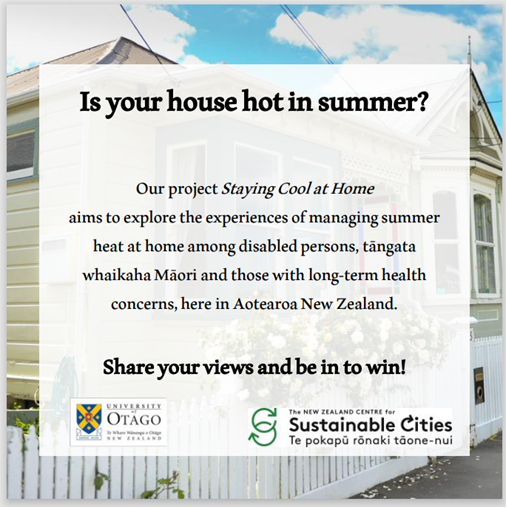
Our new @HeKaingaOranga@publichealthUOW survey explores experiences of summer heat at home among disabled persons, tāngata whaikaha Māori & those with long-term health conditions in Aotearoa NZ - if you can help, please find the survey here https://t.co/o1yQrp5JCE
“Electricity is an essential service for keeping people healthy at home and we really can’t wait for another life or death situation before we get this right.” Listen to @DrKimOS (scroll to 25’40”)
95bFM https://t.co/mkopQMjgAr
Making consumer care guidelines for electricity retailers mandatory could save lives. Read our latest Briefing from @DrKimOS@LucyTelBar https://t.co/E1tqDlRNfy
Almost a quarter of Medically Dependent Consumers who rely on electricity at home for their medical needs are not being protected by consumer care guidelines and that needs to change according to public health academic @DrKimOS
https://t.co/E1tqDlRNfy