MD,PhD |CEO Brieflands
Members:
1) Ethical Publishing & Dissemination, European Network for Academic Integrity
2) Governing board of National Medical Editors
A recent post from @sciguardians (sorry LinkedIn, this is an X handle) commented on the recent case of @LiangChengMD, from @BrownUniversity.
You can see the (X) post here: https://t.co/xn00GA6i9l
I had posted about this topic:
⚫️ https://t.co/kBfoPt5NUQ: Where I questioned the claimed world record for the highest i-10 index. This was stated in the post (now deleted) and was also stated on the Brown web page. My post ended by saying "We hope this information can be used to update his web site."
⚫️ https://t.co/lqh59jJcBi: Whether it was my post or not that led to the web page being updated I don't know (as many people had commented on it) but, within 24 hours, the web site was updated to remove this claim.
Science Guardians said the hardly anybody offered support to Liang Cheng and that he was labelled as a fraud. Just to note, I did not say that he was a fraud - I just fact checked what he said.
I would add though that he took his Google Scholar profile and trusted it enough (which the Science Guardian post said that we should all check our Google Scholar profiles) to state that he held a world record and to also put that on his web site shows, at best, naivety (IMHO).
Science Guardians also made the point that nobody looked at his @Scopus profile. Valid point but Liang Cheng's post (now deleted) was specifically talking about his Google Scholar profile. He did not himself comment on his Scopus account, h-index, citations etc.
Finally, looking at his Google Scholar profile, Liang Cheng has published 73 papers in 2026 (one roughly every two days), but his Scopus profile (looking at the same one as Science Guardian posted in their image) does not show any papers after 2024. This is slightly strange as a number of papers have been posted in Histopathology (for example), in 2025 and/or 2026, which is indexed by Scopus. It might be worth the author checking his Scopus profile, which would surely add to his 107 h-index.
---
Image credit: Science Guardians (https://t.co/xn00GA6i9l)
“Fake academic journals are publishing AI-generated papers under real professors’ names.”
https://t.co/UZtonELmWI
More on impersonation.
https://t.co/wTQ7k8Aefl
Fabricated citations: an audit across 2·5 million biomedical papers
The fabrication rate increased more than 12 times between 2023 and early 2026.
Possible causes: Paper Mills, AI use etc
https://t.co/ddCHLW6kv7
⚠️Scammers hijacked the Journal of Asian American Studies (ISSN:1096-8598) published by @JHUPress. The fake domain https://t.co/xP4LYUybZF was registered on 8/27/2024. Thanks to @andoniou.
P.S. Not included in any known list of #HijackedJournals.
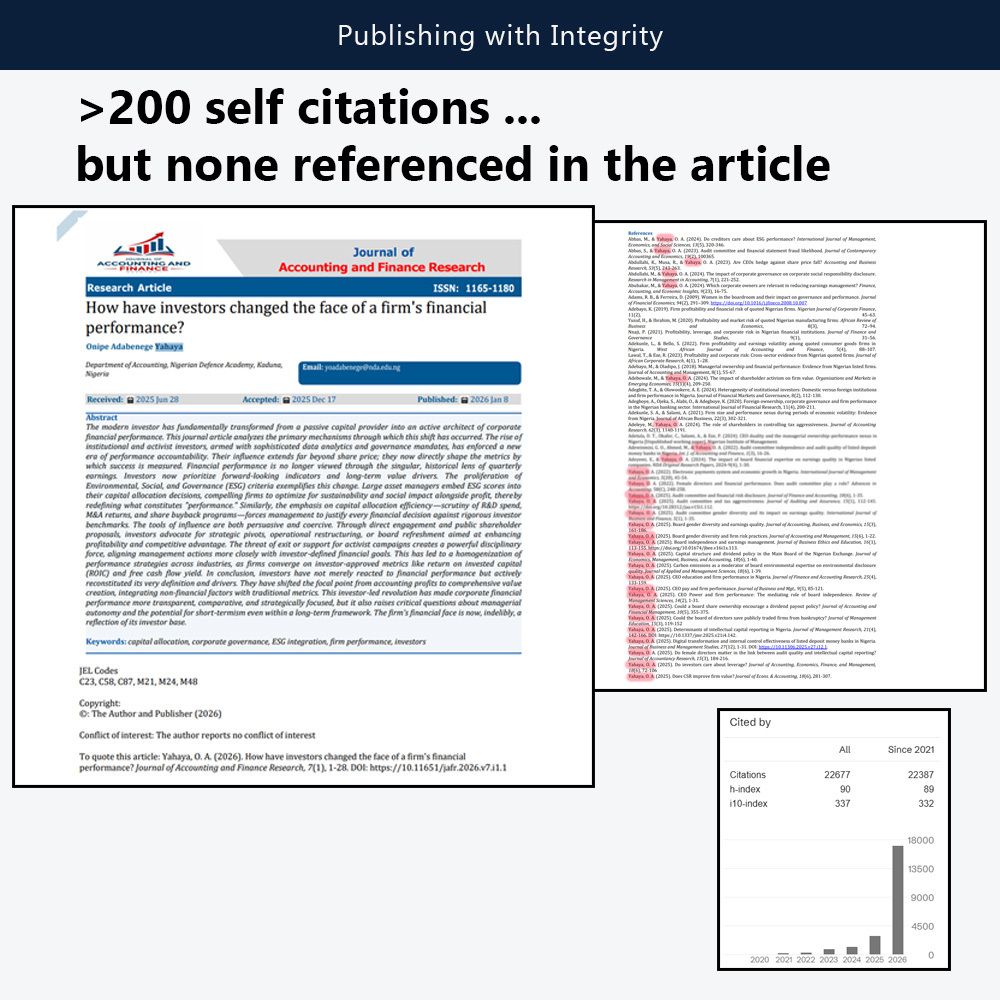
More than 200 self-citations, but not actually cited in the article.
I was drawn to an article as somebody posted about a Google Scholar profile (which showed 2,883 citations in 2025 and (already) 17,105 in 2026 - an h-index of 90). There is a link to the account below.
--- The article ---
I randomly chose an article (so many others may have similar issues) from the Google Scholar profile and noticed that:
⚫️ It self-cites over 200 times
⚫️ None of the references in the reference list - for this author - (as far as I can see) are cited in the article text.
--- The journal ===
I tried to find the journal using search, its ISSN and the DOI (which was not found) of the article but it all got a little confusing, suggesting that either the journal does not exist, it is a cloned journal or the web site is just not functioning correctly.
If you want to take a look yourself, the citation given is:
Yahaya, O. A. (2026). How have investors changed the face of a firm's financial performance? Journal of Accounting and Finance Research, 7(1), 1-28. DOI: https://10.11651/jafr.2026.v7.i1.1
--- So what? ---
Of course, this is Google Scholar profile is nonsense - as are the articles - so you may say, so what?
In my view (but may br wrong), this is done purely to manipulate Google Scholar.
This should worry all of us as if it can be manipulated at this scale what is to stop people just "manipulating it a little bit", which would be much harder to spot.
--- Comments/views ---
Any views/comments would be welcome.
--- The links ===
I have captured the Google Scholar account and also uploaded a copy of the article to Wayback Machine.
Google Scholar: https://t.co/BL2JZwWUG0 (archived at https://t.co/NUQwazA5fY)
Article: https://t.co/CkuRjpkpzG
The elephant in the room: Paper mills
Everyone in academia knows they exist.
And, increasingly, they are being discussed.
But despite that growing awareness, their full impact is still not always confronted directly.
Paper mills are no longer a fringe problem. They are a persistent and growing part of the scholarly publishing ecosystem.
And yet, in many conversations about research quality, they remain the elephant in the room.
________________________________________
What we are not fully addressing
Paper mills produce manuscripts for a fee.
Sometimes entire papers.
Sometimes authorship slots.
Sometimes fabricated data dressed up to look credible.
Most researchers are aware of this.
Editors see the patterns.
Reviewers occasionally suspect it.
Institutions encounter the consequences.
But translating awareness into consistent, system-wide action remains a challenge.
________________________________________
Why progress is difficult
There are several uncomfortable reasons:
⚫️ It is difficult to prove conclusively
⚫️ Retractions are slow and reputationally damaging
⚫️ Some institutions benefit from increased publication counts
⚫️ Journals risk exposing weaknesses in their review processes
So the system often absorbs the problem rather than confronting it directly.
________________________________________
How big is the problem?
We do not have precise numbers.
But we do have signals:
⚫️ Coordinated submissions with similar structures
⚫️ Repeated use of identical figures or datasets
⚫️ Suspicious authorship patterns
⚫️ Sudden spikes in output from unexpected sources
Bulk retractions when paper mill behaviour has been identified
Individually, these may be explainable.
Collectively, they are harder to ignore.
________________________________________
Why it matters
This is not just about “bad papers”.
It affects:
⚫️ Trust in the scientific record
⚫️ Fairness for genuine researchers
⚫️ The credibility of journals and publishers
⚫️ Decision-making that relies on published evidence
If the literature becomes polluted, the consequences extend far beyond publishing.
________________________________________
The uncomfortable question
If awareness is increasing, why is progress to address the issue so slow?
________________________________________
Your view
Is this the biggest integrity challenge in publishing today?
Or is there an even larger elephant in the room?
Just shipped a peer-review workflow package that turns a messy manuscript review into a clean, step-by-step process: structured screening, then checklist-anchored major comments (email-ready) and editorial polish—ending with an editor-in-chief style decision. 🚀📄
A journal with 400 editors may provide less editorial oversight than a journal with 40 editors.
That sounds counterintuitive. But editorial board size does not always tell us what we think it does.
________________________________________
When assessing a journal, do you ever look at the size of the editorial board?
Many researchers do. A long list of names can create a strong impression. It suggests disciplinary breadth, community support, and a large pool of expertise overseeing the peer review process.
In short, size often signals credibility.
But how much does editorial board size actually tell us about how a journal operates?
________________________________________
Operational scale or reputational signal
Large editorial boards are not inherently problematic.
Some journals receive thousands of submissions each year. Others cover multiple disciplines or aim for global representation across regions and research communities. In such cases, a larger board may simply reflect the operational scale of the journal.
More submissions require more editors. Broader scope requires more expertise.
However, board size can also function as a reputational signal.
Researchers occasionally report situations where:
⚫️ Editorial board members rarely handle manuscripts
⚫️ Individuals are unaware they are listed on the board
⚫️ Roles are largely advisory rather than operational
⚫️ Very large boards exist without clearly defined responsibilities
None of this necessarily implies wrongdoing. But it does raise an important question about what these lists actually represent.
________________________________________
The transparency gap
Most journals provide little detail about how their editorial boards function.
For example, it is rarely clear:
⚫️ How board members are selected
⚫️ Whether they actively handle manuscripts
⚫️ How often the board is refreshed or rotated
⚫️ What responsibilities the role actually carries
Without that context, the number of names alone tells us very little.
A journal with 40 active editors regularly managing submissions may provide stronger editorial oversight than one listing 400 names where only a small fraction are operationally involved.
________________________________________
A better question
Editorial boards play an important role in scholarly publishing. They influence peer review standards, editorial decisions, and the strategic direction of the journal.
So perhaps the real question is not:
“How large is the editorial board?”
But rather:
“How does the editorial board actually operate?”
________________________________________
Let’s discuss
If you serve on an editorial board, I would be interested in your experience.
⚫️ How active is the role in practice?
⚫️ Do board members regularly handle manuscripts?
⚫️ Are many positions primarily advisory?
I would also be interested to hear: what is the largest editorial board you have seen?
… and if you are a researcher, editor, or institution navigating questions around journal quality, editorial governance, or publishing integrity, feel free to reach out. I regularly work with scholars and organisations on these issues and I am always happy to discuss them.
BREAKING: Claude can now research like a Stanford PhD student.
Here are 9 insane Claude prompts that turn 40+ research papers into structured literature reviews, knowledge maps, and research gaps in minutes (Save this)
Scholarly publishing runs on trust
It might be assumed that scholarly publishing operates through formal rules and contracts, and some of it does. But much of the system still relies on trust.
For example:
⚫️ Authors trust that editors will assess their work fairly.
⚫️ Editors trust that reviewers will evaluate manuscripts objectively and maintain confidentiality.
⚫️ Reviewers trust that the work they are assessing represents genuine research.
⚫️ Readers trust that what appears in the published record reflects honest scholarship.
These assumptions are rarely questioned. They form the background conditions that allow the system to function.
________________________________________
A system built on professional norms
Formal agreements do exist. Authors sign copyright transfer forms, confirm authorship declarations, and tick boxes stating that the manuscript is original and not under consideration elsewhere.
Yet these steps do not define the system. Scholarly publishing has long relied on professional norms and shared expectations of behaviour.
Editors assume that authors list contributors honestly. Reviewers are trusted to respect confidentiality. Authors are expected to cite the literature responsibly rather than strategically.
In many ways, scholarly publishing still operates through something closer to a professional handshake than a fully monitored contractual system.
________________________________________
A changing environment
Over the past two decades, scholarly publishing has changed. Publication now plays a central role in career progression, funding decisions and institutional rankings. At the same time, submission volumes have grown and editorial systems operate globally.
Under these conditions, the traditional trust model is under pressure. Practices such as paper mills, manipulated peer review, citation rings and the trading of authorship exploit assumptions the system historically relied upon.
These developments do not only affect individual journals. They challenge the trust infrastructure of scholarly communication.
________________________________________
A question for the research community
Most researchers continue to act with integrity, and the system still functions largely because of that. However, the incentives, “publish or pressure” and scale of modern publishing are very different from those that existed when these norms developed.
This raises an important question:
Can a system built on professional trust continue to operate effectively in a global, high-stakes publishing environment? I’d be interested in your views.
________________________________________
Working in a changing publishing landscape
Researchers and institutions increasingly need a clearer understanding of how modern publishing operates.
If your institution is exploring how to support researchers in navigating this environment, I would be happy to discuss talks, workshops or advisory work.
Academic integrity across educational levels: Exploring students’ engagement with grey-zone and non-compliant practices in four European countries
#ResearchIntegrity#AcademicIntegrity#WCRI2026#WCRI
https://t.co/PwXfX2AMKp
Should the journal/publisher take another look at this article?
Recently, I posted (see https://t.co/llubkLvJTQ) about this paper (see image 1) after reading a previous post (see https://t.co/3GxysXYhFZ). My question in my previous post was, "Was the corrigendum done correctly?"
In this post, I ask if there is a case for the article to be looked at again and whether an erratum, or even a retraction, is warranted?
Here is why I ask this question:
⭕ The corrigendum lists two sources from which text has been reused. One of them is a conference paper and the other is a book. It seems a little strange that an entire book would be cited. In fact the original poster has identified three of the chapters from the book (see reference below).
So, in my view, the corrigendum should have listed four sources (see the second image):
1️⃣ Hajiyev,Ch.M. (2000),“Approach to fault detection inKalman filter based on spectral
norm of innovation matrix”, Proceedings of the International Conference System
Identification and Control Problems, Moscow, 26-28 September, pp. 1077-1085
2️⃣ Hajiyev, C. and Caliskan, F. (2003), Fault Diagnosis and Reconfiguration in
Flight Control Systems, Chapter 1: Introduction. Kluwer Academic Publishers, Dordrecht
3️⃣ Hajiyev, C. and Caliskan, F. (2003), Fault Diagnosis and Reconfiguration in
Flight Control Systems, Chapter 7: The innovation approach to fault detection. Kluwer Academic Publishers, Dordrecht
4️⃣ Hajiyev, C. and Caliskan, F. (2003), Fault Diagnosis and Reconfiguration in
Flight Control Systems, Chapter 8: Sensor Fault Detection and Isolation in Flight Control Systems Based on Innovation Approach . Kluwer Academic Publishers, Dordrecht
AN IMPORTANT POINT TO NOTE is that the three book chapters have been authored by Hajiyev and Caliskan, whereas the paper in question is authored by Hajiyev and Okatan. This means that Caliskan has been plagiarised.
⭕ We have been pointed to another article (see third image):
Hajiyev, C. (2009). Innovation approach based sensor FDI in LEO satellite attitude determination and control system. In V. M. Moreno & A. Pigazo (Eds.), Kalman filter: Recent advances and applications (Chap. 15). IntechOpen. https://t.co/fazNqH6eae
... which also contains common text with the paper under question.
===
COMMENTS
⭕ The original poster says that there is 100% plagiarism of the paper that has had a corrigendum published.
⭕ The corrigendum did not really give full details about the article/chapters where the text was sourced from.
⭕ The paper in question was not updated, so we do not know which, or how much, text has been plagiarised and/or duplicated.
⭕ There is another article where text has been reused from. Should this be listed in the corrigendum (at least)?
QUESTIONS
⭕ Has the paper in question actually made a contribution, or has the novelty already been published?
⭕ Should the journal/publisher take a further look at this paper and carry out a more forensic analysis?
The #papermill#fraud Marek Jaszczur from @AGH_Krakow loses another paper! Retraction 23 for this #fraud! Oh when will publishers learn? And his university still thinks he is a legit researcher! Yeah right...
https://t.co/VNXhSr8iEz
سرمایه های علمی پژوهشی در مجلات کشور در معرض تهدید جدی قرار گرفته اند. مسوولان چاره اندیشی کنند
-- گزارش تحریم و حذف DOI بیش از ۳۶۰ مجله علمی پژوهشی از دانشگاههای ایران
https://t.co/0m54AMs3Gz
Renaming the Problem: Why ‘Non-Recommended Journals’ Is Preferable To ‘Predatory’ in Academic Publishing | Barw Medical Journal https://t.co/PH5DHfT58g
“Citation dynamics and altmetric trends of retracted publications in Indian-funded research: pre and post retraction analysis.”
https://t.co/PiHWPAoU21