Sir Matt Busby Player of the Year ✅
United Players' Player of the Year ✅
FWA Footballer of the Year ✅
Premier League Player of the Season ✅
That's our Bruno 🐐
• Platinum chemotherapy shortage in India is becoming a major oncology challenge
• Cisplatin & carboplatin are backbone drugs across many cancers
• The issue is not just “drug availability” → raw material crisis → pricing pressure → manufacturing economics → supply-chain disruption
• Real-world impact: → treatment delays → dose modifications → regimen changes → inventory pressure
• Quick visual summary of: ✓ What is happening
✓ Why it is happening
✓ Clinical implications
✓ Possible solutions
Would like to hear how different centres are managing this situation.
#Oncology #CancerCare #DrugShortage #Cisplatin #Carboplatin #Chemotherapy #OncTwitter #MedTwitter #MVOnco
Imagine a 17 or 18-year-old kid.
A kid who practically locked himself in a room.
Cut himself off from the world. Did not attend family functions. Did not watch movies. Felt guilty even while taking breaks.
He would look outside the house and see other kids having a good time. He would long for their carefree lives, but then he would remember that lifelong dream, the dream of becoming a doctor, and he would return to the world of books.
Life became all about A, B, C and D.
As the exam came closer, life became even tougher. The pressure became too much to bear. He was still a kid, but grown up enough to dislike sharing his anxiety with others.
He would talk to a friend who was in the same situation, and then came the line that kept both of them going:
“Few weeks more, and it will all be over.”
He pushed himself further.
The anxiety increased. For the first time, he understood what sleeplessness meant, what palpitations felt like, what the pressure of expectations was, and what loneliness could do to a person.
The whole ecosystem of preparation kept telling him that he needed to do more.
Every motivational video, every strategy session, every video of toppers being made to dance awkwardly, all seemed to tell him the same thing:
You need to do more.
So he pushed himself further.
“Few days more.”
That was the thought that gave him some strength.
Then came exam day.
He had struggled to sleep the previous night. In the morning, he puked. He could not eat. His family forced him to take some juice, and somehow, he reached his exam centre.
The next few hours would decide whether his dream would come true, or whether he would see it shattered at the tender age of 17.
He did everything he could in those hours.
The exam went well.
And now, he had hope.
But that hope rested on one basic presumption:
That the system is fair.
That in this system, hard work gets rewarded.
And then came the news of a paper leak.
The boy was shattered.
The seats are few. What will happen now?
If those who got access to the leaked paper get the seats, students like him will be edged out.
And then came another news.
There may be a re-exam.
He has to go back to the same books again.
Again the sleepless nights. Again the puking. Again the palpitations.
Will he survive it?
Or will the stress be too much, and will it finally break him?
What is his fault?
What did he do wrong?
Why can his government not ensure even basic fairness in the system?
Why do leaders who cannot stop praising themselves fail to do the minimum for the kids of this country?
And why do officers who write essays on ethics become corrupt the moment they get power?
Why is this country still so dysfunctional?
And why are people still afraid to ask questions?
Alas, there will be no answers.
The kid will be told to stay strong and go back to the grind.
It will be business as usual.
Justice? What is that?
#NEET
“Why are you crying about the re-exam? It’s not like you’ll forget everything you studied in a few weeks. If you are a good student, you can study again and still score well.”
Well, that’s not how things work. Competitive examinations are not merely tests of knowledge, but also tests of timing, mental conditioning, emotional stability, and peak performance achieved after months or years of disciplined preparation. Serious students structure their entire routine around one examination date, carefully managing sleep, revision cycles, stress levels, mock tests, and mental sharpness to perform at their absolute best on that particular day.
When an exam is cancelled despite their honest effort, they are forced to recreate the same level of focus and intensity again, which is mentally exhausting and usually impossible with the same efficiency.
The hardest-working students are affected the most because they invest the greatest emotional and mental energy into preparation. After the first exam, many experience burnout, fatigue, reduced concentration, emotional numbness, and loss of momentum. Even if their knowledge remains intact, their sharpness may decline during the re-exam.
Most damaging of all, paper leaks weaken a sincere student’s faith in merit itself. When students realize that even years of hard work cannot protect them from systemic failures caused by others’ dishonesty, it creates frustration, helplessness, and distrust toward institutions.
This is why a leak-proof exam is non-negotiable, the bare minimum that can be done for hard working students.
On the first day of my medical house job in 1991, the registrar said to me: "You will quickly start to think you're irreplaceable. You're not. Remember that. If you get hit by a bus tomorrow, the consultant will look round and say 'Didn't we used to have a house officer? Get me another one!'"
About 25 years in pancreatic cancer, what we’ve really done is the same: rearranging treatment sequence and intensity.
For the first time, that cycle may be breaking👇
Daraxonrasib (pan-RAS inh)
was reported to nearly double OS compared with chemotherapy.
https://t.co/GaDveHpf2v
Cancer used to be a death sentence.
Now many are >90% survivable.
Childhood leukemia: 5% → 92%
HER2+ breast: 25% → 90%
CML: 22% → 87%
This is not "luck".
Its decades of funding towards time & infra that compounds discovery.
Pancreatic cancer today is the breast cancer of 1985, and Glioblastoma ≈ leukemia of 1970.
The scientists who will solve them
are already in labs NOW.
The question is whether we fund them long enough.
Funding doesn’t just support science.
It literally rewrites outcomes.
This plot is proof.
Source: SEER + NIH via @Jori_health
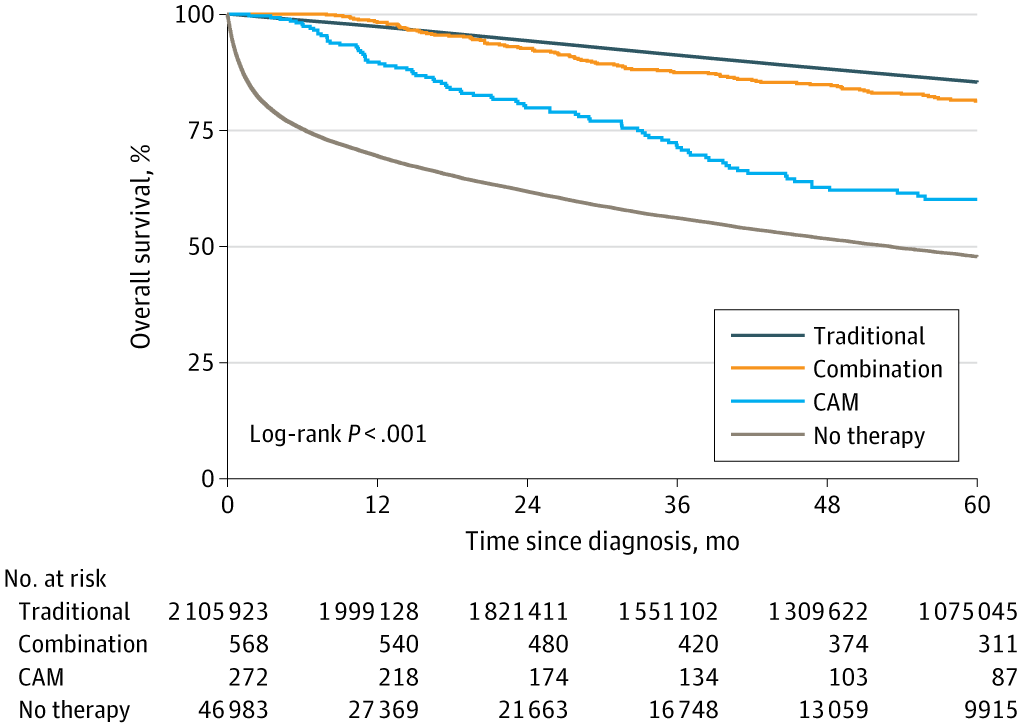
For breast cancer, alternative medicine alone was linked to a 267% higher mortality hazard.
Even when combined with standard treatment, mortality hazard was still 45% higher.
Modern oncology saves lives. Please consider using it.
Ahmedabad is the most underrated city in India.
No, seriously.
Business? Home to some of India’s oldest and wealthiest trading families. More BSE-listed companies per capita than most metros.
Food? You haven’t lived until you’ve had a full Gujarati thali at 11am on a Tuesday like it’s completely normal.
Infrastructure? BRTS, riverfront, metro — a Tier 1 city that actually planned itself.
Cost of living? Your Mumbai rent gets you a bungalow here.
Culture? IIM-A in one corner. The largest textile market in Asia in the other.
Safety? Women walking at midnight. Enough said.
And the people —
Gujaratis don’t talk about building wealth.
They just quietly do it.
Then offer you chai.
Every city has an identity.
Ahmedabad’s identity is execution.
Sabse sasta. Sabse saaaf. Sabse smart.
The best city in India isn’t the loudest one. 🧡
We’ve trained a multimodal AI model to turn routine pathology slides into spatial proteomics, with the potential to reduce time and cost while expanding access to cancer care.
Bumrah is cricket’s biggest cheatcode. In a landscape dominated by batters, the most imapactful player in the sport is a bowler. And it isn’t even close.
A story of how you are harassed for your own hard earned money
NEET SS 2025 counselling was conducted in 2025 and we were asked to pay 2,00,000 rupees security deposit for the same. Normally this is returned withing 1-2 months of counselling once admissions are done.