My views quoted in @timesofindia article by @HChhapiatoi on enrollment estimates at foreign universities and the need to bridge information gaps for students and families https://t.co/t3d4WK10Zr
The sector is still evolving rapidly, there are no standardised parameters to evaluate these campuses, and much of the information available is incomplete or inconsistent.
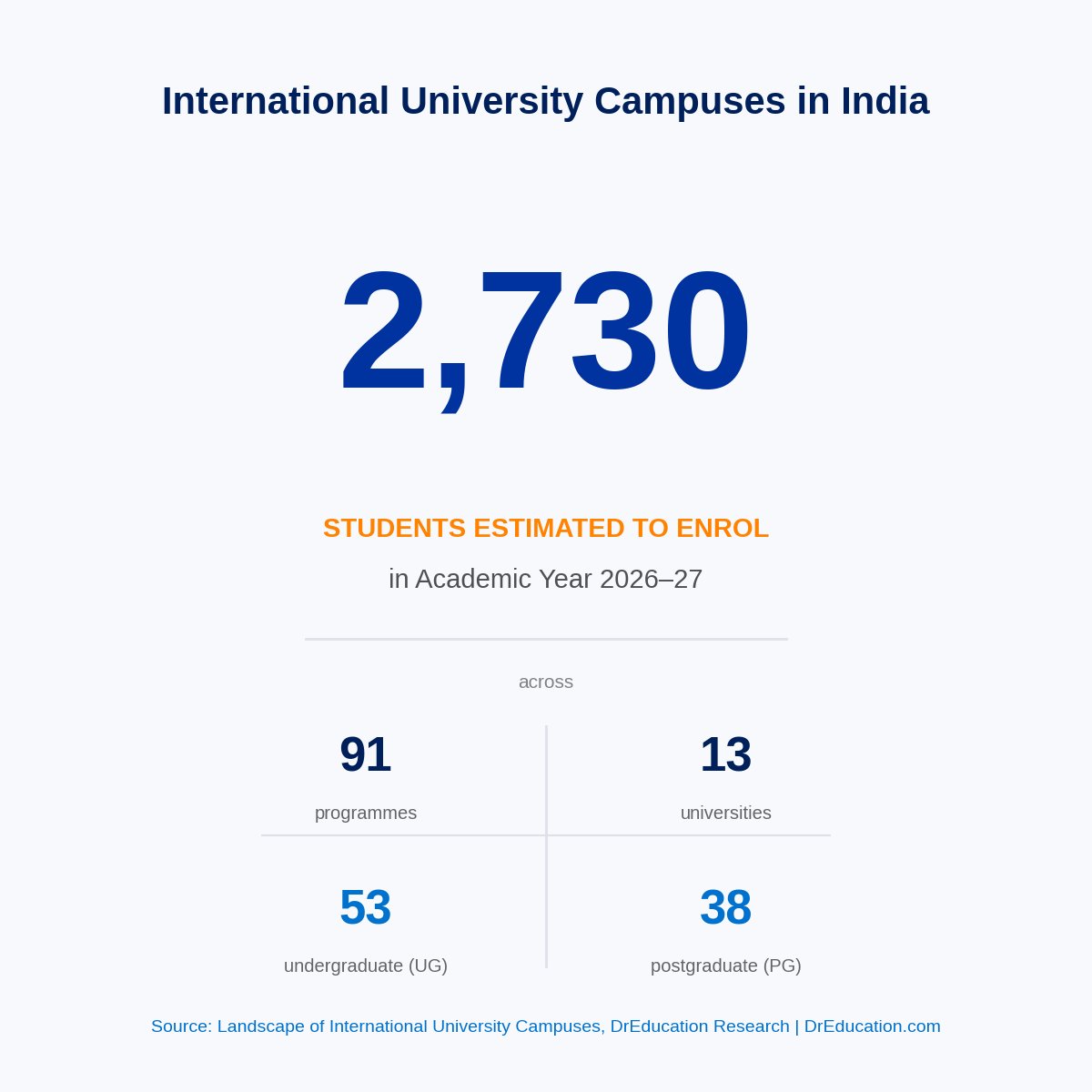
The article quotes from the report, Landscape of International Branch Campuses in India, that together, these campuses offer 91 programmes (undergraduate = 53 and postgraduate = 38), with an estimated annual intake of 2,730 students. Initial projections suggest that only around half of these seats may be filled as some of the campuses only received UGC approvals in June and July, offering little time for students to make decisions.
#highereducation #highered
Is there a difference between the average tuition fees at Indian campuses of Australian and British universities?
Of the 14 international university campuses currently operating in India, UK institutions lead with seven campuses and 50 programmes, while Australia has six campuses (UWA has two campuses) and 33 programmes.
https://t.co/9TXuFV0YTf
A comparison shows an interesting contrast between Australia and the UK in terms of average tuition fees and the number of programmes offered.
Undergraduate: On an average, Australian campuses are more expensive—around 16% higher than UK campuses (₹14.2 lakh vs ₹12.2 lakh).
Postgraduate: The pattern reverses, with UK campuses being slightly more expensive, although the gap is small—approximately 5%.
Variation in fees: UK undergraduate fees show the widest range, from ₹7.5 lakh to ₹15.0 lakh, compared with Australia.
Postgraduate premium: Moving from undergraduate to postgraduate study costs considerably more in the UK—an increase of 46%, compared with 19% in Australia.
Consistency: Australian postgraduate fees are more consistent across campuses, while UK fees vary considerably, ranging from ₹12.5 lakh to ₹23.1 lakh.
Foreign Higher Education Institutions in India: Comparing Australian and British Universities Average Annual Tuition Fee
#highereducation #highered #india #cost #UK #Australia
Navigating the India’s foreign degree maze. My views published in @Firstpost, based on our research on the evolving landscape of foreign universities in India.
https://t.co/CbZCa6ACS1
As international universities establish campuses in India, students are gaining access to a wider range of programmes. At the same time, differences in programme duration, nomenclature, tuition fees and scholarships make comparisons less straightforward.
At the postgraduate level, programmes range from one to two years, while undergraduate programmes typically run for three years, with some extending to four. These differences can have a significant impact on the total investment required for a degree.
https://t.co/9TXuFV0YTf
Scholarships add another dimension, with varying eligibility criteria and timelines making it difficult to assess the net cost based on tuition fees alone.
As this landscape develops, how will differences in programme offerings, duration and overall cost shape student choices across the 13 foreign universities currently in India?
#highereducation #highered #india #college
Fascinating insights on foreign university campuses in India @financialreview weaved around @UNSW Bengaluru first cohort
https://t.co/hjZWocQRNu
- "UNSW says 60 students have enrolled in the first cohort, spread between three bachelor’s courses in business, computer science and data science, and a master’s in cybersecurity." UNSW vice chancellor Attila Brungs says, “I refuse to call it a branch campus, I told the academic board you’re never allowed to call it a branch campus, it’s just one of our campuses.”
- UNSW "has a 51 per cent stake in the Bengaluru campus, a joint venture with Indian edtech company Emeritus. According to the university’s 2025 annual report, UNSW will make an initial contribution of about $400,000 towards the project this year."
- "The University of Western Australia has taken the bold step to go it alone, and will entirely self-fund establishing the two campuses with an initial investment of $62 million, according to vice chancellor Amit Chakma. @UWAIndia@UWAnews
- “Undoubtedly, the history of offshore delivery by Australian universities has involved a number of shipwrecks. We can only hope that our universities have done comprehensive research on the right locations, the right courses, and the right price point in what is now a very competitive market,” says @PhilHoneywood, chief executive of the @IEAAustralia
- My views quoted from the research report on international campuses "The flood of foreign institutions has created a new financial tier in Indian education. A study by higher education expert Rahul Choudaha mapped the 13 foreign universities admitting students in 2026-27 and found the fees were more than double those at the top private local universities and about a third of the cost of studying abroad."
https://t.co/9TXuFV0YTf
#highereducation #highered #india #australia
What data tells us about the relative tuition pricing of international campuses in India? My views quoted in @timeshighered article by Rosalind Skillen
https://t.co/3fGgbOQJk2
#highereducation#highered#India
My opinion piece published in @firstpost on foreign universities, particularly from Australia and the UK, rushing to establish international branch campuses in India.
https://t.co/CbZCa6ACS1
However, one of the challenges at this early stage of development of these campuses is that students and families have to make high-stakes decisions with limited, inconsistent, and evolving information.
#highereducation #highered #india #universities
My views were quoted in @TimesHigherEd on how young people in India have found a voice for triggering higher education reforms — reforms that have a complex relationship with society, youth, politics, finances, and the economy.
https://t.co/hA2UI8N1n4
Beyond the basic expectation of fairness and integrity in high-stakes exams, the movement was an expression of frustration with the lack of future opportunities. Only one in four college-educated youth aged 15 to 29 in India has a salaried job, according to PLFS data reported by Bloomberg. While youth unemployment is rising in several advanced economies too, the absolute numbers are staggering in India, given that 45 million students are currently enrolled in higher education in the country.
To onlookers outside the country, India's biggest protests in years seemingly came out of nowhere, focused on an unlikely cause: examination integrity. But in reality, they were the culmination of years of bubbling frustration among Indian youth, amid a sense that however hard they try, getting ahead is much harder than it should be — writes Rosalind Skillen, who also shares her views in the podcast.
https://t.co/Y6QTL4nMIV
#highereducation #highered #india
International students on OPT in the U.S. doubled in a decade (2015/16–2024/25). However, when seen in context of more recent enrollment data, OPT numbers are already headed for contraction.
https://t.co/P76vQ31fPK
A $100,000 fee on OPT, as reported by the WSJ — is misdirected and disproportionate, because it's aimed at a trend that's already reversing. https://t.co/Z5G5NJblv4
This policy would be like a restaurant charging more for parking than for the meal — disproportionate and misdirected. @WSJ reported that US is considering imposing US$100,000 on international students transitioning from student visa to OPT (Optional Practical Training). To put OPT numbers in perspective, US universities and colleges enroll over 19 million students and there are fewer than 300,000 international students are on OPT. The underlying policy intention seems to be more as a deterrent for international students to not stay in the US and find alternatives which most likely is about returning to their home country.
@MHackman writes "The $100,000 fee is becoming a frequent tool used by Trump immigration officials, who have developed several policy proposals to block foreigners of limited financial means from coming to the U.S. In addition to the H-1B and student visas, officials at the State Department are also weighing attaching a $100,000 bond on applicants for green cards outside the U.S., redeemable only after they move to the U.S. and become citizens."
https://t.co/YRstR6tw0m
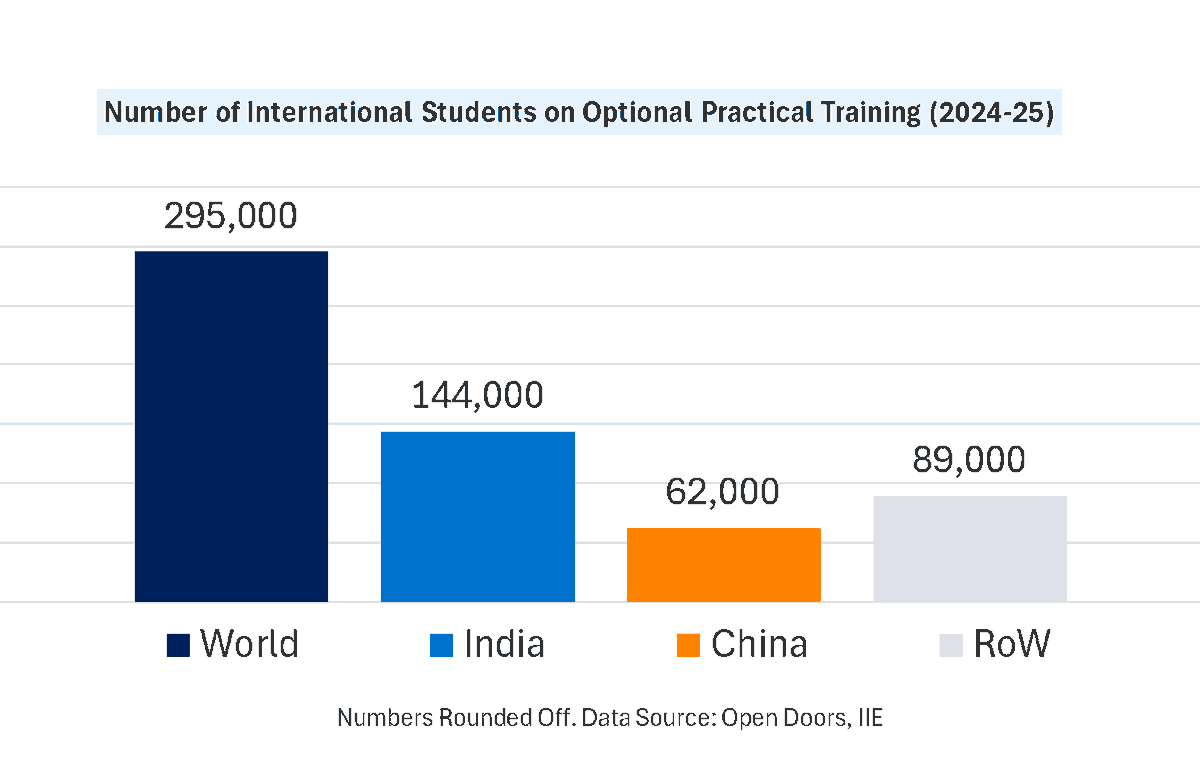
Note on figures: The Journal's report cites approximately 419,000 international students on OPT in 2024 (calendar year) — a figure that appears to include Curricular Practical Training (CPT) alongside OPT and STEM OPT, rather than OPT alone. By contrast, Open Doors (IIE) data — using the 2024/25 academic year — puts the number of international students on OPT at under 300,000, with India and China accounting for ~144,000 and ~62,000 students respectively. Either way, OPT — the actual post-graduation work numbers are considerably smaller population than the total US higher education enrollment.
#highereducation #immigration #opt
A $100,000 fee on OPT, as reported by the WSJ — is misdirected and disproportionate, because it's aimed at a trend that's already reversing. https://t.co/Z5G5NJblv4
How much it costs to study in a foreign university in India? Can international campuses in India replace study abroad experience? @TheHinduEduPlus@The_Hindu
https://t.co/tDxziA1tSH
Thirteen foreign universities operating across 14 campuses are admitting students this year, with several more expected to begin operations next year
#highereducation #highered #India #jobs
Can foreign campuses in India replace study abroad? Quoted in @The_Hindu to discuss the findings of the research report, Landscape of International University Campuses in India.
https://t.co/ChyOj6NT4w
I shared the context of narrowing pathways for post-graduate work opportunities, permanent residency and immigration in key destinations such as the United States, Canada, the United Kingdom and Australia:
“The bigger challenge is no longer getting a student visa; the bigger challenge is the transition from a student visa to an employment visa. If that pathway is getting blocked, students start questioning whether the investment is worth it.”
The article cited the data from the report that the average tuition fees at foreign university campuses in India are around ₹13.3 lakh for undergraduate programmes and ₹17.2 lakh for postgraduate programmes.
https://t.co/9TXuFV0r3H
I highlighted that "International campuses occupy a new space rather than replacing either Indian universities or overseas education. They are sitting somewhere between a top private Indian university and studying abroad. This category never existed before."
Ravneet Pawha, Vice President Global Engagement @Deakin University and CEO of South Asia for Deakin University GIFT City Campus, India said the Australian institution established its campus in Gujarat’s GIFT City to contribute to India’s growing demand for globally trained professionals rather than simply expanding overseas. “We have to understand what we can add to the existing ecosystem,” she said. “It is not about simply bringing what works overseas and assuming it will work here.”
#highereducation #highered #india
"The need is for an education reform built around the entire student journey, not just exam-based entry," writes Jeanette Rodrigues, South Asia Editor of Bloomberg @business@menakadoshi shared a chart from PLFS data in her newsletter, India Edition, showing that only 1 in 4 young Indian graduates are employed in regular salaried jobs.
One of the key outcomes of a successful student journey is a quality job. And that itself depends on a number of factors — including academic experience, skill development, and industry engagement — a few of which are within the control of higher education institutions. In other words, quality higher education focused on skill alignment is key to bridging this gap. Exam reform needs urgent attention — but underemployment and unemployment remain at the root of much youth dissatisfaction and dissent, and closing that gap requires tighter corporate engagement and industry-academia partnership.
#highereducation #skills #jobs #india #neet
I expect 30 foreign universities operating in India by 2030...data shows below 21 campuses by home country and Indian city/location.
https://t.co/RCJn6W13V6
My view quoted in @uniworldnews
"The next wave of growth is likely to come from universities beyond the early movers – Australian and British institutions. Several others are in an exploratory, ‘wait-and-watch’ stage and may act within a couple of years. So, over a five-year period, at least 30 foreign universities are expected to be operational.”
#highereducation #highered
My views quoted @UniWorldNews on @IITBombay's plan to launch its first overseas sub-campus in the US in collaboration with the @sunyOldwestbury
https://t.co/Ew2ZWclTcq
In the article by @shuriahn, I highlight the symbolic significance of the initiative. and to view this initiative in the right context of scale "This starts with certificate programmes in a Long Island suburb – not full degree programmes, not thousands of students....This looks like a deliberately phased approach rather than a large-scale rollout. Starting with certificate courses lets IIT Bombay test traction – see how the market responds, how the partnership functions operationally – before committing to degree and research programmes."
#highered #highereducation
India's higher education has made significant progress in the last five years, with increased enrollment and participation of females in top undergraduate programs. The GER reached a new high as per the latest AISHE report
A @timesofindia report 👇
https://t.co/bpb9sdVymL