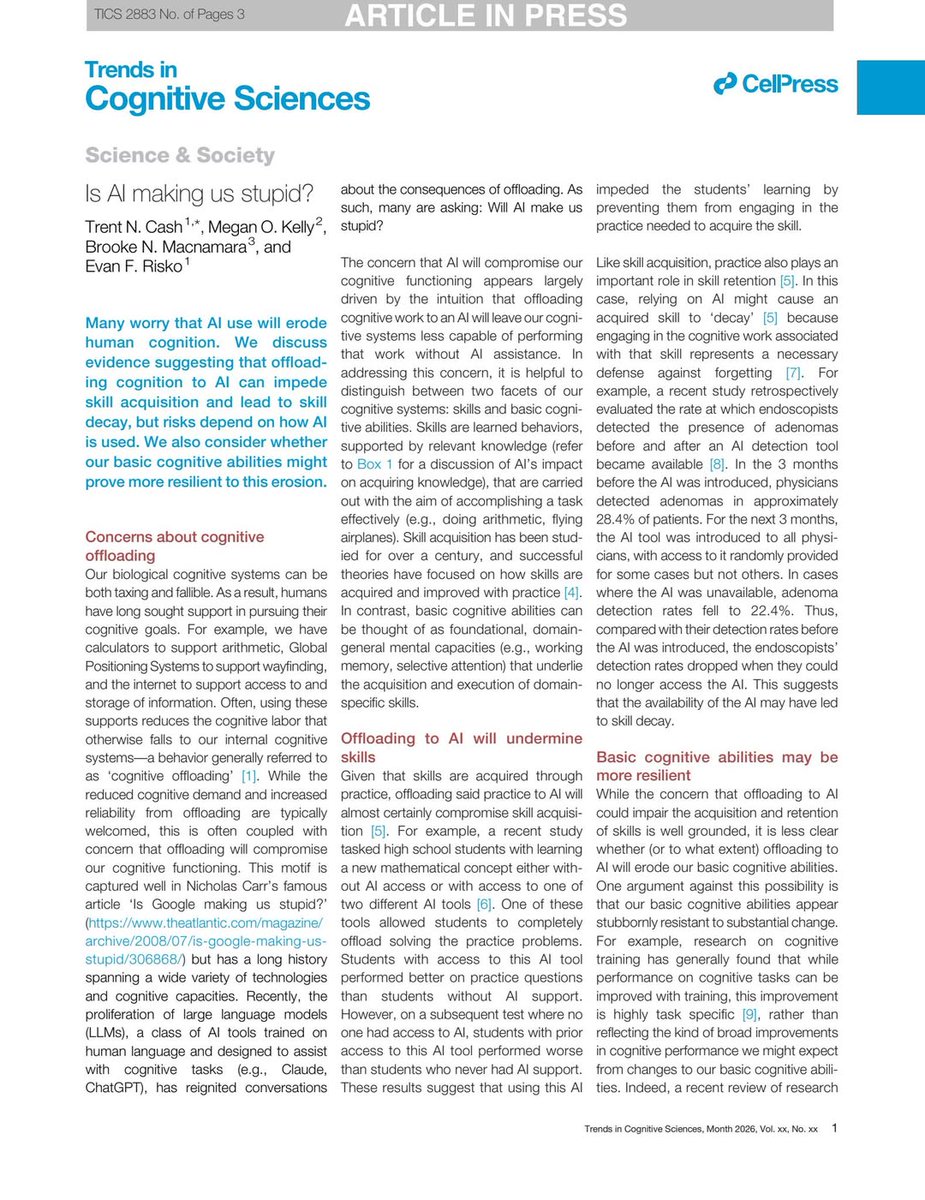
Is AI making us stupid?
Many people worry that AI use will erode human cognition. A new paper reviews evidence that offloading cognition to AI can impede skill acquisition and lead to skill decay.
However, this is not inevitable. It depends on how you use the technolog.
https://t.co/6ZbuTwQTVp
Glyphosate isn’t controversial because it’s understudied.
It’s controversial because the evidence is ignored.
Fact 1. This chemical is exhaustively studied:
•40+ years of data.
•Thousands of studies.
•Reviewed repeatedly across continents.
Fact 2. Global regulators agree:
Every major regulatory authority that assesses real-world exposure reaches the same conclusion:
•US EPA
•EFSA
•ECHA
•Health Canada
👉 Not carcinogenic at human exposure levels.
👉 Not genotoxic.
👉 No unacceptable health risk when used as directed.
This is not one agency.
This is not a global conspiracy.
Fact 3: The largest human study says no.
•54,000+ pesticide applicators.
•Followed since 1993.
•No link to overall cancer.
•No consistent link to non-Hodgkin lymphoma.
If glyphosate caused cancer, this study should have found it.
It didn’t.
Fact 4: Food residues are not the issue.
•Residues are far below safety limits.
•Dietary exposure does not pose a cancer risk.
•Drinking water exposure is not a health hazard.
“Toxic” without dose is not toxicology.
Fact 5: Worker exposure is also low.
•Measured exposures are far below NOAELs.
•Regulators repeatedly conclude: not of concern.
So where does the scare come from?
One outlier → IARC
IARC did a hazard classification, not a risk assessment.
They put glyphosate in the same category as:
•Red meat.
•Hot beverages.
•Being a barber.
IARC explicitly ignores exposure.
Regulators do not.
This is the entire conflict:
Hazard-only classification
vs
Risk-based regulation.
Confuse the two - and fear wins.
Bottom line:
No pesticide regulator on Earth currently considers glyphosate a cancer risk at real-world exposure levels.
The science is boring.
It’s to put a stop to the misinformation.
Modern farming methods have lifted millions of people out of poverty.
→ Agrochemicals.
→ Mechanization.
→ Genetics.
We can feed more people and preserve biodiversity by improving land-use productivity through increasing crop yields.
🌱 Exciting opportunity at the Salk Institute! We're seeking a Full Professor in Plant Biology. Join a world-class team pushing the boundaries of scientific discovery. Ideal for leaders passionate about innovative research and interdisciplinary collaboration. Apply now! 🌿https://t.co/FQcqC219La🌿
#PlantBiology #ScienceJobs #AcademicCareers #SalkInstitute