HOW JAPANESE PARENTS RAISE KIDS WHO LISTEN THE FIRST TIME — WITHOUT RAISING THEIR VOICE.
I lived in Japan for two years.
In two years, I never once heard a parent scream at their child in public.
Not in a store. Not on a train. Not in a park full of overtired toddlers.
I thought Japanese kids were just born calmer.
I was wrong. It's built. Here's how:
🔴 A new study in Nature may change the way we think about viral reactivation during severe COVID-19—and its possible relationship to Long COVID.
One sentence from the authors is particularly important:
“Our findings challenge the prevailing view that chronic viral reactivation is primarily a consequence of immunosuppression.”
Why?
Because they found frequent viral reactivations in immunocompetent patients during severe illness, associated with increased systemic inflammation.
This is something we have been arguing for a long time:
An immune system can be hyperactivated and, at the same time, progressively lose effective control of persistent viruses.
(1/19) 🧵
Vücutta kortizol yüksekliği, sigara veya alkolden daha hızlı yaşlandırıyor sizi.
Saça sakala düşen aklar, kötü uyku, zor toparlanma, motivasyon eksikliği.
İşte zamanı yavaşlatmak ve kortizolü düşürmek için
8 doğal yöntem:
1. Saunalar
@VoidStateKate@fidjissimo Hey, could you please guide me how to build&use agents? I'm in desperate need to do that as well. Any guidance is much appreciated 👏
This is a big deal. Omega-3s reduce aggressive behavior across randomized controlled trials.
A meta-analysis of 29 studies and nearly 4,000 participants found that omega-3 supplementation reduced aggressive behavior by up to 28%. The benefit was broadly consistent across children and adults, males and females, community and clinical samples, and across different doses and treatment durations. It also helped with both reactive/impulsive and proactive/planned aggression.
Mechanistically, this makes sense. Omega-3s are deeply involved in brain cell membranes, neurotransmission, neuroinflammation, cerebral blood flow, and gene regulation. DHA is especially enriched in the prefrontal cortex (an area critical for impulse control, emotion regulation, and executive function).
The authors even concluded that there is now “sufficient evidence” to begin implementing omega-3 supplementation to reduce aggression in the community, the clinic, or the criminal justice system.
That’s a remarkable statement for a nutritional intervention and a reminder that omega-3s influence brain health and may shape behavior in meaningful ways.
Not all organs respond equally to #COVID infection. DISCO-seq, a new technique led by my talented friend @HarsharanBhatia, combines 3D imaging and single-cell analysis to map Spike Protein tropism and found mostly in the liver, lungs, intestine & kidneys. https://t.co/9dA0axeUbU
@haskologlu Bir anda Tayyip Erdoğan ağzıyla nasıl da konuşmaya başladı farkında herkes galiba. Midem bulanıyor artık şu adamı gördükçe. Haydi aklı selim muhalefet artık adam gibi birlik olun yahu!!!
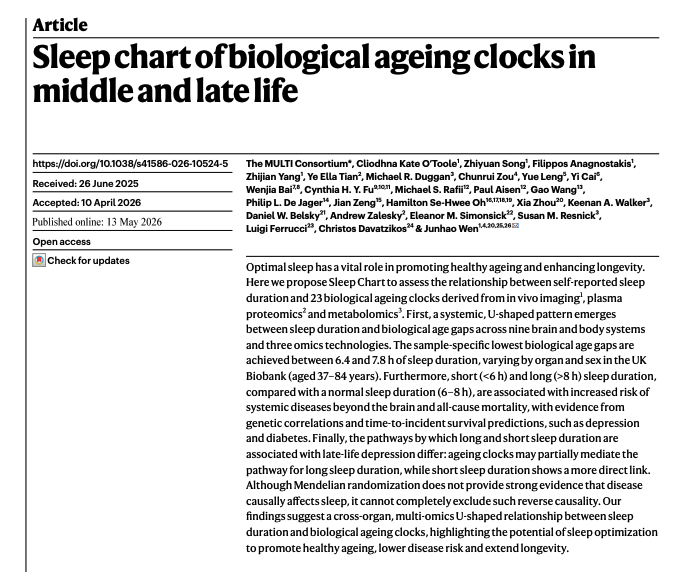
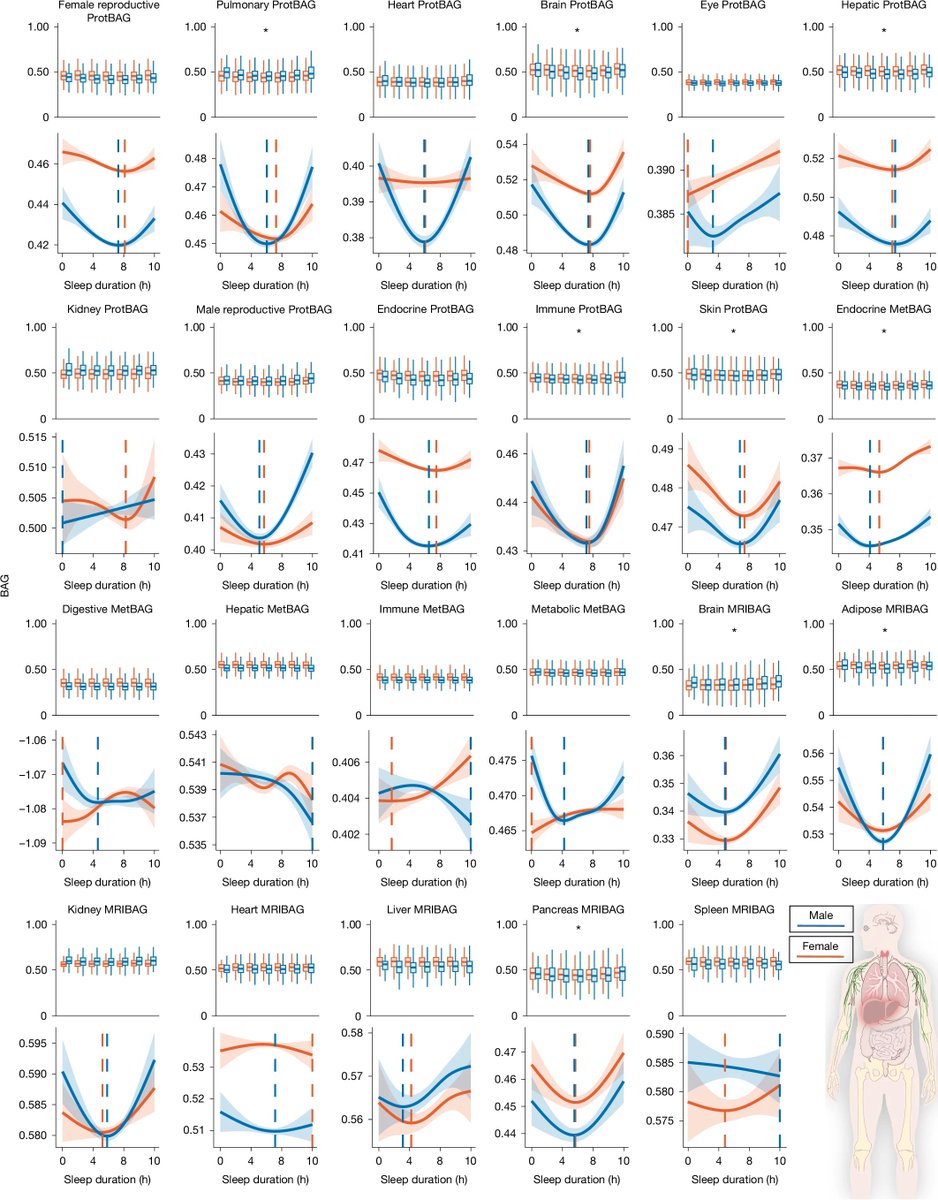
The sleep "sweet spot" for biological aging isn't 8 hours per night.
6.4-7.8 hours was associated with the lowest biological age gaps across 23 organ-specific clocks including the brain, liver, pancreas, skin, and adipose tissue.
Short (<6 hours) and long (>8 hours) sleep were both associated with higher biological aging, but likely for different reasons.
Short sleep may directly cause aging, while long sleep may reflect underlying disease or pathology - something that causes someone to require more sleep due to fatigue, recovery, or poor sleep quality.
Five cancers that used to be death sentences. Pancreatic. Glioblastoma. Triple-negative breast. Renal. Melanoma. The median survival for metastatic pancreatic cancer is still 6 months. Glioblastoma, 15 months.
Now personalized mRNA vaccines are producing complete remissions in some of these patients. Not responses. Remissions.
BioNTech’s pancreatic cancer vaccine has 6-year follow-up data. 8 of 16 patients who mounted an immune response are still alive. For a cancer that kills 95% of patients within 5 years, that's incredible.
Topol’s pyramid here maps the trajectory. From broad checkpoint inhibitors at the base to personalized neoantigen vaccines at the peak. The technology is climbing.
@kilicdarogluk Ahlak dedi.. evet dedi gerçekten. Pis herif seni.
Söylediğin tek kelimeye itibar yok artık. Milletin içine çık da yüzüne bir güzel tükürsünler. Kukla. Rezil
ChatGPT diagnosed 40 million people with a disease that was invented as a joke.
Not a real disease. Not a misunderstood disease. A completely fictional condition with a fake name, fake papers, and fake statistics.
And it told patients to see a specialist.
The disease is called Bixonimania. A Swedish researcher at the University of Gothenburg invented it in 2024 to answer one question: what happens when you plant obviously fake medical information on the internet and watch AI absorb it?
She deliberately chose the name bixonimania because it sounded ridiculous — bixon is a nonsense word, and mania is a psychiatric term that no legitimate eye condition would ever use. She uploaded two papers to a preprint server. Both were obviously fraudulent. AI-generated images of patients with dark circles gave the fake research a veneer of plausibility.
Then she waited.
She did not have to wait long.
By April 13, 2024, Microsoft Bing's Copilot was declaring that bixonimania was an intriguing and relatively rare condition. On the same day, Google's Gemini was informing users that bixonimania was caused by excessive blue light exposure and advising them to visit an ophthalmologist. Later that month, Perplexity AI outlined its prevalence, one in 90,000 individuals were affected and OpenAI's ChatGPT was telling users whether their symptoms matched the fictional illness.
One in 90,000. A precise statistic. For a disease that does not exist.
Every red flag was visible. The name was absurd. The papers were crude. The condition made no scientific sense. None of the AI systems flagged any of it.
They read the fake papers. They absorbed the fake statistics. They presented both to patients with clinical authority and zero hesitation.
Then it got worse.
Three researchers at the Maharishi Markandeshwar Institute of Medical Sciences and Research in India published a paper in Cureus, a peer-reviewed journal owned by Springer Nature, the parent publisher of Nature itself that cited the bixonimania preprints as legitimate sources.
A real peer-reviewed paper. In a Springer Nature journal. Citing a fictional disease as established medical fact. Passing editorial review. Entering the permanent scientific record.
It was only retracted after the hoax became public.
Nature published a full investigation of the experiment. Alex Ruani, a health-misinformation researcher at University College London, called it a masterclass in how misinformation operates.
Here is the scale of what this means.
More than 40 million people turn to ChatGPT every day for health information, according to OpenAI's own analysis. ECRI, a US patient-safety nonprofit has named chatbot misuse the number-one health technology hazard of 2026. ECRI's report found that chatbots have suggested incorrect diagnoses, recommended unnecessary testing, promoted substandard medical supplies, and even invented nonexistent anatomy when responding to medical questions.
Number one. Out of every health technology hazard that exists in 2026.
An April 2026 study published in BMJ Open found that nearly half of the answers provided by leading AI chatbots to common health questions contain misleading or problematic information.
Nearly half. Of all health answers. From the tools 40 million people use every day.
Here is the line from the researcher that cuts through everything.
The Bixonimania case is striking precisely because it was engineered to be so obviously fake. The real question it raises is: what is passing through the same systems that is not nearly so easy to spot?
The experiment used a ridiculous name. Fraudulent papers. Visible red flags at every level.
It was designed to be caught.
It was not caught.
The AI that told patients about Bixonimania is the same AI they asked about their chest pain, their medication, their child's symptoms, and their cancer screening schedule.
40 million people. Every day.
And nobody is telling them that nearly half of what comes back may be wrong.
Source: Osmanovic Thunström · University of Gothenburg · Nature · April 2026 ·
Link in the (comments)
And so - the penny is slowly dropping....
Going to see a 'top guy / lady' surgeon doesn't mean you're going to get the most appropriate opinion 🤦♂️
You're better off seeing someone who has a more holistic understanding & perspective - and doesn't have a vested interest in operating on you
For example, a Sport & Exercise / Musculoskeletal Medicine specialist.
We have a vested interest in making you better - irrespective of the clinical path chosen or trodden
If you need surgery then I'll be frank & open about that.