Was at the WH Correspondents dinner last night, a rare DC trip for me without a subpoena. On the positive side—was exciting, no one was killed, and ended early. I noted a new litmus for status among the gov’t elite—whether you were whisked away by secret service, or left to fend.
As Arc approaches mainnet, we’re opening the network.
Starting today, developers can spin up a testnet node, inspect the code, and actively test and challenge Arc through our live bug bounty on HackerOne.
→ Arc Testnet code is now open-source
→ The Arc bug bounty is live on @Hacker0x01
→ Developers can run their own Arc nodes
Inspect it. Test it. Validate it.
Blog: https://t.co/C7aui0hEaa
Bug Bounty: https://t.co/9HBl9Ui8ds
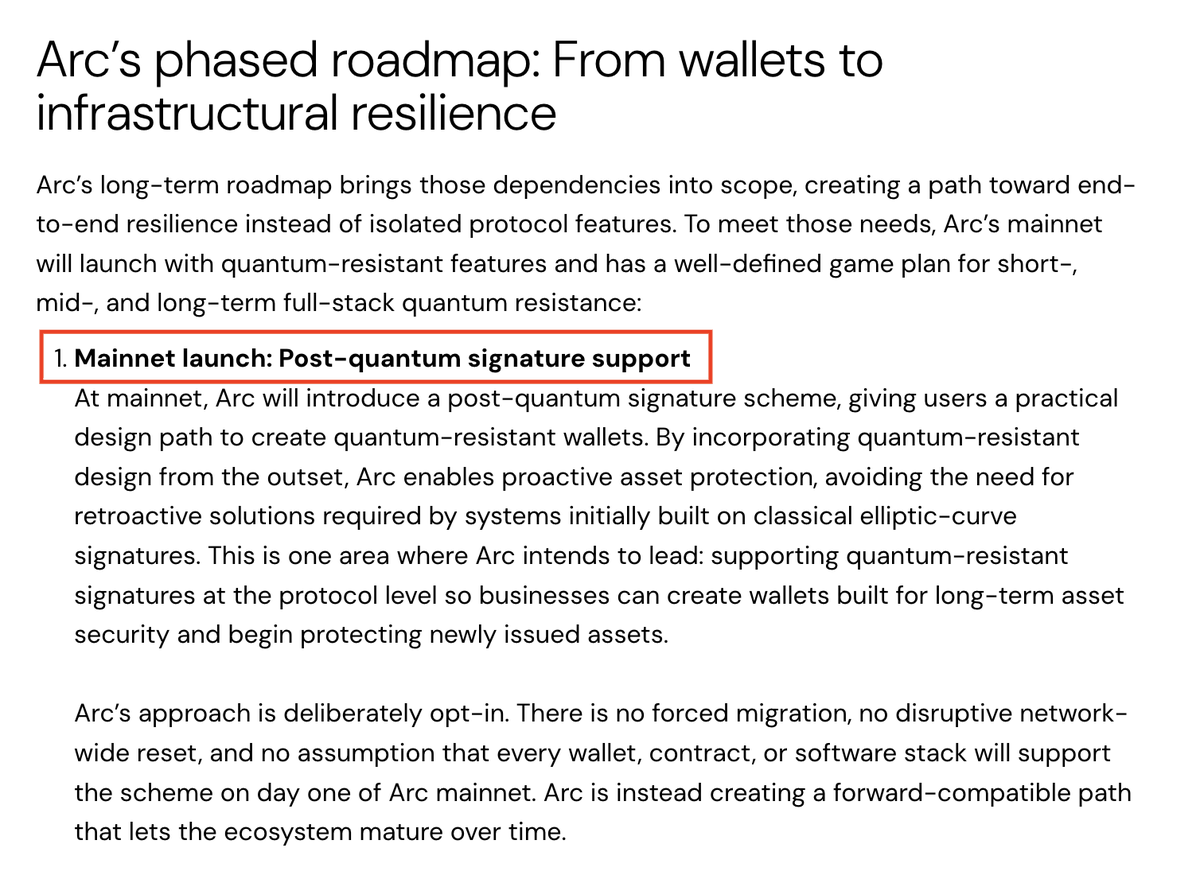
Circle announced the quantum-resistant roadmap for its L1 blockchain Arc, adopting a phased approach to full-stack quantum resistance across wallets, private state, validators, and infrastructure. The mainnet will introduce post-quantum signatures with an opt-in model. Circle added that quantum computing could threaten public-key cryptography by 2030 or earlier and warned of “harvest now, decrypt later” risks.
Virtuals is excited to support the agent economy on Arc.
USDC settles 98.7% of all agent-to-agent payment volume today. @circle built @arc to be the settlement layer for that future: dollar-native gas, sub-second finality, nanopayments to six decimal places.
Virtuals is building the layer on top: the infrastructure for agents to discover, negotiate, escrow, and settle every deal on Arc.
Now live and available on Arc's testnet today.
The entire row is alllllll yours.
Welcome to United Relax Row, three adjacent United Economy seats with adjustable leg rests that can each be raised or lowered to create a cozy lie-flat space for stretching out...
You'll also get a mattress pad, blanket and two pillows. If you’re traveling with kids, a plushie too! United Relax Row will be available starting next year on more than 200 of our 787s and 777s, each with up to 12 of these brand-new rows.
https://t.co/bzHodhQ5Y8
Very cool research from @FourPillarsFP on Circle Nanopayments including how they reduce gas costs and work with our noncustodial Gateway wallets.
If you're working on agentic finance or nanopayments we'd love to have them on @arc !
How do Circle’s Nanopayments work?
@circle has unveiled a new feature called Nanopayments.
It allows transfers as small as $0.000001 while claiming zero gas fees. How is that possible?
The secret lies in batched settlement.
If every payment created its own onchain transaction, gas costs would quickly add up.
Instead, Nanopayments collects users’ offchain payment signatures through the Circle Gateway. The system calculates net balances and periodically settles accumulated payments in a single batch.
How Nanopayments Work
Here is a simplified look at the process:
1. Deposit: The buyer sends USDC from their wallet to the Circle Gateway Wallet. This is an onchain transaction and gas is paid only once at the initial deposit.
2. Request and negotiate: The buyer requests a paid resource from the seller. The seller can respond through the x402 protocol.
3. Sign authorization: The buyer signs an EIP-3009 message. This is an offchain signature that authorizes payment to the seller and requires no gas.
4. Settle and serve: Circle Gateway verifies the signature and checks the buyer’s balance. The corresponding amount is locked. The seller immediately delivers the paid resource to the buyer.
5. Batch settlement: The Gateway periodically aggregates pending offchain signatures, calculates net balances, and settles them onchain in a single transaction.
In other words, thousands of offchain payment transactions are consolidated into one onchain transaction. That is why the effective gas cost approaches zero.
Security Model
One point worth highlighting is that the offchain payment authorization process might appear custodial at first glance. However, Circle Gateway is designed to be non custodial.
Circle Gateway runs inside an AWS Nitro Enclave TEE. Within this environment, the system verifies EIP-3009 signatures, computes batch settlement results, and signs the final batch transactions. The TEE signing keys are securely protected using AWS KMS. Even Circle employees cannot access the enclave or the keys.
Thoughts
There have been many attempts to implement micropayments. Most approaches simply relied on sending transactions on networks with extremely low gas fees.
Nanopayments takes a different path. By aggregating offchain transactions and processing them in batches, it dramatically reduces gas costs. (For reference, the USDT chain @Stable has implemented a similar concept at the network level called the USDT Transfer Aggregator.)
This approach could become especially meaningful in the future. As the agentic economy evolves, AI agents may increasingly stream payments in real time. Nanopayments creates the infrastructure that makes that model viable.
I'm actually pretty open-minded about the anti-data-center populism.
From everything I've seen from people working on this, reducing industrial-scale hardware availability seems to be both the most practical, and most non-dystopian / non-invasive way to lengthen AGI timelines.
So if the movement that makes that happen starts out with anti-data-center populism, that seems fine?
Of course you have to do things other than going after data centers located in populated areas to really make a dent on AGI timelines (my intuition is that 10-100x compute reduction is feasible in a "static" model of the world, and 100-10000x if you compare to a counterfactual that includes future chip design progress; those numbers *would* make a dent), but there is a first step for everything.
Was truly a pleasure to work under Sterling and I’m forever grateful for him bringing me onto the @arc team.
He will be missed everyday at @circle but I can’t wait to see what he cooks up at @HyperliquidX . Incredible role for an incredible person.
Hyperliquid
Excited to finally announce that I’ve joined Hyperliquid Labs to help with BD and partnerships. My initial focus will be expanding builder code integrations by working with developers globally.
> Hyperliquid offers liquidity on par with or deeper th an CEXs that's available to any app via builder codes.
> Access crypto and tradfi perps via HIP-3.
> No partnership agreements.
> Fully customizable fee model.
When generational founders like @chameleon_jeff and @iliensinc ask you to come help them build something you drop everything and run towards it.
Hyperliquid
Super excited to work with the @hibachi_xyz team! Onchain FX is here and we are pumped to have new markets and DeFi-native FX primitives living on @arc
We are at the biggest disconnect I’ve ever seen in crypto between current market sentiment / short termism and how serious the current opportunity is. Everyone is coming onchain and I’ve never been more excited to be in this industry. We will look back and laugh at this moment.