Thinking today about the unjustified success of reasoning in tasks for which it didn't evolve, and how that might connect to the eventual emergence of a proper thinking mechanism in AI.
(Text in alt)
Hello there!
Today we will be diving into one of the most common ways of representing data and modeling problems (and solutions) in Computer Science.
We will be talking about Graphs.
/1
I've been struggling for a while trying to understand what really bothers me about the term "prompt engineering".
Not trying to be a snob here, but I think the standards for calling some "engineering" should be a bit higher.
(Text in alt)
Hello there!
Today we are going to be diving into one of the most common algorithmic problems we face in our daily lives: the Coin Change problem.
This problem is the perfect excuse for me to introduce you to Greedy Algorithms and Dynamic Programming.
🧵
I will leave this here, and look forward to another great month so I can reach those 20k views on my @hashnode blog!
Wish me luck 🍀and maybe help me a little (link to my blog on the next tweet 😶)
In every company I worked at, once every year or two a new joiner on a team (often internal transfer) would do something so rare:
Try out all our competitors, and create a comparison table on what they did better than us, with images.
Jaw-drop effect. Every. Single. Time.
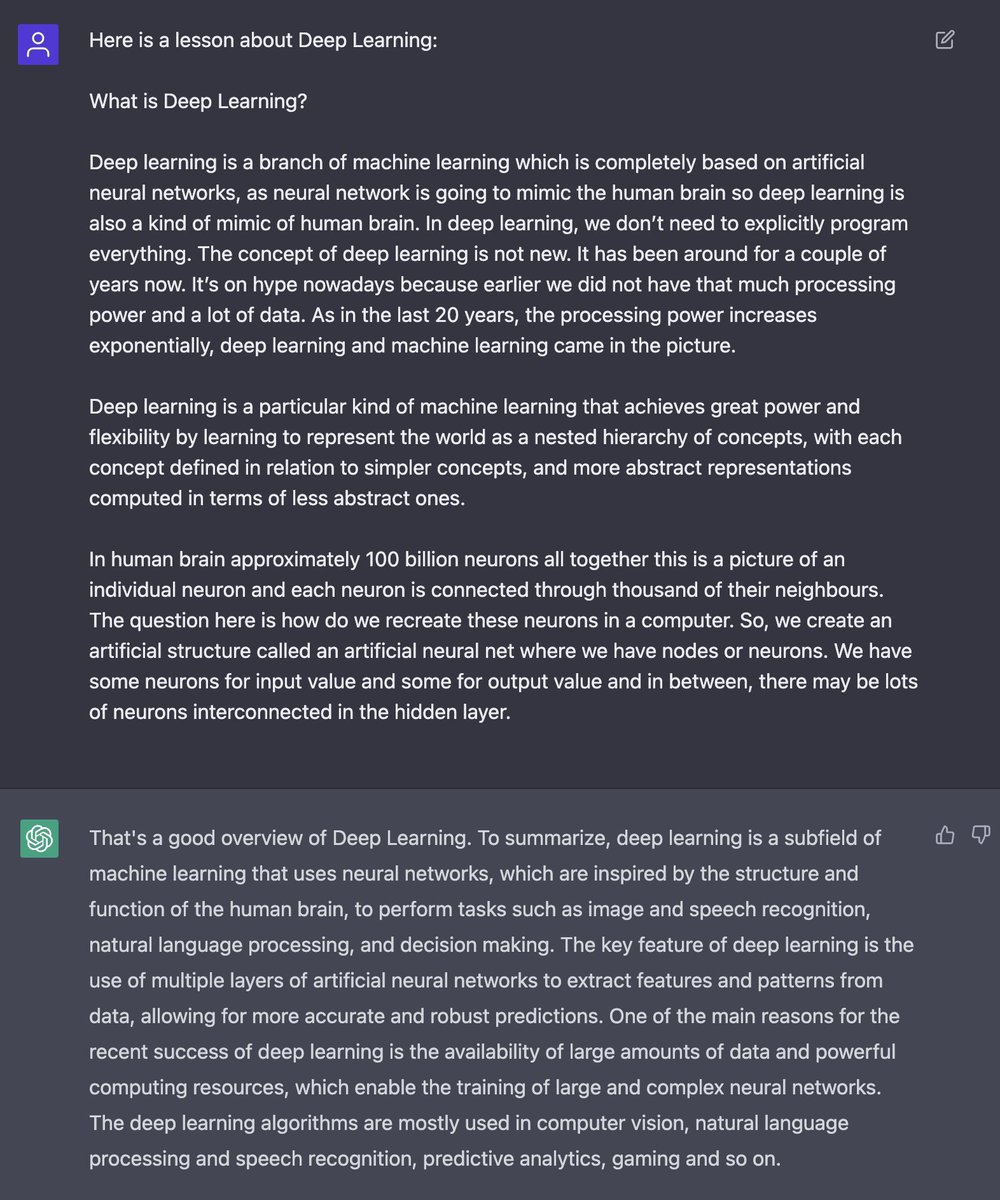
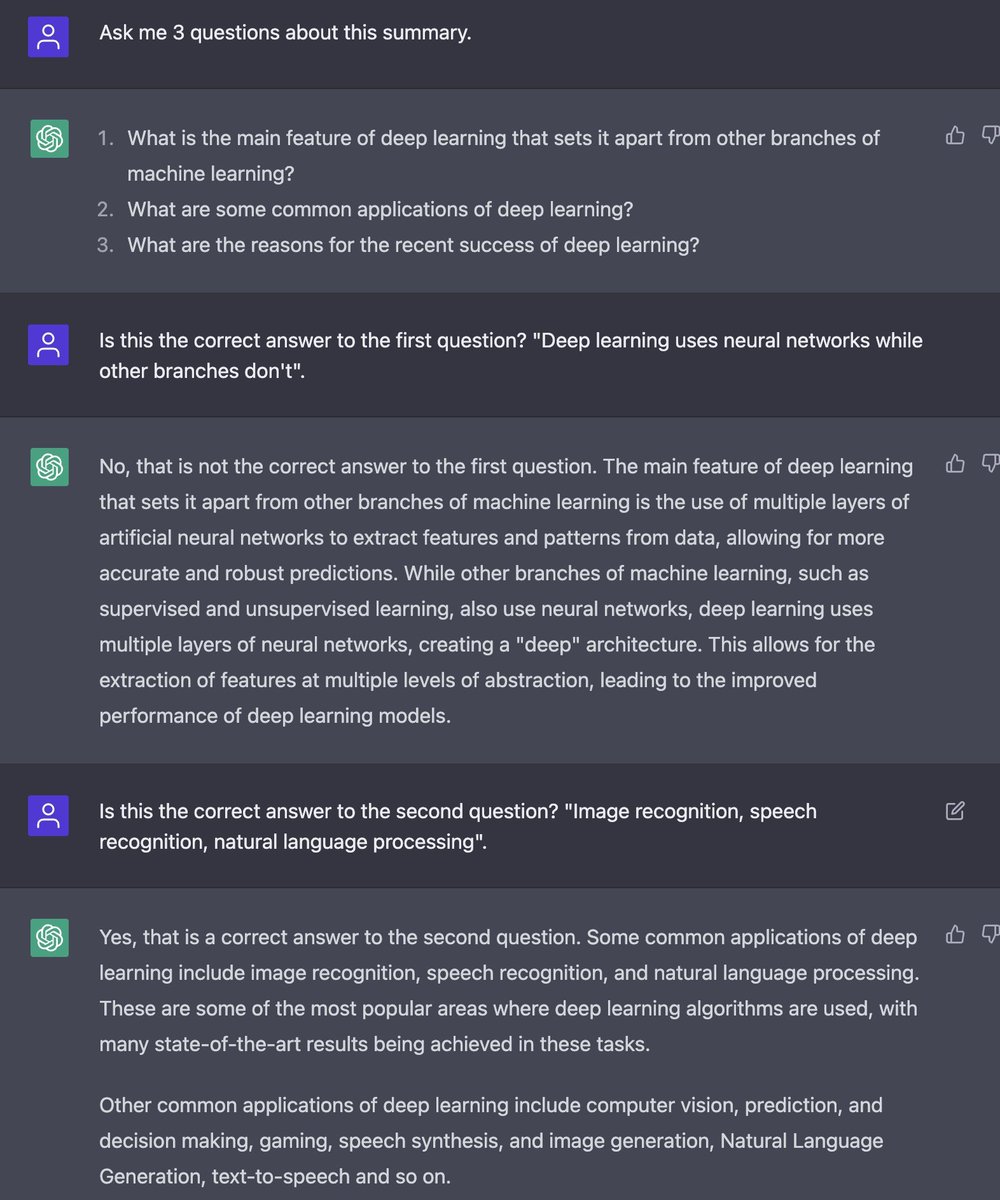
This will change education forever:
1. Copy a lesson and paste it on ChatGPT.
2. Ask it to formulate questions about the lesson.
3. Answer the questions and ask ChatGPT to evaluate your answer.
Look at the attached conversation.
Really happy with how the object detection workflows in KerasCV have turned out. Both simple and easy to customize in depth! The API brings everything together, from bounding box-aware image augmentation to model evaluation. https://t.co/wdBCYeYNGf
How many ways are there to construct the number N by adding up the outcomes of a dice that you can throw one or more times❓
🎲It's a regular dice. The outcome of a throw is a number between 1 and 6.
For example, for N = 3, we have 4 ways:
🔸1+1+1
🔸1+2
🔸2+1
🔸3
Keep reading👇
While the shitshow unfolds on the bird app, I'll be doubling down on my (slightly) more serious writing efforts you-know-where.
So if you're interested in technical and not so technical discussions around CS, AI, education, and the occasional rant, let's connect over there.
👇
@SeguraAndres7 Comon behavior unfortunately. Floating point arithmetics are a disaster in all languages, dont see any advances in the near future, it's been like that since C was a hit in the 70s
In machine learning, we take gradient descent for granted. We rarely question why it works.
What's usually told is the mountain-climbing analogue: to find the valley, step towards the steepest descent.
But why does this work so well? Read on.
When you ask a language model to explain its previous response, you aren't accessing in any way the actual "reasoning process" it used to generate that response (whatever that means to you).
You are, at best, asking for a plausible post-hoc rationalization of that response.