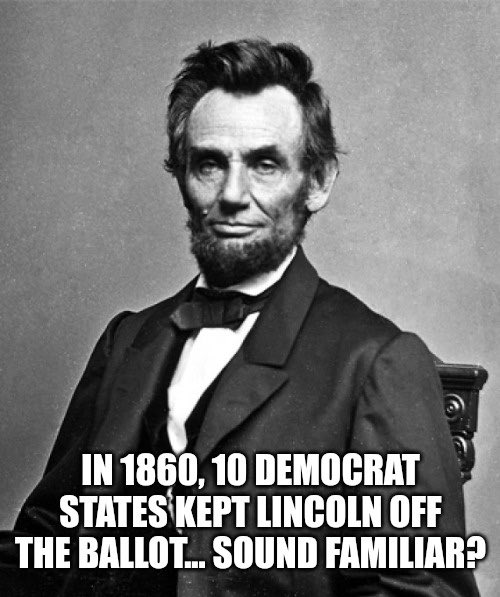
@alx “There were no ballots distributed for Lincoln in ten of the Southern states: Alabama, Arkansas, Florida, Georgia, Louisiana, Mississippi, North Carolina, South Carolina, Tennessee, and Texas.”
ТОП-10 стран, где обсуждают смерть Пригожина
Вчерашний информационный бум резко переклю��ил внимание с международной повестки на внутреннюю. Решил посмотреть, каким странам больше всего интересно то, что происходит в России.
На первом скриншоте топ-5 стран по запросу «Евгений Пригожин».
На втором скриншоте топ-5 стран по запросу «Prigozhin».
#Россия
#Африка
Dubravskiy Consulting conducted a sociological research (polls) among the Russian population and found out whom the people of Russia would like to see as the President of the United States from the current candidates for the post.
Answer options include: Trump, Haley, Ramaswamy, Pence, Williamson, Biden, Kennedy Jr., DeSantis.
Brief conclusions:
— Donald Trump is most attracted to Russians (more than a quarter of answers, 27%);
— In second place is Robert Kennedy Jr. (11.3%);
— Incumbent President Joseph Biden attracts only 2%;
— DeSantis Approval Rate is 1%;
— In total, candidates from the Republican Party attract 29.2% of respondents, from the Democratic - 14.0%;
—Trump is significantly more likely to attract men, respondents under 45 years old and people with a family income of 90 thousand rubles. per month or more;
— Kennedy Jr. is more popular among respondents aged 45 and older;
— The approval rate of other candidates is below 1%.
#USA #Elections2024 #Trump2024 #Trump #BidenHarris2024 #Biden #DeSantis2024 #Desantis #Ramaswamy #Pence
https://t.co/YI9p1D7wuo
In 2016, the Green Party played an outsized role in tipping the election to Donald Trump.
Now, with Cornel West as their likely nominee, they could easily do it again.
Risky business,
Как прошёл референдум в Узбекистане?
Представляем новый доклад Дубравский Консалтинг о прошедшем 30 апреля референдуме в Узбекистане.
В этот раз мы сосредоточились на юридической и политтехнологической составляющих. В первой части подробно разобрали принятые поправки и процесс голосования. Во второй части в ходе полевого исследования проанализировали весь спектр применённых политических технологий.
Кампания состояла из двух треков — информационного и агитационного. К части инструментов мы подготовили собственные рекомендации.
Внутри доклада много иллюстраций и фотографий.
Доклад доступен по ссылке — https://t.co/EYJfmt5KGj
#Узбекистан
Недавно леворадикальные активисты попыталась «обнулить устаревшее законодательно», используя для этого проект новой Конституции.
Как чилийцы смогли дать отпор коммунистам и что их ждёт дальше — читайте во мнении Павла Дубравского.
https://t.co/vUsFsAAneG
This text is inspired by an NLR article by Camila Vergara (https://t.co/O5WkFdqv9j) in which she discusses, why Chile voted against the most progressive constitution in the world. I will roughly present Vergara’s main arguments to continue her analysis and make a humble attempt to enrich public analysis not only from a political philosophy point of view but also from the purely practical viewpoints of political technologies and public campaigns, areas in which I specialize. I hope that my experience and this public analysis will help reform advocates around the world achieve their goals and avoid potential mistakes. My analysis may seem cynical or even rude—if so, I apologize—but this view will encourage you to look at the causes of defeat from a different angle.
You may have a question: why read a Russian resident’s opinion about the situation in Chile? There are two key reasons. First, in my profession, I study elections and election campaigns around the world, though I focus on the USA and Latin America. Second, in 2020, held a constitutional referendum through which our president pushed to change the constitution to allow himself the opportunity to remain in power for several more terms. During this campaign, the Liberal Democratic opposition was divided on how to conduct campaigning and talk to voters. Lacking a unified strategy, the opposition failed to form a ready-made political proposal because it was not unified, instead splitting into two groups—one that boycotted the referendum just not coming on poll stations and one that actively opposed it with asking voters to vote against new constitution.
The results of both Chile's and Russia's recent constitutional referendums both included the opinion that the problem lay not in the political proposal of the democratic public to voters but in the strength of political opponents. Though this is the case in Russia, where all election commissions, legislation, and political processes are subordinated to the state, there was competition among ideas in Chile. Though Russia’s political opposition criticized the agitation methods of pro-government forces, these forces gained popularity and continued using such methods.
I am by no means equating the referendum in Chile, which has working democratic institutions, with that in Russia, where these institutions do not work. However, as I noted similarities in the discourse of the democratic forces of both campaigns, I followed Chile’s referendum especially closely.
I am very sympathetic to the 2022 draft of the Chilean constitution, although I find it highly ideologized and very difficult to implement. In some areas, such as gender equality, protection of indigenous peoples, and preservation of the environment, it is groundbreaking. I would very much like voters to take the right lessons from this campaign and to respond positively to such projects. However, I have noticed another side of such projects. Because useful and socially significant initiatives are often broken down by and not realized because of electoral and technological naivete, such projects are rarely implemented.
Let me remind you that Chile’s draft constitution was rejected by 62%, an absolute majority of the population. Vergara identifies two reasons for this result: the right-wing disinformation campaign across traditional and social media and the exclusion of the popular sectors from the constituent process. Both factors contributed, but I believe that neither is the primary reason for the progressive project’s defeat.
Let’s examine why this project failed and how a successful campaign might be built. In her analysis, Vergara correctly emphasizes the differences between 2020 and 2022 voters. It is also true that under an unpopular administration, voting against any administration-backed project can be perceived as a public vote of no confidence or an opportunity to vent discontent. For example, many Trump votes in 2016 were more against Hillary Clinton than for Trump.
The core of Vergara’s article is devoted to analyzing the right-wing information campaign, which intimidated Chileans and played on their fears. While this is a perfectly proper direction for analysis, it reveals a completely different side of the question. Let’s imagine that in an election, your political opponents are playing on fears that you will come to power (political repressions, radical political and economic reforms, changing the comfort way of life). What might such fears and prejudices be based on? A lack of information and your weak information campaign will lead voters to afraid of changes in political system. While you can justly blame your opponents for exploiting human emotion, you should also consider your own mistakes to determine why people voted against you so easily.
It was not the distribution of fake constitutions that caused the Chilean draft constitution to be defeated (by the way, it remains unclear whether such distributions were recorded and if so, what complaints they prompted), nor was it the huge sums spent on the campaign against it. It was the weak information campaign by supporters of the new constitution. In short, Chileans were given a large amount of confusing information that they had to study and vote on within a short time.
It is worth noting that the new constitution not only radically revised some rights of citizens but also rebuilt the state system, as global changes always scare people. For it to pass, voters had to not only read this long draft in a short time but also support all its proposals. Given that few read the draft constitution, the knowledge of the average Chilean voter was built on social network discussions and campaign messages from both sides. It is not appropriate to treat voters as interested experts who can independently absorb and judge complex issues. Voters must be persuaded and agitated. And that’s exactly where “apruebo” (campaign for accepting the new draft of constitution) lost the campaign for the constitution.
The main success of the right-wing forces was concentrated criticism of the entire draft constitution. For voters who did not study it, it looked intimidating, as it changed the state structure and did not explain how it would solve socioeconomic problems. The reasons for its defeat are much simpler than the right’s active disinformation campaign. Such campaigns are part of every election, so it is strange to focus on this as the cause of the defeat. The Chilean left, by the way, took the defeat worthily, demonstrating that changes are important for reasons beyond their own political ambitions. As in any election, however, an offer was made to voters—in this case, to solve the current socioeconomic problems through a new constitution. Yet voters didn’t see this, instead seeing an attempt to create a utopia developed in complete isolation from other political forces. That`s why they voted against this draft.
The content of the draft’s new basic law illustrates how it was developed—in the Constitutional Assembly’s isolation from the expert community and other political forces. Therefore, even in regions suffering environmental problems or poor access to drinking water—both of which the new constitution promised to solve—most residents voted against it. Voters were told about quotas, Pinochet`s bad ideas, and indigenous peoples but nothing about their future or how the new constitution would solve their problems, though it initially aimed to solve them. Instead of point solutions, the Assembly developed an idealistic left-wing project that could not be properly “sold” to voters.
Significant mistakes were also made in implementing political technologies and public campaigns. The right wingers focused on one approach—criticizing the project—which allowed them to concentrate their message and simplify their political proposal. This idea can be briefly expressed as “just come and vote against.” The left’s message was more diverse, but judging by the numerous propaganda videos I watched, it focused on topics such as the rights of indigenous peoples, ecology, and water deprivation. Compared to the right’s message, it was varied and complex. It was enough for opponents of the new project to focus their active campaign on criticizing the project and its proposed radical changes to the country, such as its restructuring of the parliament.
It is impossible to sell a document of several hundred pages to a voter. I am sure that not all Chileans have read the current constitution. The campaign for the new constitution was to be based on the principle of point solutions. These constitute either one or two issues for the adoption of a draft with three to five questions on whole chapters that are easy to orally explain to any voter within 30 seconds. The campaign must offer a universally persuasive “pitch” that indicates to diverse groups of voters why it is important to vote for a new draft. Accordingly, blocks should be divided into categories such as sex equality, ecology, water deprivation, and the right to housing. For such a project, it is worth including only those issues that relate to the 2019 protests. If these are adopted, further steps toward systemic changes in state structure can be planned.
Most importantly, I would not hire consultants from just one political view on a such project. General ideological beliefs are good, but they can prevent one from looking at the situation in a detached, professional way.
Whatever the causes of the proposed constitution's defeat, Chile has now chosen a path for its second attempt at developing new constitution. I sincerely hope that this wonderful nation will resolve the contradictions that exist in its society and rid itself of the problems that plague it.
#chile #rechazo #apruebo #plebiscito #referendum
@lawralta Сравнивать медийные охваты политиков, заявивших о выдвижении на пост президента — не рано, а самое время. Только так и можно оценить, насколько вообще они интересны.
Многие сравнивают запуск кампании Десантиса и Байдена, критикуя первого за технические проблемы во время выдвижения своей кандидатуры.
Проблема в том, что большинство забудет неудачный стрим, а вот 500к зрителей единовременно это отличный показатель + тотальное обсуждение во всех СМИ. Для сравнения, спустя месяц после выдвижения Байдена, его видео-анонс посмотрело около 480к людей. То есть Десантис как минимум интересен в моменте.
Другой важный показатель — охватность. За месяц с момента выдвижения Байдена, его твитт посмотрело около 40 млн человек, Десантиса — 24 млн.
В Конгрессе начались слушания по Твиттеру. Экс-руководители признали бан темы ноутбука сына Байдена, признали ошибку. Вмешательство ФБР отрицают, как и правительства. Слушания шли 6 часов, впереди ещё больше интересного.
Параллельное выступление Трампа с обращением Конгрессу показывает, что он создаёт альтернативное политическое предложение. В том числе, сугубо идеологическое, вне классических институтов. Трамп повторяет классическую популистскую модель поведения, только радикальнее, чем в 2016.
По выступлению Байдена в Конгрессе. Он задал повестку будущей кампании 2024: снижение джанк налогов, повышение корпоративных налогов, право на аборт, защита транс-персон, бан автоматических винтовок. Любой кандидат кроме Трамп будет второй скрипкой по этим темам.