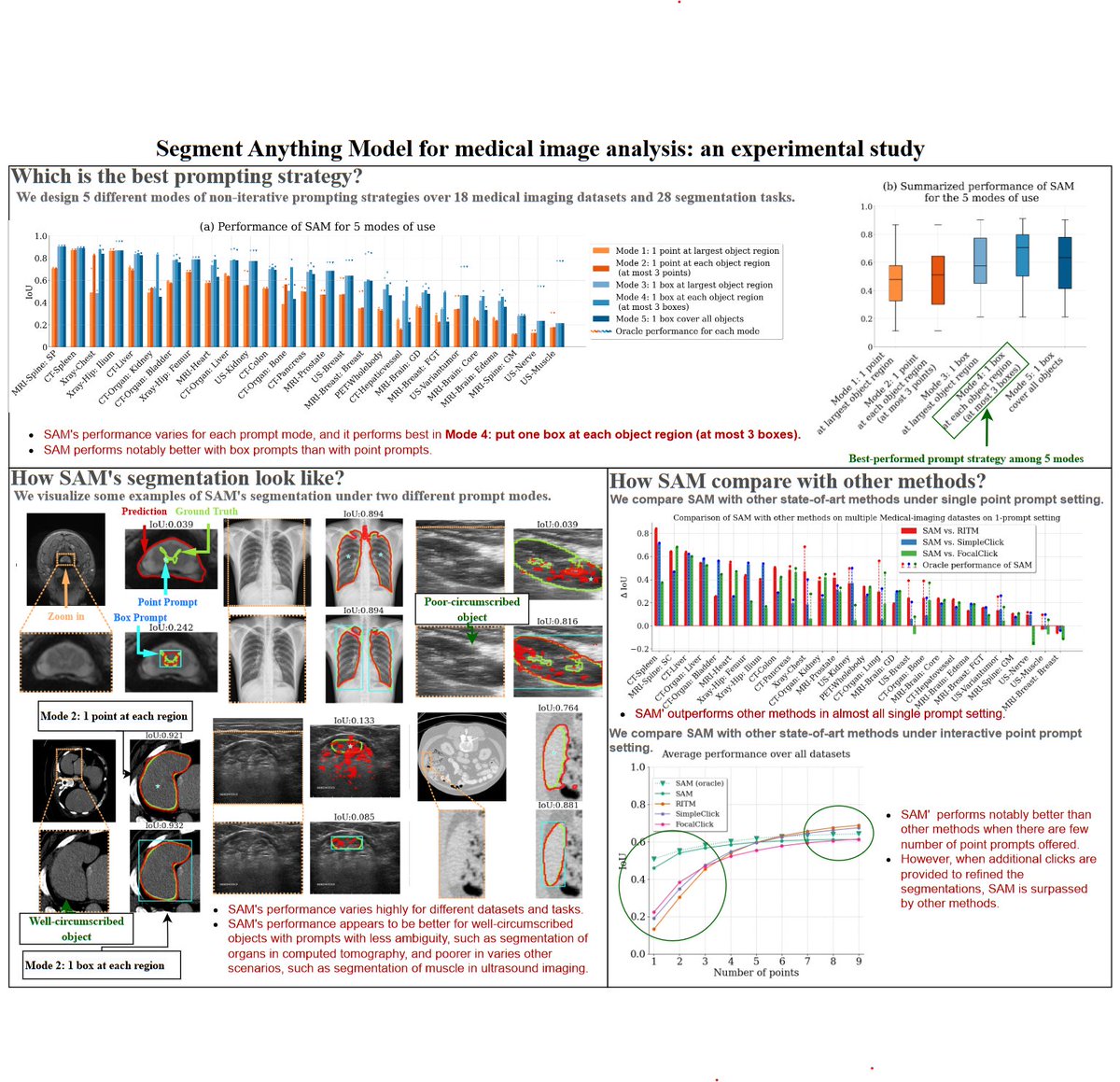
Does Segment Anything Model work for medical images?
Following our initial analysis a few weeks ago, we conducted thorough experiments on 19 datasets.
The paper is here: https://t.co/pKd0sQI4be
Here is what we learned. 🧵1/9
Does Segment Anything Model (SAM) really work on medical images?
We tested it on 11 datasets and wrote a paper:
https://t.co/cYaNOSSpRY
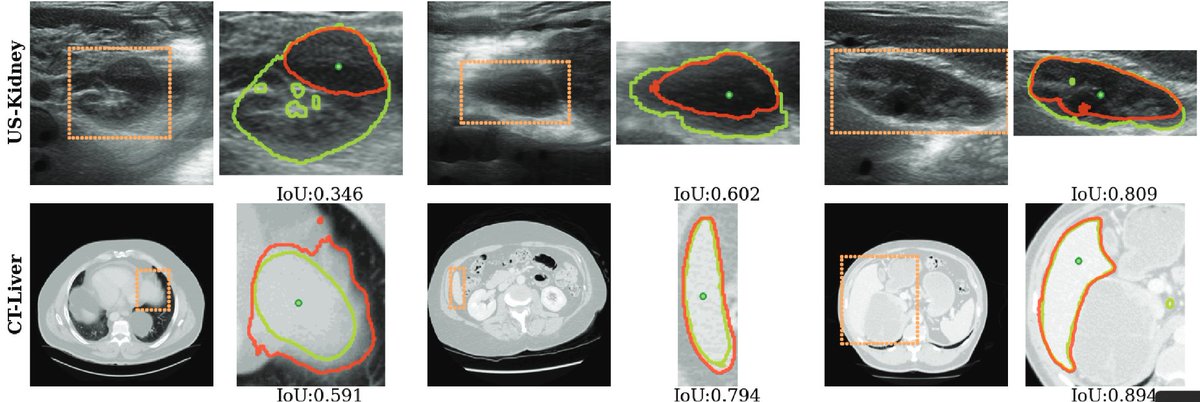
In brief: Performance varies widely across different datasets from impressive (given zero-shot setup) to poor.
Details follow. 🧵1/14.
Exciting news! The results of the DBTex Digital Breast Tomosynthesis Lesion Detection Challenge, led by @duke_spark's @nick_konz and @MazurowskiPhD, have just been published in @JAMANetworkOpen! They present new algorithms, a benchmark, and a dataset.
https://t.co/2z4O6JCqkm
When tested, the automatically extracted labels from the developed rule-based algorithm were 91% to 99% accurate as compared to manual validation set. (4/6)
All of the model’s weights, code, and hyperparameters are publicly available here. More details and implications can be found in the attached paper.
https://t.co/UZUzSoXl3u
https://t.co/SXk5RCKgwD (5/6)
The weakly supervised model learned to extract volume level labels through automated rules from radiology text reports to reduce the need for human annotation efforts. (3/6)
This paper by @duke_dair's @MazurowskiPhD and colleagues combats this issue by utilizing automatically extracted labels from radiology text reports for multi-disease classifiers for body CT scans. (2/6)
AI algorithms developed for disease classification typically target one disease and organ, limiting its clinical potential. A major challenge for developing multi-disease detection/classification models comes from a shortage of annotated data. (1/6)
This paper by @duke_dair's @MazurowskiPhD and colleagues @budamat@ebadawy_ explores whether deep learning can use MRI images to predict lower-grade glioma (LLG) genomic subtypes. (1/7)