@jhnwr I've tried poetry and it wasn't great experience. My current toolset, which so far worked for the last few months, is pyenv to manage different python versions and venvs, and pip-tools to compile dependencies defined in pyproject to requirements file which I install with pip.
ml-stat-util: Statistical functions based on bootstrapping for computing confidence intervals and p-values comparing machine learning models and human readers
Lang: Jupyter Notebook
⭐️ 42
Author: @budamat#MachineLearning
https://t.co/37KxMcKXOq
new blog post: all about transformers! covering the intuition behind an "attention only" network, building up an understanding of scaled dot product attention, and detailing the original transform architecture. let me know what you think! 🙏 https://t.co/Lj9HnarUw4
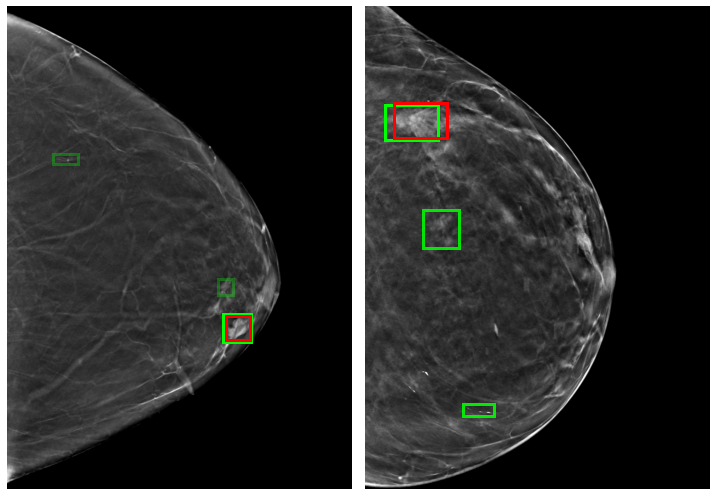
I'm excited to share that the results of the Digital Breast Tomosynthesis Tumor Detection Challenge (DBTex) have officially been published in our @JAMANetworkOpen paper, with our public benchmark, dataset, and detection algorithms' code (links 👇)! https://t.co/9g3sYaIHDi (1/n)
8 teams in the international DBTex competition produced #AI algorithms with high sensitivity to detect lesions on digital breast tomosynthesis (#DBT) images, including model code, datasets, and benchmarks for future researchers. https://t.co/AN3FXdE4hL
ml-stat-util: Statistical functions based on bootstrapping for computing confidence intervals and p-values comparing machine learning models and human readers
Lang: Jupyter Notebook
⭐️ 39
Author: @budamat#MachineLearning
https://t.co/37KxMcKXOq
@JordBHansen@ScrapingF Thanks for letting us know @JordBHansen. We do work with Amazon. 100% success rate and 3.37 seconds average processing time according to our benchmark: https://t.co/rM9ppM7CXE
Class imbalance, or having significantly higher number of examples in a training set than other classes, can have adverse effects on training deep learning models in achieving optimal classification performance. There are several methods to manage class imbalance.. #AI
Class imbalance, or having significantly higher number of examples in a training set than other classes, can have adverse effects on training deep learning models in achieving optimal classification performance. There are several methods to manage class imbalance.. #AI
Development and evaluation of deep learning algorithms for breast cancer screening has been limited by a lack of well-annotated, large-scale publicly available data sets. This paper by #DAIR’s Dr. Maciej Mazurowski @Maciej and colleagues @budamat @nianyili @JosephLo16 provide...
We’re in the midst of a broad movement toward data sharing and advanced data analytics in medical research. @writemed reports on a great example in breast cancer screening. #DataSharing@budamat@MazurowskiPhD https://t.co/A5oFS3QNbY
A curated dataset of over 22K digital breast tomosynthesis images should help advance the AI algorithms used for breast cancer imaging. https://t.co/Zqg49tzyEK
In this study, the publicly available data set, alongside the deep learning model, could significantly advance the research on machine learning tools in breast cancer screening and medical imaging in general. @budamat@MazurowskiPhD@DukeRadiology https://t.co/QjPHzlpbbe
NEW PUBLIC DATASET ALERT! We made a new dataset of medical images available for machine learning including 5,610 digital breast tomosynthesis studies for 5,060 patients. This translates into 22,032 reconstructed volumes. Annotations are included.
https://t.co/ShAcChnfnP
1/8
🚨New Paper Alert🚨
The top 3 teams of the first DBTex challenge (@NYUImaging, @IBMResearch, @ViCOROB) share the lessons we learned on a short paper in @NatMachIntell!
We discuss how we trained AI models on 3D mammograms and room for improvement.
https://t.co/1WZOhBPDap
1/n
Short paper in Nature Machine Intelligence @NatMachIntell on our participation in the 1st DBT lesion detection challenge, joint collaboration with the winners of the challenge @nyuimaging and @IBMResearch, @kjgeras@ViCOROB@UdGRecerca https://t.co/sjen3ZYfGX
NEW MACHINE LEARNING CHALLENGE! We just launched DBTex2 challenge to develop machine learning algorithms that detect abnormalities in digital breast tomosynthesis images. The challenge comes with a publicly available dataset for more than 5000 patients.
https://t.co/dCQfVNPPH6