Was fun talking with @alexklein0x about many things, but in particular loved being able to spotlight how Coatue Growth operates as one team: Thomas, @spencermpeter , @jadelai__ , @1daveschneider , @carynm650 , @DanRose999 , @BenSchwerin , Colin, Abhi, and now @hanseulnam , Philena, and Pranav who recently joined us.
The one constant at @coatuemgmt is that we're always adapting and only as good as our next investment. Privileged to build with this team
listen here
https://t.co/1qWjkIlLTQ
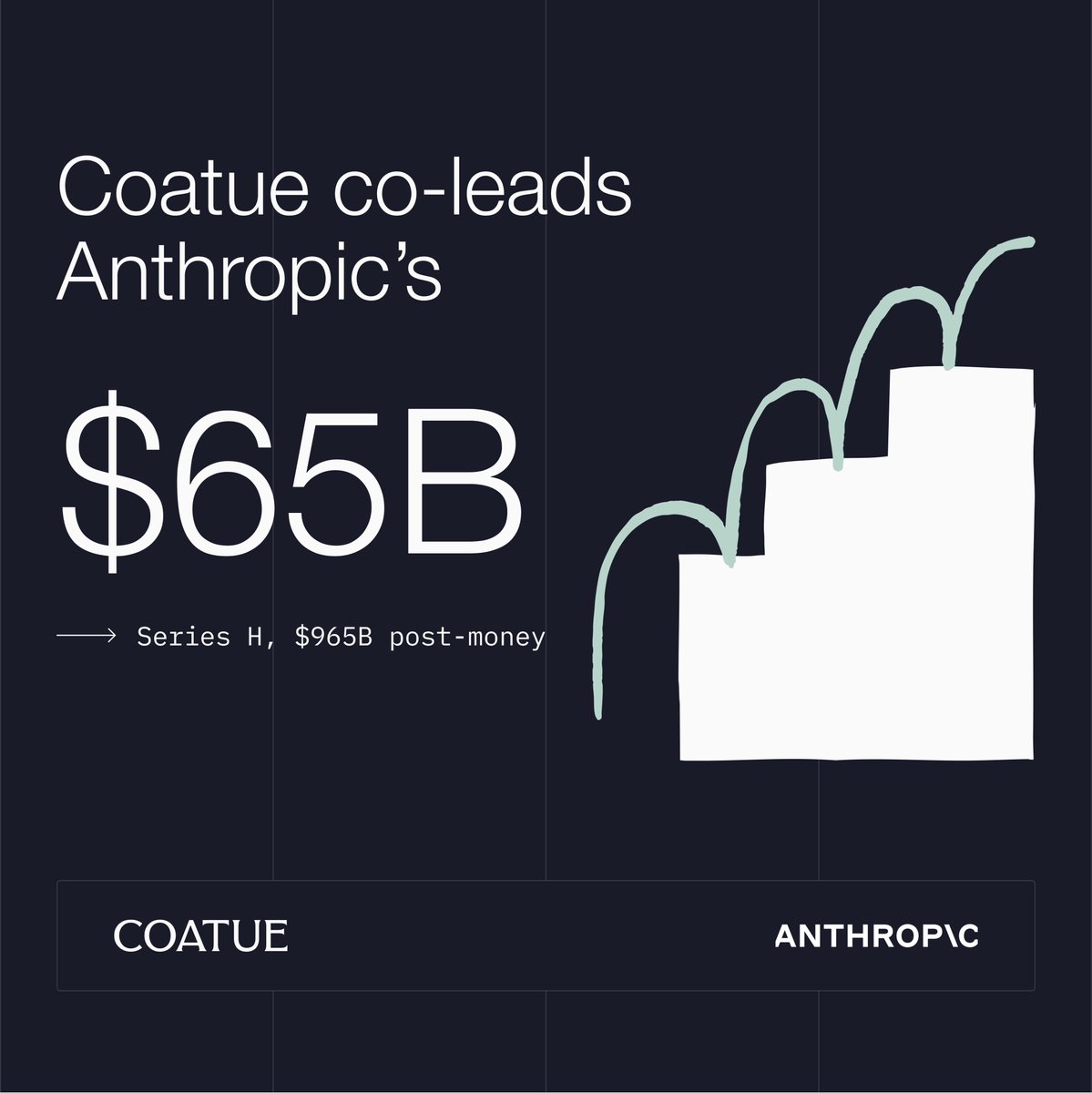
In February we co-led @AnthropicAI's Series G. Today, we're co-leading their Series H.
In the months between, organizations across industries have built Claude into their core operations, with adoption continuing to expand across enterprise customers and internationally. Run-rate revenue crossed $47 billion earlier this month.
Why we are tripling down ⬇️
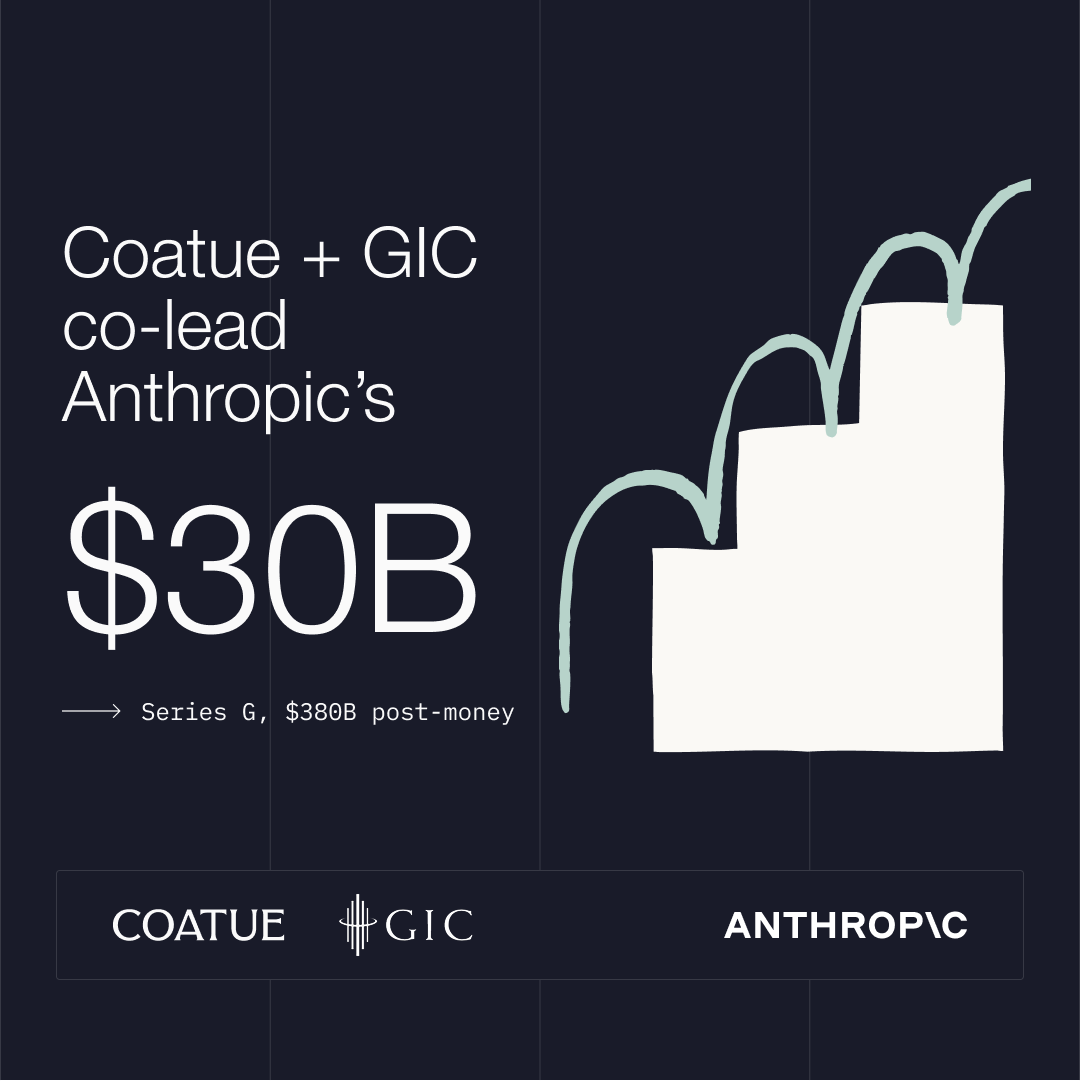
We’ve raised $30B in funding at a $380B post-money valuation.
This investment will help us deepen our research, continue to innovate in products, and ensure we have the resources to power our infrastructure expansion as we make Claude available everywhere our customers are.
Today, @rhythmrg, @lindensli and I are introducing @appliedcompute. We’re building Specific Intelligence for the enterprise.
Achieving SOTA today means specialization in both human and machine talent. We’ve spent the last six months working with companies like @cognition, @DoorDash, and @mercor_ai, unlocking their company knowledge to build custom agent workforces that outperform frontier models at specific tasks.
My cofounders and I all worked on different parts of this problem while at OpenAI, from Codex to o1 to the ML systems and infrastructure for RL training. Two-thirds of our team (see below!) are former founders, and everyone brings a deep technical background, from top AI researchers to Math Olympiad winners.
We’ve raised $80M from @benchmark, @sequoia, @Lux_Capital, @eladgil, @victoralazarte, and @Casspi18, and we’re hiring across engineering and research.
AI has changed software engineering more in the last 3 years than it has changed in the previous 30.
What’s needed is not a debate about whether it’s going away—instead it’s a serious discussion about its future: What are the new primitives, techniques, and best practices for software engineering in the age of AI.
That’s why I brought Scott Wu (@ScottWu46) on AI & I.
He’s the founder of @cognition, the company behind the world’s first autonomous AI coding agent, Devin. Cognition got to $73M ARR in less than 2 years—and they just acquired Windsurf to accelerate their growth.
I had Scott on the show to talk about where the programming goes from here. We get into:
- What the new tools and workflows are for AI engineers. In the near term, Scott sees software engineering defined by a spectrum of tools. At one end are AI features that speed up coding, like tab complete; at the other are agentic systems, like Devin, that can take on tasks independently. Until engineers can operate entirely at the higher layer of abstraction, he argues, both are essential.
- Why Scott thinks AGI is already here. By the benchmarks of a decade ago—passing the Turing test, solving hard math problems, and operating agentically—AGI is already here. The line keeps moving, he argues, because humans constantly redefine work around what machines can’t yet do.
- Why developers will turn into product architects. Scott sees the long-term future of software engineering as a steady climb up the ladder of abstraction. Just as programming went from assembly to languages like Python and JavaScript, he thinks the future is humans focusing on the product, while AI agents execute.
- How Devin stacks up against @AnthropicAI’s Claude Code. Scott credits Claude Code’s success to great product design and the models becoming capable enough to support autonomous workflows. But according to him, the CLI itself isn’t the breakthrough, it’s how a tool fits into a developer’s workflow. Claude Code’s paradigm is that the AI is you, taking the wheel of your computer, he says, while Devin is like the engineer sitting beside you: it runs in its own cloud environment, manages the repo, and improves over time at testing and refining code.
This episode of @every’s AI & I is a must-watch for anyone interested in the brass tacks of how AI changes the future of programming.
Watch below!
Timestamps:
Introduction: 00:02:02
Why Scott thinks AGI is here: 00:02:32
Scott’s personal journey as a founder: 00:09:27
Why the fundamentals of computer science still matter: 00:16:55
How the future of programming will evolve: 00:22:30
A new workflow for the AI-first software engineer: 00:26:50
How Devin stacks up against Claude Code: 00:29:33
Reinforcement learning to build better coding agents: 00:40:05
What excites Scott about AI beyond Cognition: 00:50:05
Big milestone from the @skypilot_org team & community. 1M+ users have downloaded SkyPilot to experience the "sky" — their (single or multi) cloud infra is more unified, and their AI team runs more jobs faster.
Your AI infra will probably get a refresh too; try it out:
Today we are thrilled to share that we’ve raised $106M in a new round led by @SalesforceVC with participation from @coatuemgmt and our existing investors.
Our vision is to rapidly bring innovations from research to production and to ultimately build the best platform we can for developers, startups, and enterprises to run generative AI applications built on open-source models at production scale.
https://t.co/P7ZYyimBry
State of code today has been centered around copilot - search, chat, code complete. This is one of the few products I’ve seen that’s actually taking on full tasks as an L1 SWE on autopilot. Clever way to capture the logic and reasoning capabilities of a developer. Congrats @cognition_labs@ScottWu46 & team!!
Today we're excited to introduce Devin, the first AI software engineer.
Devin is the new state-of-the-art on the SWE-Bench coding benchmark, has successfully passed practical engineering interviews from leading AI companies, and has even completed real jobs on Upwork.
Devin is an autonomous agent that solves engineering tasks through the use of its own shell, code editor, and web browser.
When evaluated on the SWE-Bench benchmark, which asks an AI to resolve GitHub issues found in real-world open-source projects, Devin correctly resolves 13.86% of the issues unassisted, far exceeding the previous state-of-the-art model performance of 1.96% unassisted and 4.80% assisted.
Check out what Devin can do in the thread below.
Excited to share that I'm joining Coatue as a Partner to focus on early stage investment efforts in enterprise software, AI/ML, open source and data infrastructure, developer tooling, security, etc. Please reach out if you're building in these spaces.