🚨New Paper Alert🚨
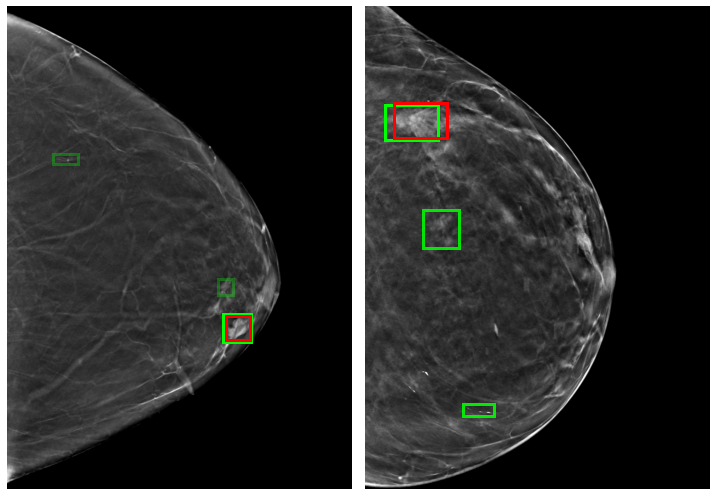
The top 3 teams of the first DBTex challenge (@NYUImaging, @IBMResearch, @ViCOROB) share the lessons we learned on a short paper in @NatMachIntell!
We discuss how we trained AI models on 3D mammograms and room for improvement.
https://t.co/1WZOhBPDap
1/n
We are looking for exceptional candidates for technical roles at @Ataraxis_AI:
* Research Engineer (Optimization/Systems): https://t.co/OXkC1cu2zs
* Research Engineer (Data Science): https://t.co/S73fzW66eQ
* Research Scientist (Causality): https://t.co/fqDEcx86em
Join us!
Today, we announce a strategic research collaboration between Ataraxis AI and MEDSIR (@wearemedsir), a global leader in oncology research.
The partnership will evaluate the Ataraxis Breast platform in several international randomized controlled trials. Together, we aim to generate robust clinical evidence on the role of artificial intelligence in predicting outcomes and treatment effects in early-stage and metastatic breast cancer. The analyses will especially focus on novel therapies investigated in MEDSIR's groundbreaking trials, including CDK4/6 inhibitors and antibody-drug conjugates (ADCs).
This is one of many ongoing partnerships at Ataraxis working on developing a robust evidence base supporting the accuracy and utility of Ataraxis AI-native tools, and moving AI precision oncology closer to becoming the standard of care.
Read the full announcement here: https://t.co/vFAG0BYhrn
I'm thrilled to share that I've successfully defended my PhD thesis in Biomedical Imaging and Technology at @nyugrossman!
Many thanks to my advisors, committee members, and colleagues for their support.
#PhDone#PhD#AcademicTwitter
Got experience in #biostatistics & interest in working w/ an interdisciplinary team on leading-edge medical imaging science?
We'd like to hear from you.
#job: https://t.co/I3lgOVe0gC
Know someone qualified who may be interested? RT!
#hiring#stats#research#medicine#radiology
Does your multimodal model fail to utilize all modalities? It could be due to incidental correlation, which is a spurious correlation induced by a lack of data. Learn more in our @TmlrOrg paper w/ @yixinwang_, @kjgeras, and @kchonyc.
https://t.co/78B6sXwJwD
1/7
Training deep neural networks on large 3D medical images is difficult.
We developed a deep neural network that focuses computation on suspicious regions, enabling learning from hundreds of millions of pixels.
Github: https://t.co/TUjDbsiOnA
Paper: https://t.co/A7n9rGATdh
1/8
I'm excited to share that the results of the Digital Breast Tomosynthesis Tumor Detection Challenge (DBTex) have officially been published in our @JAMANetworkOpen paper, with our public benchmark, dataset, and detection algorithms' code (links 👇)! https://t.co/9g3sYaIHDi (1/n)
I am happy to share our paper, “Exploring the Acceleration Limits of Deep Learning Variational Network–based Two-dimensional Brain MRI,” which has been recently published in Radiology: Artificial Intelligence.
https://t.co/yaAxn2vrEZ
It's typical to sum the task losses in multitask learning (MTL), but this induces spurious dependencies between the input and targets. In our #NeurIPS2022 paper, we mitigate this at inference time using existing MTL methods.
w/ @kchonyc@kjgeras
https://t.co/xpnsHsstFa
1/8
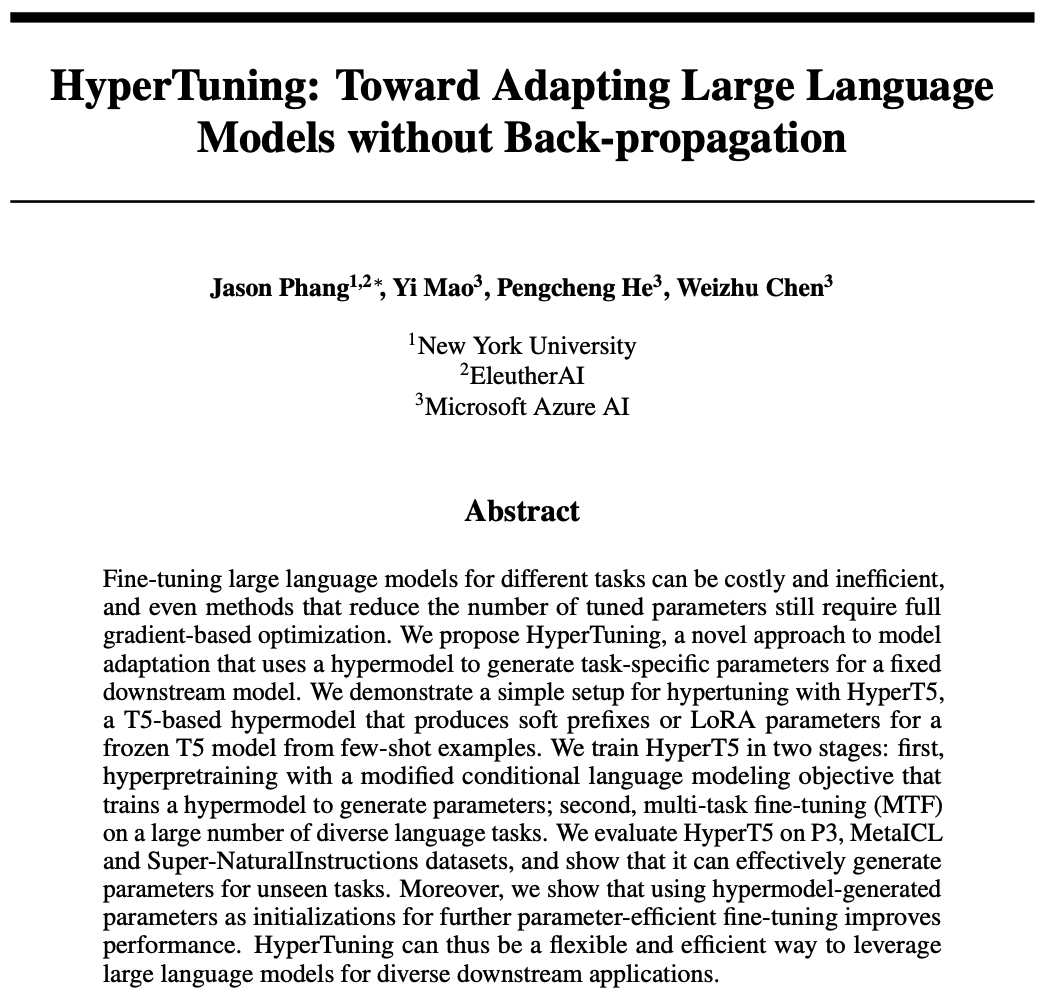
Introducing HyperTuning: Using a hypermodel to generate parameters for frozen downstream models.
This allows us to adapt models to new tasks *without* back-prop!
Paper: https://t.co/TI737SZgn6
1/10
Training deep neural networks on large 3D medical images is difficult.
We developed a deep neural network that focuses computation on suspicious regions, enabling learning from hundreds of millions of pixels.
Github: https://t.co/TUjDbsiOnA
Paper: https://t.co/A7n9rGATdh
1/8
Check out our preprint on arXiv to see the architectural details including how to stabilize weakly-supervised semantic segmentation with pretrained ReLU backbone networks. We utilize a novel constant weight initialization and ReLU(tanh(x)) nonlinearity to address this issue.
7/8
A #DeepLearning algorithm that boosts the accuracy of dynamic contrast-enhanced #MRI for #BreastCancer could reduce false positives and minimize unnecessary biopsies in the clinic, suggests a new study. @JanWitowski@kjgeras@nyugrossman https://t.co/ZMsWz1rdXE