WARSH:
WHILE THIS SUMMER’S PCE AND CPI READINGS WERE BETTER THAN EXPECTED, THEY DO NOT TELL ME THAT UNDERLYING TRENDS HAVE MEANINGFULLY IMPROVED.
man are they really gonna hike…
I wanted exposure to DDR2/DDR3 bottleneck ongoing and found ESMT (3006).
A $2.5B MC fabless company with PSMC wafer allocation (esp. focused on DDR2).
Last month's net income was: $109.5M (July month), which annualized is $1.31B net profit (1.9x runrate P/E).
If we look at net profit throughout the months tracking legacy DRAM price hikes:
Jan 2026: ~$16M (est)
Feb 2026: ~$17M
Mar 2026: ~$31M (est)
April 2026: ~$58M
May 2026: ~$60M (est)
June 2026: ~$67M (est)
Jul 2026: ~$110M
(Estimated months are inferred from reported quarterly totals. July is company reported)
This earnings progression reminds me of $SNDK style price hikes + earnings inflection (esp. the report released this month).
And I do expect DDR2/DDR3 capacity to remain constrained throughout 2027 (with legacy players like Winbond withdrawing from certain lines too like DDR2).
It's not quite all inventory liquidation like the other peers. Sure lower cost inventory helped, but the primary driver seems to be the widening spread between wafer costs/supply and legacy dram ASPs?
Their balance sheet is extremely solid as well:
- Cash on hand: ~$395.9M net cash
- $249.6M inventory, $146.3M receivables
And the net income progression... is before further legacy DRAM hikes expected in Q3.
*disclosure own positions, NFA
It's always a bit daunting being early without much commentary around the idea. Wondering if anyone can stress test this thesis?
Since a company that grew monthly net income from $16M -> $100m this year alone (July Annualized would be 1.9x P/E).
And benefits from another projected wave of DDR2/DDR3 hikes this quarter... maybe like 35-40% for DDR2 lines per Trendforce, and DDR3 likely continuing to rise.
Do markets just not know about this bottleneck/company or am I missing something from my research?
AMD's Chief Technology Officer just sold $13.6 million worth of stock.
The sale came as shares surged 189 percent over the past year.
Here's the trade:
How I Make More Money & Lose Less Trades With IV (Implied Volatility) 💰
Before we start: I recorded a video a few years ago explaining how IV (implied volatility) is the market’s expectation of future movement. If you're new to the concept, watch the video since IV is genuinely hard to feel from text alone. I'll link to it in this thread (its also in my highlights tab) and to my options book as well.
I want to give you the piece that turns IV from a
definition into a decision: how to tell whether IV is actually high or low, and what that should change about the trade you put on. Because here’s what most traders get confused. An IV reading of 40% means nothing on its own. For one stock that’s dead calm; for another it’s a chaos.
IV is only useful in context.
IV Rank vs. IV Percentile
Two readings put IV in context, and they’re not the same thing. I won't get into the formulas here (download by free book if you want to go deeper) but I want to explain.
IV RANK: This tells you where today’s reading sits between its highest and lowest points over the past year. An IV Rank of 80 means current IV is near the top of its yearly range.
IV PERCENTILE: An IV Percentile of 80 means IV was lower than today on 80% of the past year’s days. I lean on percentile, and here’s why: Rank can be distorted by a single volatility spike. One panic event sets a sky-high “1 yr high” and crushes every rank reading for the next twelve months. Percentile reflects how IV actually spent its time.
In short, use both and when they disagree, trust the percentile.
Making More Money:
This is the payoff and its significant. Your directional analysis leads you to choose calls or puts. You're bullish or bearish. The volatility regime tells you whether you should be a buyer or a seller of premium in the first place. In Insider Access (more in the thread) I sometimes call for buying calls or puts as my idea and sometimes the strategy is to sell them or use options strategies. See the first image I have included here.
Low IV (low rank/percentile): premium is cheap. Favor buying it, long calls and puts, debit spreads,
deep-in-the-money calls (see Going Deeper and Playing Safer in my book). You want to own optionality when the market is underpricing movement.
High IV (high rank/percentile): premium is hot. Favor selling credit spreads, iron condors, strangles
(see the spreads chapter). You want to be the one collecting inflated premium when the market is
overpaying for movement.
That's the basics, if you want the deeper breakdown with examples on how to approach your strategy, read the section in my options book that I'll refer you to in thread.
Choosing "Optimal" Options Contracts For Day Trades
Let’s talk strike prices.
Risk Level
For short day trades or scalps, I usually want to be modestly aggressive.
Think 7 out of 10 on the risk/aggression scale.
For that type of trade, I’m usually looking for contracts that are liquid, responsive, and priced in a range where the stop does not become absurdly tight.
Contract Price
In general, I like contracts in the $0.40 to $0.80 range.
That is usually my sweet spot for short-term day trades, assuming there is strong volume and open interest.
This applies most often to 0DTE index options and weekly expirations on individual equities.
The reason is simple:
I want enough premium for the contract to move, but not so little that every penny becomes a massive percentage move against me.
Expiration and Theta
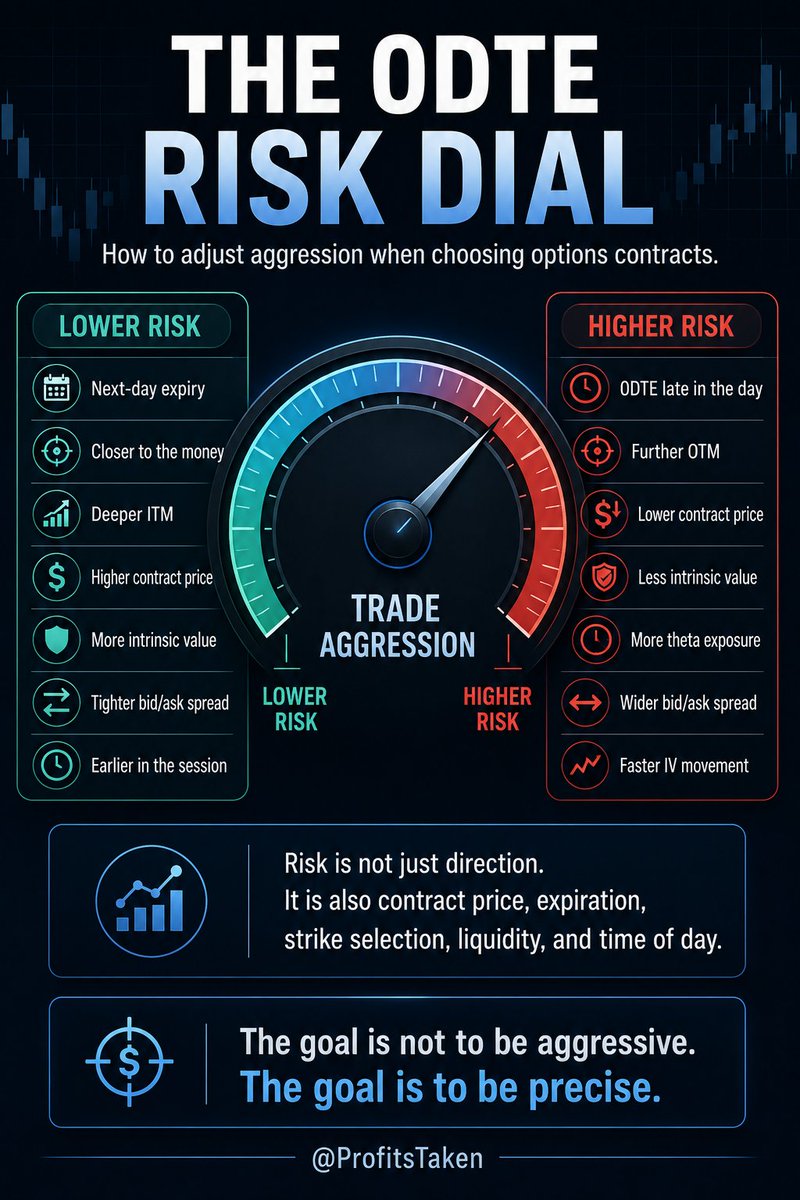
With 0DTE, risk increases as the day goes on.
The later it gets, the more theta starts working against you. Contract value can decay very quickly, even if the underlying move is not dramatic.
If it is late in the day and the pace feels too aggressive, one simple adjustment is to look at the next day’s expiration.
That can help reduce the intensity of the trade.
How To Reduce Aggression
If you want to be less aggressive, you can generally do that by:
- Choosing a later expiration
- Going closer to the money or deeper in the money. - Selecting a higher quality contract with more intrinsic value
- Avoiding extremely cheap, low-probability contracts
- Deeper ITM contracts usually carry more intrinsic value and less pure theta/IV exposure.
-Cheap, far OTM contracts are often more like fliers.
Why I Avoid Very "Cheap" Contracts
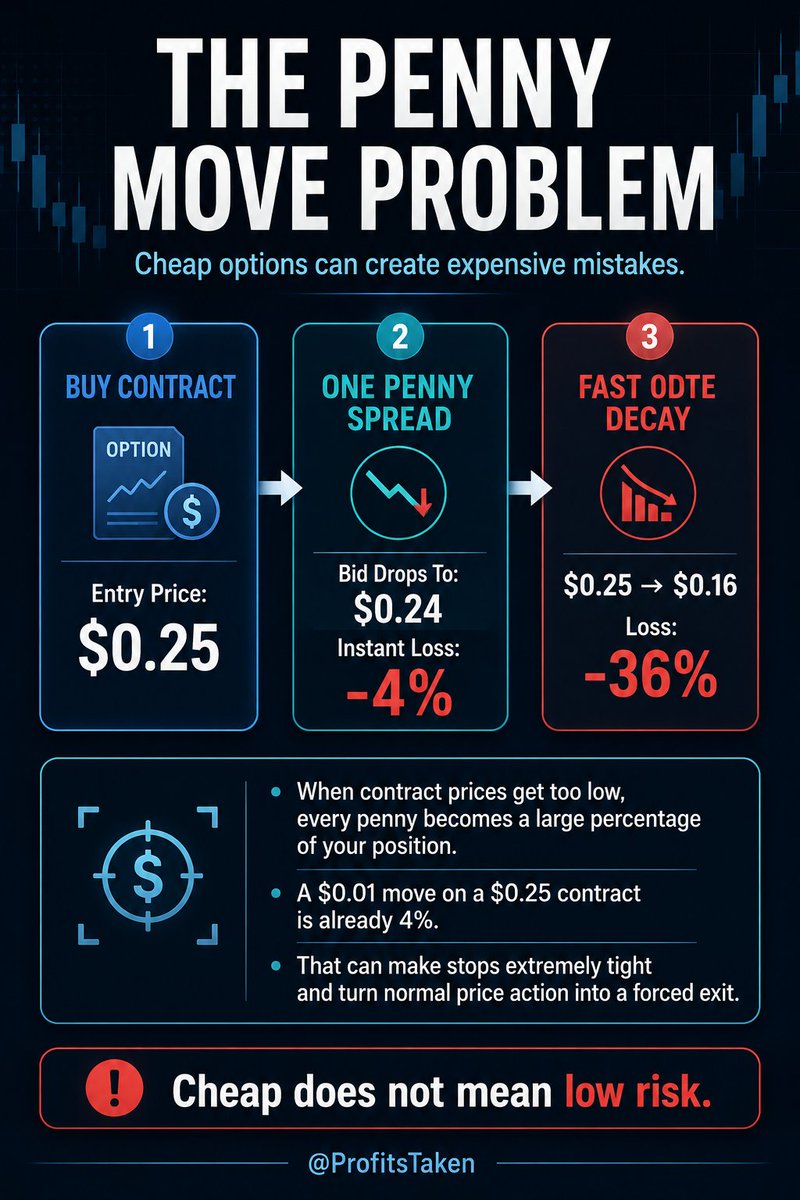
Once you get under $0.30, and especially near $0.25, the trade becomes extremely tight.
Example:
You buy a contract at $0.25.
If the bid is $0.24, you are already down $0.01 on the spread.
That one penny is a 4% move.
If your stop is 10%, you are already almost halfway there the moment you enter.
This is why cheap contracts can be deceptive.
They look inexpensive, but the percentage movement is massive.
A one or two penny move can stop you out quickly.
The Flier Trap
A $0.25 contract can become $0.16 very quickly on a 0DTE move.
That is a 36% loss.
If you entered that trade prepared for it to be a flier, fine. That is a defined strategy 👍
But deciding it is a flier after it moves against you is not strategy 🙅♂️
That is usually just an attempt to justify your bad entry.
Fliers should be rare, calculated, and sized properly.
They are high-risk, low-cost trades where the upside must be clearly asymmetric.
My General Preference
To recap:
I generally prefer the $0.40 to $0.80 contract range for day trades.
Time of day matters heavily with 0DTE.
There comes a point where theta erodes value too quickly and changes the risk calculation.
Risk can be adjusted through:
Contract price
Strike selection
Expiration date
Delta
Liquidity
Time of day
The small details matter.
Tip I Share With Insiders Trading My Live Stream Signals:
Is 0DTE moving too fast for your comfort level?
That's OK - everyone has a different threshold.
If IV moves are shaking you out, or the action feels too volatile, look at next-day options.
There is nothing wrong with reducing the speed of the trade. The goal is not to prove how aggressive you can be. The goal is to execute well.
Final Thought
No FURU nonsense aiming to for unrealistic targets.
No random contract chasing.
No emotional “it’s a flier now” excuses after the trade goes against you.
The goal is to be prepared, professional, and consistent.
Contract selection matters.
Strike selection matters.
Theta matters.
Liquidity matters.
Stops matter.
The small details are often the difference between a controlled trade and a panic trade.
These are the general protocols I use myself and that Insiders are provided as well.
If this was helpful, bookmark it for reference and share with others.