Wally Funk waited 60 years to get to space, and no one ever earned it more. She trained with the Mercury 13 in 1961, out-tested the men, and was told no anyway. She never stopped flying — 19,600 hours, thousands of students, a lifetime of firsts.
Five years ago this month, I had the honor of flying with her on New Shepard's first crewed flight. At 82, she was fearless, joyful, and asking to go again before we’d even landed.
Her dream took six decades, but it came true. Dreams have no expiration date. Godspeed, Wally.
@UltraRunnerPod@DawnsMission They did it even well before COVID. The Japanese are most often doing it because *the wearer* is sick and to protect others, it’s a courtesy.
yea that's no problem. All of those little sandwiches which are available from convenience stores are surprisingly good. You don't need to go with the egg type. And like all things in Japan hey are all meticulously presented. The food scene is so good in Japan - it goes way beyond these sandwiches.
Bill Maher said tonight that Elon Musk has been the smartest on the subject of AI.
"I am very close to the cutting edge in AI and it scares the hell out of me. By the time we are reactive with AI regulation it is too late. AI is a fundamental existential risk for human civilization, and I don't think people fully appreciate that." - Elon Musk in 2017/2018
A major additional factor should be considered.
Satellites with localized AI compute, where just the results are beamed back from low-latency, sun-synchronous orbit, will be the lowest cost way to generate AI bitstreams in <3 years.
And by far the fastest way to scale within 4 years, because easy sources of electrical power are already hard to find on Earth. 1 megaton/year of satellites with 100kW per satellite yields 100GW of AI added per year with no operating or maintenance cost, connecting via high-bandwidth lasers to the Starlink constellation.
The level beyond that is constructing satellite factories on the Moon and using a mass driver (electromagnetic railgun) to accelerate AI satellites to lunar escape velocity without the need for rockets. That scales to >100TW/year of AI and enables non-trivial progress towards becoming a Kardashev II civilization.
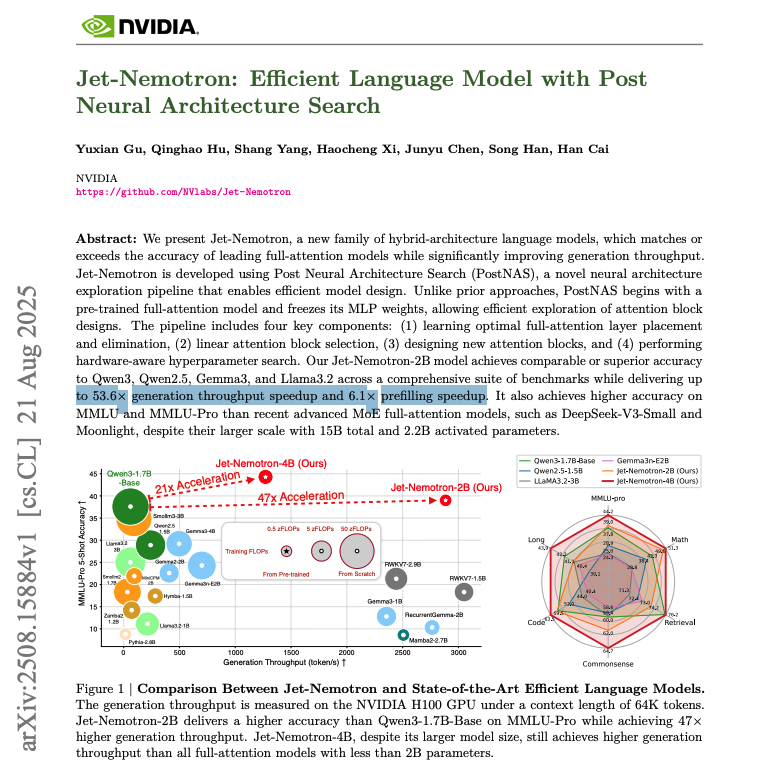
NVIDIA research just made LLMs 53x faster. 🤯
Imagine slashing your AI inference budget by 98%.
This breakthrough doesn't require training a new model from scratch; it upgrades your existing ones for hyper-speed while matching or beating SOTA accuracy.
Here's how it works:
The technique is called Post Neural Architecture Search (PostNAS). It's a revolutionary process for retrofitting pre-trained models.
Freeze the Knowledge: It starts with a powerful model (like Qwen2.5) and locks down its core MLP layers, preserving its intelligence.
Surgical Replacement: It then uses a hardware-aware search to replace most of the slow, O(n²) full-attention layers with a new, hyper-efficient linear attention design called JetBlock.
Optimize for Throughput: The search keeps a few key full-attention layers in the exact positions needed for complex reasoning, creating a hybrid model optimized for speed on H100 GPUs.
The result is Jet-Nemotron: an AI delivering 2,885 tokens per second with top-tier model performance and a 47x smaller KV cache.
Why this matters to your AI strategy:
- Business Leaders: A 53x speedup translates to a ~98% cost reduction for inference at scale. This fundamentally changes the ROI calculation for deploying high-performance AI.
- Practitioners: This isn't just for data centers. The massive efficiency gains and tiny memory footprint (154MB cache) make it possible to deploy SOTA-level models on memory-constrained and edge hardware.
- Researchers: PostNAS offers a new, capital-efficient paradigm. Instead of spending millions on pre-training, you can now innovate on architecture by modifying existing models, dramatically lowering the barrier to entry for creating novel, efficient LMs.