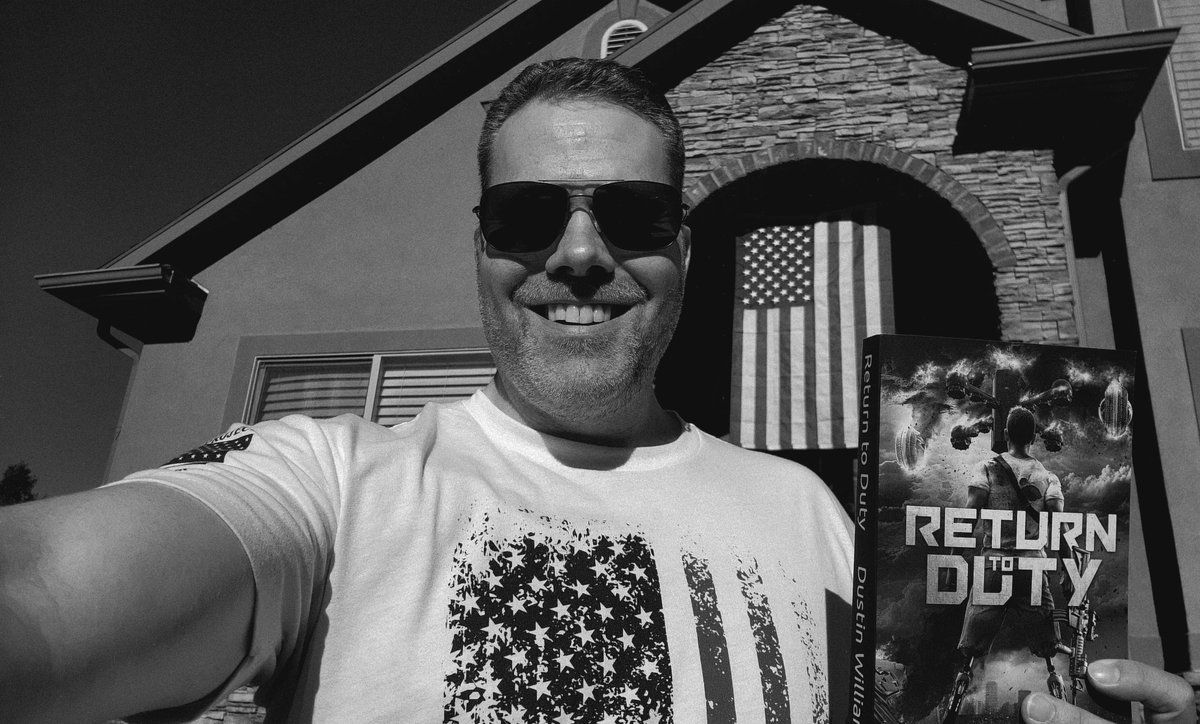
Hello writing community and SciFi readers! Thank you for visiting. I'm a husband and father, professor at the University of Utah, screenwriter, and SciFi author of "Return to Duty". It's a fast-paced adventure about Capt. Ryker Vaughn, a double amputee who receives life-changing bionic legs but vows to never walk again. Yet when an unparalleled force enters Earth’s atmosphere, threatens to extract the planet’s most valuable resource, and abducts his little brother, he must make a decision: stay under the covers, or return to duty.
I came up with my book idea while I was part of a research team that developed real-life prosthetic/bionic leg technology called osseointegrated implants for Wounded Warriors. Some of my grandest author highlights are:
1) Doing book signings at Barnes & Noble and getting "Return to Duty" on B&N bookshelves!
2) Meeting Col. (Retired) Greg Gadson who was an inspiration for my protagonist. Greg served in Iraq, lost both legs, and starred in the movie Battleship! He is a real-life hero and genuine inspiration.
3) Receiving an International Silver Medal 2024 Readers' Favorite award for "Return to Duty".
4) Completing the movie screenplay for "Return to Duty" and being a quarter finalist in the Table Read My Screenplay Hollywood 2024 competition.
Visit my author site:
https://t.co/HQ6o6RCs67
Happy writing and reading!
What a kind and inspiring message. Thank you, @jordanbpeterson. May we who bear this mantel continue such legacy and strive for success. God bless America.
To the Americans:
I've travelled all over the world. I've familiarized myself with many places, and met many people. And I'm a Canadian, although I’m privileged to reside once again in the States.
And here's something I've noticed, and it’s a key element of America's continuing greatness:
You bloody Americans value success, and you believe in its existence.
This is something that doesn't really happen anywhere else in the world. Even in other free democracies—the United Kingdom; Finland, Sweden, and Norway; Australia, New Zealand and Canada; Germany, France, and the Netherlands (great countries all)—a counterproductive cynicism too often reigns.
Success is equated with exploitation.
Ambition is looked upon with contempt.
This happens sometimes in the United States too—particularly among the miserable progressives, who confuse their resentment, ingratitude and unearned skepticism with wisdom.
But in your great country, by and large, striving is admired and success celebrated.
This means that more people strive and succeed in the US than anywhere else. And it's increasingly obvious. You remain stunningly more innovative and productive than any people anywhere else on the planet.
And so I say, as all should who are fortunate enough to live in the western world, let alone America:
Thank God for the United States.
Thank God for the wisdom of its founders.
Thank God for its faith in the free market and in the natural rights of man.
Happy birthday, you damn Yankees and Southerners.
Long may your admirable country dominate the world.
Long may your freedom and hope provide an example to those suffering everywhere at the hands of their malevolent states.
May your two and a half centuries of unparallelled success be just the beginning.
Your country is the light of the world, and the city on the hill.
Thank God for the USA.
Happy 250th.
Dr. Jordan B. Peterson
Feeling grateful and fulfilled today. July 4th was rich, filled with family, friends, patriotism, service, and celebration. I'm particularly grateful to spend my life's experience with my remarkable wife. Here's to a beautiful sabbath, a BBQ, and more celebration! Extraordinary!
Thank you!
Happy 250th 4th of July! I sincerely thank God for all those who have been willing to and who have given their lives and time to building the greatest nation on Earth. My life effort is to try and bless and thank those who have been willing to put their life in front of mine.
Happy 250th 4th of July! I sincerely thank God for all those who have been willing to and who have given their lives and time to building the greatest nation on Earth. My life effort is to try and bless and thank those who have been willing to put their life in front of mine.
The United States of America is a miracle in the history of the world. A little time overseas is all it takes to see what a glorious place we call home.
Proud—and grateful—to be an American.
RESPAWN cover reveal!
One breakthrough. One family. A mother's will to save her children.
Death may not be the end when bioterror begins.
Coming fall 2026!
No doubt, the 1838 Missouri Extermination Order led to persecution, which prompted Illinois to offer refuge to Latter-day Saint refugees. Nauvoo’s city council provided protections against extradition or removal efforts perceived as unjust. They were humane safeguards, while Missouri was out for blood. Definitely a sad mark in our country's history. May such hate and inhumane action never exist again.
Grok teaches us a lot:
The statement mixes some accurate historical elements with significant oversimplifications, missing context, and loaded framing. Joseph Smith faced repeated legal actions amid intense religious and political conflict, but the record does not support a simple narrative of him as a serial criminal "dodging justice" through mere loopholes. Here is a breakdown based on primary documents, court records, and historical analyses (including Joseph Smith Papers project materials, contemporary legal proceedings, and scholarly reviews such as Dallin H. Oaks’ 1965 analysis in the *Utah Law Review*).
### 1. "Years dodging warrants and exploiting legal loopholes to avoid extradition for treason..."
- **Missouri treason and related charges (1838–1843) were real.** After the 1838 Mormon-Missouri War, Missouri grand juries indicted Joseph Smith and others for treason, riot, arson, larceny, and related offenses tied to the conflict. He was held in Liberty Jail after a preliminary hearing found probable cause. He escaped custody in 1839 during a transfer (along with others), citing fears for his life.
- **Context matters enormously.** The preceding events included Missouri’s “extermination order” (Governor Lilburn Boggs), militia actions, and documented violence against Latter-day Saints (e.g., Haun’s Mill massacre). The preliminary hearings were irregular (military-influenced courts, concerns about coerced or weak evidence). Joseph and other leaders viewed Missouri courts as biased and dangerous; they had reason to believe return meant death or sham proceedings rather than fair justice.
- **Extradition attempts (1840–1843) were resisted through legal means, not just “loopholes.”** Illinois courts (and in one key 1843 federal case before Judge Nathaniel Pope) granted writs of habeas corpus and blocked extradition. These were lawful remedies available under the U.S. and Illinois constitutions. The Nauvoo municipal court’s broad habeas powers stemmed from a city charter lawfully granted by the Illinois legislature (though critics rightly called the charter unusually expansive, creating a de facto semi-autonomous enclave). Joseph lived openly in Illinois after 1839; Illinois had initially welcomed Mormon refugees. This was not fugitive evasion in the criminal-underworld sense—it was using available legal forums in a new state after fleeing documented persecution.
- He was never convicted on the Missouri treason charges. The pattern was indictment/extradition attempt → legal challenge → release or dismissal.
### 2. "...for treason, kidnapping, and attempted assassination charges..."
- **Treason:** Accurate as to the Missouri indictments (1838 events). The later 1844 Illinois treason charge is addressed below.
- **Attempted assassination (Boggs shooting, 1842):** Joseph and Porter Rockwell were charged in Illinois as accessories/conspirators in the shooting of former Missouri Governor Lilburn Boggs. Joseph denied involvement, went into brief hiding, then surrendered. A federal court ruled the Missouri extradition requisition insufficient and released him. No conviction resulted. No conclusive evidence directly tied Joseph to ordering or knowing of the specific act in a way that held up in court. Rockwell was also acquitted in related proceedings. This was a serious allegation that followed him, but it did not result in a criminal conviction.
- **Kidnapping:** This does not appear as a prominent or sustained charge in the major historical records of Joseph Smith’s legal cases. The core Missouri indictments centered on treason, riot, arson, and larceny/receiving stolen goods from the 1838 conflict. Mutual accusations of violence, imprisonment of opponents, and property issues existed on both sides during the Missouri War, but “kidnapping” as a distinct headline charge against Joseph personally is not well-supported in the primary legal documents reviewed. It may reflect conflation or rhetorical escalation.
### 3. "Its a bit disingenuous to paint this particular arrest as illegal only."
- **The 1844 arrest sequence had mixed legal grounding.** It began with a riot charge tied to the June 10 destruction of the *Nauvoo Expositor* press (ordered by Joseph as mayor and the city council, who declared it a public nuisance). A Carthage justice issued a warrant. Joseph was briefly arrested in Nauvoo, obtained habeas corpus from the Nauvoo municipal court, and that court dismissed the riot charge, finding the action orderly and authorized.
- **Legality of the Expositor destruction is debatable, not clearly “illegal riot.”** Under 1844 Illinois/common law (pre-14th Amendment incorporation of the First Amendment), local governments could abate public nuisances, including libelous or inflammatory publications likely to incite violence. Scholarly analysis (notably Oaks) concludes the council likely had authority to destroy the *issues* of the paper on nuisance/libel grounds, especially given its attacks on city leaders and exposure of polygamy. However, destroying the *printing press and type* itself exceeded typical nuisance abatement and was probably a civil taking of property (better addressed via lawsuit or criminal libel prosecution rather than summary destruction). It was a major political miscalculation that handed opponents a powerful pretext and inflamed anti-Mormon sentiment. Joseph acted believing (per some contemporary accounts) it would prevent greater bloodshed.
- **Voluntary surrender + added treason charge:** After Governor Thomas Ford’s assurances of protection and a fair trial, Joseph and others went to Carthage on June 24–25. Upon surrender, a new treason charge was added (related to declaring martial law in Nauvoo amid rising mob threats). Treason was non-bailable under Illinois law at the time. Historians widely view this treason charge as weak or pretextual—designed to keep Joseph in custody without bail amid volatile conditions. He was never given a full hearing or trial on it.
- **Bottom line on “illegal only”:** The initial riot warrant had a plausible (if contested) basis. The process as a whole—especially the treason addition and the state’s failure to provide promised protection—was deeply flawed. Calling the entire episode “illegal only” is incomplete; calling it a straightforward, good-faith arrest leading to due process is also incomplete.
### 4. "It's missing the forest for the trees."
- **The forest (broader context) is real and relevant.** Joseph Smith operated in a highly adversarial environment of religious bigotry, political competition (Mormon voting power and bloc voting), personal grievances from dissenters (the *Expositor* publishers were former close associates), and mutual escalation. His leadership included theocratic elements, a large private militia (Nauvoo Legion), secret plural marriage (publicly denied at times, which fueled charges of hypocrisy and immorality), and aggressive use of legal and municipal power. These created powerful enemies who were willing to use both the legal system and extralegal violence. The legal troubles were not purely fabricated persecution; some stemmed from real actions with legal consequences.
- **The trees (specific facts of the 1844 arrest and killing) also matter and cannot be dismissed.** Joseph surrendered expecting due process under Governor Ford’s explicit protection pledge. He was murdered by a mob (including elements of the militia supposedly guarding him) on June 27 while in state custody, before any trial. That was extrajudicial killing—plainly illegal under any standard. Even if every prior warrant and the riot charge were 100% valid, the mob murder while under state protection remains a profound failure of the rule of law. This is the core reason Latter-day Saints view it as martyrdom: he was killed for his religious leadership and testimony without the trial he had submitted to face.
- **He was never convicted of the capital crimes alleged.** Across dozens of arrests over his life, Joseph was repeatedly released, acquitted, or had charges dismissed. The pattern includes both genuine persecution *and* the consequences of controversial decisions.
**Summary assessment:** The claim correctly identifies that Joseph Smith had a long, contentious legal history and used available legal tools (including the expansive Nauvoo charter) to resist extradition to what he and his followers reasonably saw as hostile jurisdictions. It overstates “dodging” and “loopholes” while underplaying documented Missouri persecution and the legal legitimacy of habeas corpus challenges. On the 1844 arrest specifically, the riot charge had debatable but non-frivolous grounding; the treason charge and ultimate mob killing did not. The “forest” of mutual conflict and Joseph’s own provocative actions is essential context—but it does not erase the “trees” of due-process failure and extrajudicial murder. Both sides in this historical tragedy used law and sometimes violence; reducing it to “Joseph was just a criminal evading justice” or “Joseph was a pure innocent persecuted for righteousness’ sake” misses the documented complexity.
Historical sources (Joseph Smith Papers, court records, Oaks’ legal analysis, and major biographies) support this nuanced picture rather than a one-sided exoneration or condemnation.
If you have access to their journals or more personal accounts written by others that lived close to them/their time, let me know and we can assess. The principle of Joseph's words were that he would not fight the arrest and would go to jail. But while Christ certainly went like a lamb to slaughter, even He taught on numerous occasions that the day would come when He treats wickedness with fierceness (see below; if I remember correctly, there's apparently a great war coming, something about Michael and a dragon). I also consider events in historical context. "Gunslinging" was far more common and accepted back then. Even politicians and civilians were still dueling in the mid-1800s. Nothing I promote, but I believe in self defense.
From Revelation 19:
12 His eyes were as a flame of fire, and on his head were many crowns; and he had a name written, that no man knew, but he himself.
13 And he was clothed with a vesture dipped in blood: and his name is called The Word of God.
14 And the armies which were in heaven followed him upon white horses, clothed in fine linen, white and clean.
15 And out of his mouth goeth a sharp sword, that with it he should smite the nations: and he shall rule them with a rod of iron: and he treadeth the winepress of the fierceness and wrath of Almighty God.
16 And he hath on his vesture and on his thigh a name written, King of Kings, and Lord of Lords.
@John_Stone_@ThoughtfulSaint Did other prophets kill in self defense-type situations, or in defense of the Lord and freedoms? I can think of a few: Moses, King David, Elijah.
@latterdaylaura I had a bit of fun tossing some scientific words into my book, Return to Duty. I wrote it for all audiences: military Sci-Fi based on real-life bionic leg tech I helped develop, family focus, with a touch of budding romance. I hope you give it a read!
https://t.co/k0yO3VF23Y
I'd be honored if you listen to my book, Return to Duty! Military Sci-Fi where Captain Ryker Vaughn receives new prosthetic/bionic legs called osseointegrated implants, which I helped develop in real life. After losing his legs, Ryker suffers survivors guilt, vows to never walk again, but when fused organic machines (FORM) threaten to commandeer earth's water, he must decide: find a way to use his new legs, or stay under the covers.
Link below. I'd welcome a review and your feedback!
https://t.co/hSn64nf2Tu