If you’re a young investor trying to make sense of this market, you have to bookmark this and read it line by line. Josh Kushner (whose a legend imo) wrote his first ever formal letter to backers of his $65 billion firm, Thrive Capital. it offers a rare window into where the smartest capital is actually flowing.
Winning isn't about diversification anymore…
Read this slowly.
Before her passing from stomach cancer, the iconic designer Cressida Rodriguez left behind a chilling reminder of what actually matters when the curtain falls:
"I had the most expensive cars parked in my garage, but now I move in a wheelchair."
"My closets were filled with couture and luxury, but my body is now wrapped in a standard hospital gown."
"I had millions in the bank, but not a single dollar could purchase a second of extra time."
"My home was built like a palace, yet I finish my life in a narrow hospital bed."
"I used to sign autographs for crowds, but today I only sign medical consent forms."
"I used seven personal stylists for my hair, and now I have none left to comb."
"I flew across the world on private jets, but now it takes two people just to help me reach the doorway."
"I could feast on anything on earth, yet my dinner has shrunk to two pills and a few drops of saline."
"None of the fame, the money, the cars, or the glory can comfort you in the end. There is nothing more real than life, and nothing more certain than death."
You are richer than you think if you woke up today with breath in your lungs, strength in your legs, and a quiet plate of food in front of you.
Do not wait for a diagnosis to start appreciating the ordinary. Hold your health close, cherish the people around you, and be deeply grateful for the simple gift of today.
Most people cannot read a steak, which is why they keep buying the wrong one.
Read it in three places, and read it in this order.
The cap. That thick band of pale fat curving round the outside edge, running the full length of this one. Buy it for that alone. As it renders it bastes the meat from the outside in, and if the pan is hot enough it crisps into something close to crackling. It is also the first thing a nervous shopper asks the butcher to cut away, which is how a good steak gets ruined before it leaves the counter.
The seams. Those wide white rivers running through the middle, dividing one muscle from the next. That is the spinalis separating from the eye, and the spinalis is the finest piece of beef on the animal. Cut it away, eat it on its own, and you will understand why butchers quietly keep that bit for themselves.
The marbling. The fine web threaded all the way through the red, like frost on a window in January. That fat sits inside the muscle, so it cannot be trimmed off and it cannot leak away. It melts as the steak cooks, from within, and it is the entire reason a ribeye is juicy while a fillet is merely polite.
Flavour lives in the fat. Not in the protein, not in the sear. Almost every aroma compound your nose picks up when beef hits a hot pan comes out of the lipid, which is precisely why a lean cut tastes of very little and needs a sauce sent in to rescue it.
Fat is where the vitamins are. A, D, E and K2 will not dissolve in water and they do not travel in lean muscle. Trim the fat and the delivery system goes in the bin with it.
Fat is where the fullness comes from. It is what shuts appetite down and keeps it down, which is why a lean meal leaves you rummaging two hours later and a fatty one does not.
Fat is what keeps everything moving. It carries the bile, it lines the tract, it is the reason a fatty meal goes through you like it was designed to.
Fat is the energy. Nine calories a gram against four, burning clean, no spike, no crash, no dip at three in the afternoon.
Fat is the fabric. Every cell membrane you own, the sheath on every nerve, sixty per cent of your brain by dry weight.
This one has all three markers. Cap on, seams open, web running edge to edge. Most of what sits in a supermarket chiller has a shaved cap, thin seams and almost nothing running through the middle.
Even a ribeye this good comes in at about 1.2 grams of fat to 1 of protein, which is barely over the line.
So finish it in butter anyway. Fifty grams in the pan at the end, off the heat, spooned over until the whole thing is glossy.
Then eat it slowly, because you will not want anything else for the rest of the day, and that is the point.
Logan Ryan says he made close to $80 million in the NFL and never spent a dollar of his salary.
Not a car. Not a house. Not one paycheck.
He retired at 33 and lives entirely off what his investments pay him.
He posted the whole thing himself this week, and it's the best financial advice any athlete has given in years.
First, who he is.
Logan Ryan was not a superstar. He grew up in Berlin, New Jersey, played at Rutgers, and went in the THIRD round to New England in 2013. Eighty third overall.
He never made a Pro Bowl in eleven seasons.
What he did do was last. Patriots, Titans, Giants, Buccaneers, 49ers. 755 tackles, 19 interceptions, 15 forced fumbles, 13 sacks.
And two Super Bowl rings.
Here's the mindset, in his own words.
He points out that he was the 14th cornerback taken in his draft class, and says that chip never left him.
"It made me suspicious of any dollar that felt too easy to spend. So I never touched the paychecks."
So how does a man live for eleven years without spending his salary?
He built a portfolio and lived off what it produced. Commercial real estate. Private credit. And notably, he got into OpenAI early, while he was still lining up at corner on Sundays.
He also lives beneath his means on purpose. His words: he doesn't fly private, and he still doesn't wear the heavy jewelry.
And he says he asks his financial advisor more questions than any other client on the man's books.
Now the part that matters most, and it's the reason he wrote any of this.
"Most guys who hit that number are broke a few years after their last check. I've watched it happen up close."
That's not a hypothetical for him. He spent eleven years in locker rooms watching teammates get life changing money and lose all of it within a few years of their last game.
His actual thesis is one sentence, and it flips how most people think about a big contract.
"Chasing a big number was never the point. What actually bought my freedom was saving relentlessly, year after year, while everyone around me spent."
The number was never the win. The saving was.
And here's what freedom actually meant to him: "I retired at 33 and answered to no schedule but my kids'."
One more thing worth knowing, because this isn't a story about hoarding money.
In 2017, right after signing a three year, $30 million deal with Tennessee, Logan Ryan surprised his older brother.
His brother had gotten into Drexel, graduated with honors, and was working as an engineer, and was still buried in student loan debt.
Logan handed him a check for $82,000 and wiped it out.
His comment at the time was that the system is broken and makes no sense, and that he was fortunate enough to be able to take care of it.
He didn't spend his money on himself.
He spent it on being done working at 33 with his kids and his brother taken care of.
For more stories like this, follow us on any platform @thesportsontap
HSA is like a Roth IRA on steroids:
- money you put in get an income tax deduction
- earnings grow tax free
- withdrawals are tax free for medical expenses
- after 65, it can be treated as an IRA
- no payroll taxes if contributed via payroll
Invest your HSA and let it grow!
My friend's iPhone was stolen outside a bar in Brooklyn.
9 minutes later, the thieves wiped his entire Apple ID right from his lock screen.
A detective showed us the exact 9-step playbook thieves use to hijack locked iPhones.
Change these settings TODAY before it's too late: 👇
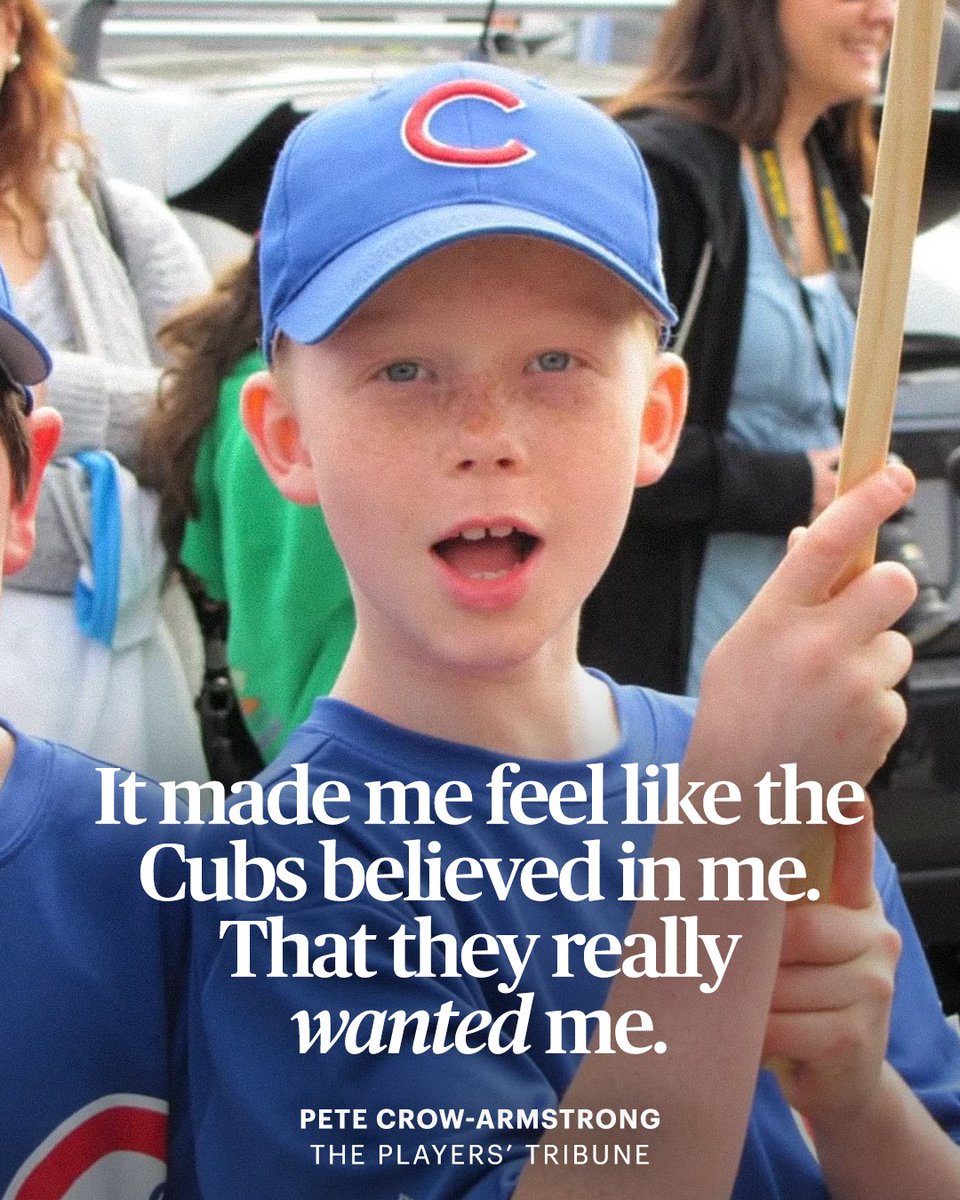
Pete Crow-Armstrong loves playing for the @Cubs. His dad loves it, too: “Growing up in L.A., my dad gave me a couple of rules.
1) I couldn’t root for the Dodgers.
2) I couldn’t root for the Cardinals.
He’s from Naperville, just outside Chicago. He didn’t force me to be a Cubs fan, but let’s just say it was heavily encouraged. When I was a kid, maybe seven or eight, I’d bust open my parents’ door first thing in the morning and start jumping on the bed, Let’s go throw the ball!! Dad!!! Get UP!! Let’s go!!! They’d stick me in front of the TV while they got their day started. And I’d watch the same thing almost every morning: Kerry Wood’s 20-strikeout game. Dad must have recorded a re-run of it or something, I don’t know. But it was always on the TV, ready to be replayed whenever I wanted.
I’ve got something to admit though, I was a bit of a s*** growing up. Dad is a big Bears guy, and like I said, I was just this little rascal. So my guys were Aaron Rodgers and Clay Matthews. I’m sorry about that. I am. It’s not that I didn’t love Matt Forte or Brian Urlacher or Peanut Tillman — I just loved giving my dad a hard time. So I’d run around the house laughing every time Rodgers dropped a dime at Soldier Field. But baseball was different for me. I didn’t really have a team. I had my dudes. Soriano, Jeter, Damon, Derek Lee, Matt Kemp, Jim Edmonds. Cutch a bit later. My guys. And you remember that board game, All Star Baseball? I loved that s***. That was my jam....
My dad came to me with an ultimatum. He’s an absolute baseball nerd. Big analytics and prospects guy. I was only 11 or 12 and he sat me down and was like, Look, if you’re going to pick a team, now is your last chance to pick the Cubs. We’ve got a bunch of kids coming up soon. Báez, Contreras, Bryant, Russell, Almora. We’re going to be good. Now is your chance.
I was like, Alright, alright. Fine. Go, Cubs, go....
My dad and I watched Game 7 together, just the two of us. Felt like it went on for three days. I remember him jumping up and down and crying. I don’t think I fully got it in the moment, you know? I was like, Dad, don’t be weird … stop crying. But I’m sure almost every Cub fan of a certain age had tears in their eyes that night. And now, a bit older, I get it.
Five years later, I got traded for Javy.
I can’t lie, when I first got the news, my heart was racing. I was injured, and I felt like I was a long way from making it to the show. When I heard I was being moved, I thought maybe I was being given up on. But then I saw it was for Javy and it calmed me down, in a way. It made me feel like the Cubs believed in me. That they really wanted me. It’s funny, man. I was on my way to lunch that day with my parents and my agent. And my dad played it cool. He was just talking about the opportunity and all that. That’s my mom rubbing off on him. She’s cool like that. But she talks about that day now and she’s like, When your dad found out … he had a MOMENT.
His son was a Cub. Pretty cool.” https://t.co/a22ZCXkLSy
I cleaned YEARS of microplastics, PFAS,and other toxins from my blood…
According to a study published today (10.61373/bh026a.0024), Double Filtration Plasmapheresis, also known as Inuspheresis, can remove a substantial amount of microplastics (+ nanoplastics) and PFAS (forever chemicals) from the blood.
These are both notoriously difficult to remove from the body. Few other therapies have been shown to be this effective.
Here’s how it works: Inuspheresis separates your blood into plasma and RBC fractions and then filters the plasma through a very fine filter before returning it to your body with your RBCs. This filter is then washed and the toxins collected in an eluate (pictured here) which can be analyzed for toxins.
This is different from TPE (therapeutic plasma exchange) which removes 70% of your plasma and replaces it with purified albumin only. This removes everything from your plasma, both good and bad. This puts significant stress on your body to replenish the good things it lost (immunoglobulins, clotting factors, SHBG, hormones, etc.).
Both are intriguing therapies and Insuspheresis is particularly interesting because it saves more of the good stuff from your plasma that are lost with TPE but gets rid of the bad stuff.
What bad stuff?
What I found in my eluate blew my mind:
>p,p DDE (breakdown product of DDT) 1220 ng/L (very high). A pesticide linked to hormone disruption, sperm damage, and cancer risk. Found in insecticides and food sprayed with them.
>gamma hexachlorocyclohexane (lindane) 202 ng/L. Another pesticide linked to hormone disruption, sperm damage, immunotoxicity. From pesticide residues in food or drinking water.
>Dichloromethane 9417 ng/L. Linked to liver toxicity, headaches, and cancer. From adhesives, paints, varnishes, and plastic industry.
>Trimethylbenzene 2960 ng/L. Linked to liver, kidney, thyroid, and immune damage.
>Benzene 446 ng/L. From fuels, exhaust, solvents. Linked to blood cancers (AML), immune suppression, and fatigue.
>Xylene 163 ng/L. From fuels and exhaust gases. Linked to headaches, fatigue, liver/kidney damage, and reproductive harm.
>Polychlorinated Biphenyls (PCBs 138, 153, 180) PCB 180 57 ng/L. From plastics, electrical appliances, farm-raised fish. Linked to lower testosterone, thyroid disruption, immune suppression, and lymphoma.
And now this new study suggests I also removed a large amount of microplastics and PFAS from my blood, as well.
The study was small, but showed up to 75% reduction in PFAS and 70% in microplastics in the cohort along with reductions in inflammatory markers like CRP and fibrinogen (18 patients for PFAS, 6 for microplastics, 34 for inflammatory markers). These toxins piggyback on lipoproteins, which are removed as part of the apheresis protocol.
When I posted about this procedure last year many people commented that these claims were bogus, and that the kidneys do the work of filtering your plasma many times over on a daily basis.
While the kidneys do filter the plasma throughout the day, they are not adept at removing the lipid soluble toxins that adhere to lipoproteins in the same way that Inuspheresis (or TPE) can. There's a big difference in filtering power here.
Inuspheresis is not cheap (around $7000 for two sessions, price will decline with more availability in the future) but it appears to be very effective for removing toxins in a unique way from the human body.
After I had the procedure (I did two sessions last summer in Spain) I was tired for a few days but overall felt great and have felt good since. I will post my most recent set of labs separately in the future, but all biomarkers look very good without any hormone replacement (T is 775ng/dl, fasting insulin 2.5, thyroid labs pristine, ferritin 100ng/ml etc.) I am planning to repeat the procedure this summer and will share updated results.
Inuspheresis is not available in the US currently, but has been used in Europe since 2008 and over 70,000 treatments have been done. Props to the folks at https://t.co/bO5AJINIkV who are working on bringing this to the US in the very near future.
We live in a toxic world. I try my best to avoid forever chemicals, microplastics, and pesticides but it's impossible to be perfect.
I'm super excited about procedures like this which may help change the trajectory of human health in our increasingly polluted world.
(h/t to @mikeroplastics for background info this is and previous posts on Inuspheresis)
MDMA plus high-dose psilocybin was the hardest psychological work Andrew Huberman has ever done.
He is explicit: no one should try this without clinical support, and many people should not take these compounds at all. He has only done the combination twice.
MDMA first created the empathogen effect that made difficult material approachable. Psilocybin alone at four to five grams of dried mushrooms had been terrifying and physically harsh.
Together, the MDMA allowed him to stay with the hardest childhood material instead of pushing it away. He also reported no typical post-MDMA drop.
Both compounds increase neuroplasticity in different ways, MDMA primarily through elevated serotonin and oxytocin systems, psilocybin through 5-HT2A receptor activation, which may explain why the sequence felt uniquely intense and why the usual comedown was absent.
Huberman has a rare ability to describe extreme personal experiences with precision, honesty, and strong caveats. That combination is what makes his accounts trustworthy.
Terence Tao, UCLA professor and the most decorated mathematician alive:
"Hedge funds hand you $750K a year for a single skill: telling a real pattern from noise. I've spent a lifetime on it, and almost everyone has it flipped."
this free lecture is the entire "find the signal" problem those firms are paying for, delivered at UCLA by the most awarded mathematician alive and put online for nothing.
at the chalkboard it's plain. Tao's lifelong idea is that almost nothing is purely one thing. there's flawless structure, like a clock, and flawless randomness, like a coin toss, and nearly everything real sits somewhere between the two. the work is pulling them apart.
the primes are the cleanest test. they look scattered and lawless, yet Tao and Ben Green proved they hold evenly spaced runs of any length you ask for. order was buried inside the apparent chaos the whole time. that's "signal detection" with the marketing stripped off.
he gave this at UCLA and it has stayed free ever since. exactly the point of the article above: the mathematics those firms pay half a million for is public, written down and free to anyone tonight.
the lecture costs nothing and anyone can press play. what no one can sell you is the judgment to tell when a pattern is real and when your own eyes invented it. that judgment is the entire job, and it takes years to earn.
Elon Musk's security team once described what happens when he visits the Gigafactory in Texas unannounced.
He doesn't schedule the visit. He lands, drives to the factory, and walks onto the production floor without telling anyone he's coming. His security team calls it a "flash audit." The managers call it something less polite.
He walks the line. Slowly. Stopping at stations. Watching individual workers perform tasks. Timing processes with his phone. Writing notes. Not speaking to anyone for the first thirty minutes. Just observing.
Then the questions start. And the questions are specific. Not "how's production going." Questions like "why does this weld take 11 seconds when the robot is rated for 7" and "why is there a three-second gap between this station and the next one." Questions that require you to know your process at a level most managers don't because they stopped watching the details months ago.
A former production manager said the unannounced visits are the single biggest driver of excellence at Tesla. Not because of fear. Because everyone knows that at any moment the CEO might appear and ask a question that only the people actually paying attention can answer.
He said Elon doesn't punish people who don't know the answer. He replaces them with people who do. And the speed of that replacement is what keeps everyone paying attention.
Most companies have a CEO who visits the factory once a quarter for a photo. Tesla has a CEO who appears like a ghost on the production floor and knows more about the process than the people running it. That's not management. That's obsession. And the production numbers reflect the difference.