Today’s Western Mail column ⬇️
“there is an opportunity to build a new Wales that is driven by home-grown, innovative and entrepreneurial businesses that have social and environmental ideals at the heart of everything they do”
That should be the future of the Welsh economy 🏴
WRU has to publish the evidence that underpinned its decision to cut a region and just redact where needed says @dylanjonesevans https://t.co/G6uj9yKhCC
It's over 13 years since Peter Thomas characterised the WRU's attitude to the pro clubs as "power, control, divide, conquer, wipeout".
The faces may have changed, but it sometimes seems that little else has.
As more and more students begin using A.I. to complete assignments, professors across the country are changing their approach—and losing their hope. “My emotional response to all this is hard to describe, something between disgust and despair,” a history professor writes. “Was it always the case that half of our students would cheat if it were easy enough?” Jay Caspian Kang collects testimonials from 12 faculty members from across the country on how A.I. usage in the classroom has changed their work. Read them here: https://t.co/v4ZvuuBzv1
There are only five levels of income:
Level 1 - you work
Level 2 - your team works
Level 3 - your systems work
Level 4 - your product works
Level 5 - your money works
Fascinating post and reflects what we found in the UK StartUp Reports over the last five years.
Traditional measures still focus on company registrations, VAT, employees, premises and external investment, but we found that many new founders now begin from home, self-finance, use freelancers and digital platforms, and generate meaningful revenues before appearing in those statistics.
The result is that entrepreneurship may be changing faster than our measurement systems and we are still counting firms as they used to be built, rather than founders as they now actually start and grow businesses.
High streets are bound up with people’s sense of place and local identity.
In Wales, that identity is layered in a way it is not everywhere, namely, rooted in market towns and former industrial communities, fiercely local and often carried through the Welsh language itself.
A high street is where a community sees and recognises itself, and when it empties, the loss is not only economic, it is a loss of confidence, of meeting places and of the small daily encounters that help hold a town together. The boarding-up of a landmark shop sends a signal about the health of a place that no economic strategy, however ambitious, can easily offset.
The latest edition of my Substack newsletter "What Wales Could Do Next" examines the future of the high street and examines how a new Welsh Government seeking to demonstrate that devolution can still deliver tangible and widely felt change, could do far worse than begin here, on the streets where people in Wales actually experience the economy.
The intellectual work has already been done by a range of organisations, including through Wales’s own Town Centre First framework, which remains one of the better examples of place-based policy anywhere in the UK. What has been missing is not ideas, but the political will to make the high street a genuine priority and then to follow through with the patience, focus and discipline that effective delivery requires.
None of what follows requires new powers from Westminster, only sequencing, focus and the will to spend the first hundred days well. If I were advising the incoming administration, I would press for five things:
Suggestions for change include:
✅ A founder-facing “meanwhile” scheme that turns vacant town-centre units into short, low-friction trading opportunities for new businesses, delivered through Transforming Towns but designed around the entrepreneur rather than the council bidding cycle.
✅ A business-rates regime that rewards occupation, using Wales’s devolved control of non-domestic rates to make taking on an empty high-street unit demonstrably cheaper than leaving it dark, and to favour first-time and independent traders.
✅ One accountable town-centre lead per priority town, with a published vacancy and footfall target, replacing diffuse partnership responsibility with a single named person.
✅ National high-street data platform, built on the CDRC model, so that funding follows evidence and outcomes are measured rather than assumed.
✅ A decisive shift from capital to occupier, rebalancing the programme so that as much energy goes into who trades and survives, and into bringing anchor services and residents back into the centre, as goes into bricks, public realm, and ribbon-cuttings.
That choice is now available, and the question for the new Wales is whether it will be.
Full article here ⬇️
https://t.co/KVKIyxF7Qy
The older I get, the more I realize...
- being disliked by idiots is just proof you’re not one of them
- you rarely win big without pissing someone off
- anger is useful in physical fights, but a killer of logic
- strong beliefs paired with little knowledge is a dangerous place to operate from
Seriously - the only attraction for me to do this, is the ability for me to be able to say it in my words, when I want, and how I want. Yes, I will make sure to the best of my ability to follow rules re: public company fiduciaries and dissemination of information. But the idea that someone else crafts your communication and tweets for you - is not better than giving an interview to a publication and worry that the journalist will cherry pick to validate their narrative. Control the narrative and the consequences by doing it yourself.
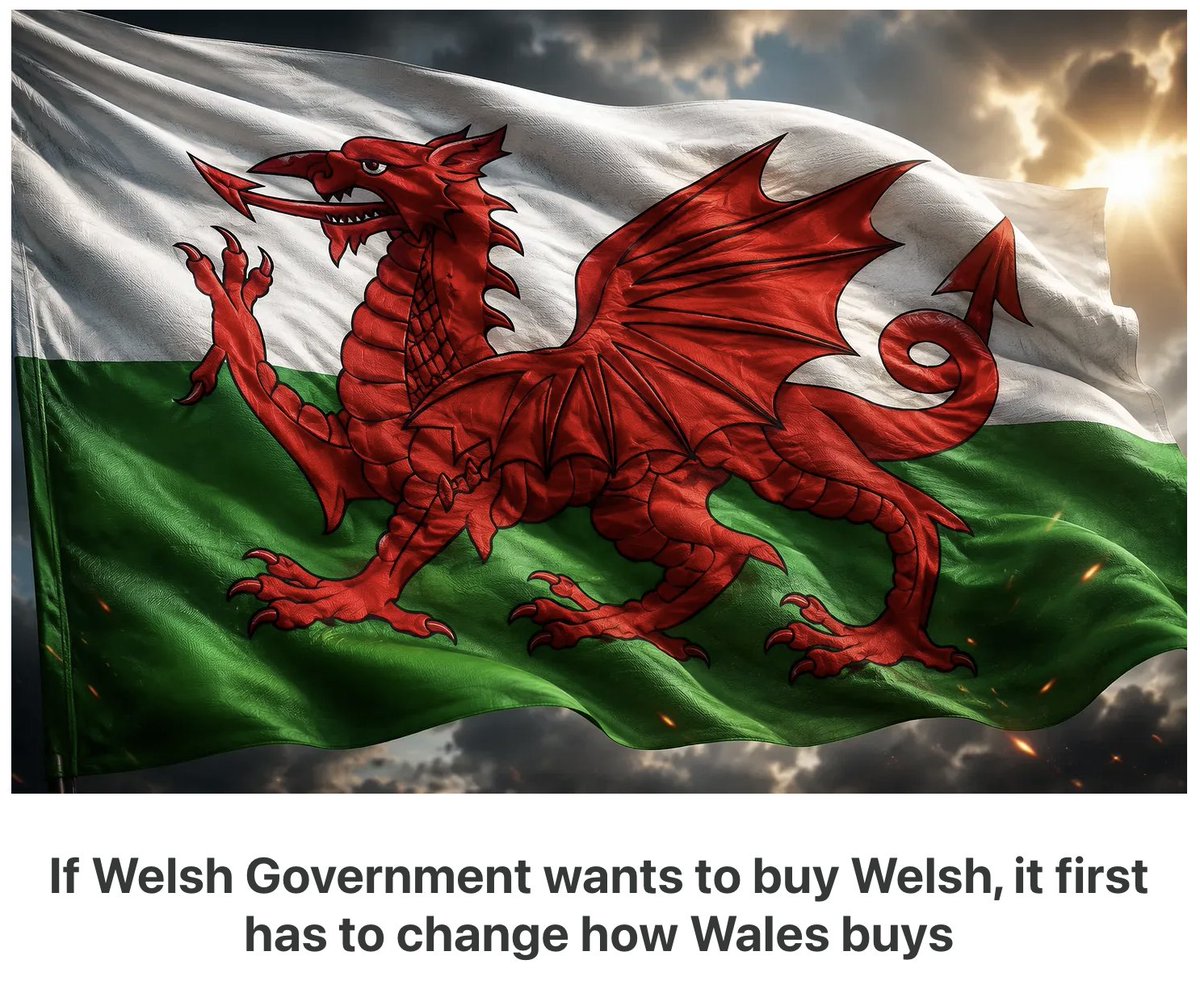
How do we ensure more local firms get access to @WelshGovernment contracts?
For more than twenty years, I have argued that one of the most underused economic levers available to Welsh Government is not another grant scheme, another strategy, or another publicly funded initiative, but the way in which Wales buys goods and services.
Every year, Welsh public bodies spend more than £8 billion through procurement and yet, for all the talk over the years about supporting local businesses, too much of that spending still fails to build the Welsh firms, supply chains and jobs that we need.
That is why I was particularly interested in @Plaid_Cymru's manifesto commitment to increase the share of Welsh public procurement going to Wales-based suppliers from 55% to at least 70%. If delivered properly, this could be one of the most significant economic interventions of the next Welsh Government, but as I argue in my latest Substack newsletter "What Wales Could Do Next", the real issue is delivery.
If Wales is serious about using procurement as an economic development tool, then we need to know where public money is currently going, which firms are winning contracts, where Welsh SMEs are being excluded, and whether large frameworks are helping efficiency at the expense of local economic impact.
We also need to simplify tendering, improve prompt payment, make social value measurable, use data and AI to identify gaps in Welsh supply chains, and consider whether Wales needs its own public interest procurement marketplace to make it easier for public bodies to find Welsh suppliers.
I also look at the claim that this policy could create upwards of 35,000 jobs, and whilst the ambition is welcome, the figure needs to be tested. A more cautious estimate may be closer to 15,000 to 20,000 jobs, which would still be a major achievement if the policy is implemented properly.
The broader point is that Wales does not lack ambition but discipline in execution, and if the new Welsh Government wants to be judged differently, then procurement should be one of its first major delivery tests.
Public procurement should not be about paying a little more to be local or protecting firms from competition. It should be about using the state's purchasing power intelligently to build more competitive Welsh businesses, stronger local supply chains, and better jobs across Wales.
https://t.co/XMaMqyaFGa
Richard Branson on why you should never be afraid to fire your bank:
"There is a very very thin dividing line between success and failure."
Branson's most harrowing brush with that line didn't come from a bad product or a market collapse.
It came from his bank on a Friday afternoon.
After launching Virgin Atlantic's inaugural flight from London to New York, Branson returned home to find his bank manager sitting on his doorstep. The verdict: the bank was closing Virgin down on Monday. He had two days to repay the loans.
His response?
"I remember pushing the bank manager out of my house, telling him he wasn't welcome."
Then he got to work.
Branson spent the entire weekend calling music distributors around the world asking each one for a temporary loan to get Virgin through the week. They came through.
By the end of that same week, he hadn't just survived. He'd found a new bank willing to lend him 30 times the overdraft facility his old bank had offered.
The lesson he took from it:
"Don't think of your bank as somebody that you're beholden to."
Most people never switch banks. They treat it like a lifelong relationship. One they're too intimidated or too loyal to exit. Branson's argument is that this deference is a trap.
Move your bank when it stops serving you. Move your doctor too. The willingness to step up and make uncomfortable changes when the relationship no longer works. That's not recklessness. That's how you survive.
Most people who start businesses without financial backing will fail at some point. Branson admits he has only just stayed on the right side of that dividing line. But staying on the right side often comes down to one thing: being willing to act when others freeze.
Media: Big Think