@realOkayTeacher@MartinCothran@DanWillingham Interestingly, around the same time that Gardner proposed multiple intelligences, in a report for the ILEA David Hargreaves emphasized the importance of multiple aspects of achievement (academic skills, practical application, personal and social skills, motivation and commitment)
@Coach_Milly_@MartinCothran Not sure about that. There are savants (Stephen Wiltshire for art, Derek Paravicini for music) that would probably score very low on traditional measures of intelligence...
@realOkayTeacher@MartinCothran Not sure. Most measures of cognitive function correlate a bit (the so called positive manifold) but I think Gardner's position was that the correlations of some of these measures was much lower that amongst the ones we emphasize in schools.
@MrZachG No argument here. It'll be harder. But I think people are less likely to say "It won't work here" when it's working in the room nextdoor. As Chip and Dan Heath write in "Switch" it's often a good idea to start with the bright spots rather than imposing solutions from outside...
@helenrey@SoLInTheWild Another example is that the normal reaction for a car at its highest going round a loop in a track is zero. One way I speeded up the process was to make students rest their hands on the track at the top, so they could feel the car pushing up as it went past...
@ShakinthatChalk@Ailsa50410891 One of the most valuable experiences I had in my secondary school was being part of a debating club where sometimes we didn't know which side of the debate we would be advancing until the debate started.
@helenrey@SoLInTheWild Problem was, three weeks later, they were back to adding tops and bottoms. What I think we can do is install a "critic" that tells them that their naive way of thinking is not correct.
@helenrey@SoLInTheWild And in maths. I used to try "torpedoing" students' incorrect strategies by showing students that they didn't work, for example by showing that 1/2 and 1/2 would be 2/4 using their naive "add the tops and add the bottoms" strategy, which they could see was incorrect.
@AltB56073878@tombennett71@rpondiscio I'm with you in spirit, but the prospect of imagining _all_ the ways that our statements may be misunderstood makes me feel very tired...
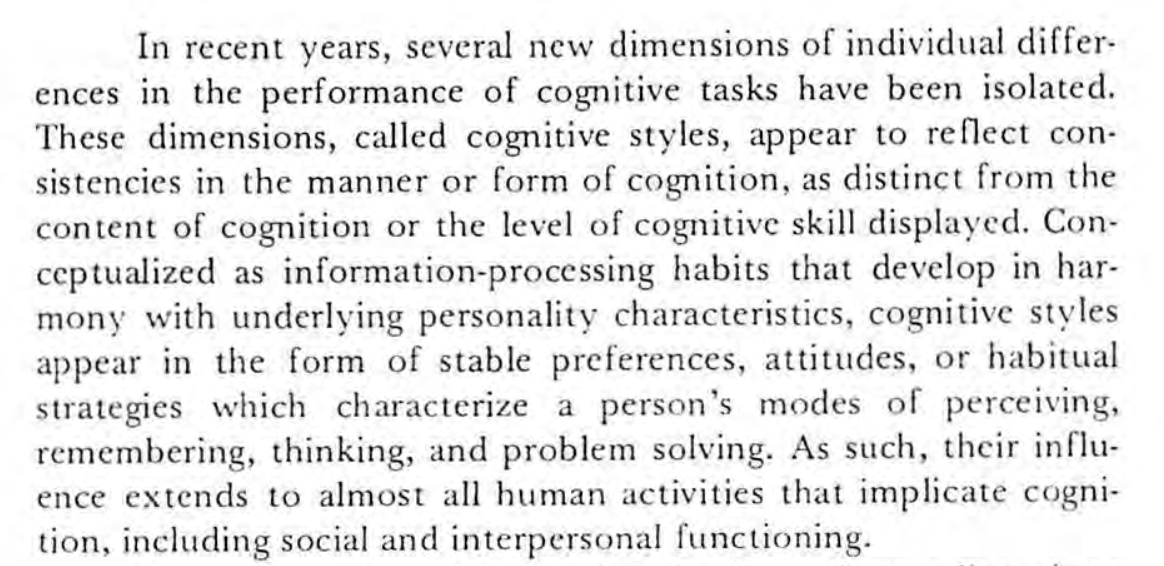
@rpondiscio Also important to note that learning styles are not the same as cognitive styles. Here's some useful thoughts on the latter from Samuel Messick's chapter in the Encyclopedia of educational evaluation (Jossey-Bass, 1976 p. 60)
@rpondiscio I think we need to be careful when we say that learning styles do not exist because (a) they may exist but we haven't found them yet and (b) it depends what you mean by learning styles: